 | How to measure the Shore A hardness of a rollerRubber & polyurethane COMMENT MESURER LA DURETÉ SHORE A — ROULEAUX EN CAOUTCHOUC ET POLYURÉTHANE |
A roller’s hardness reflects how well its covering resists indentation — a key performance parameter. At Soremag, it is measured on the Shore A scale — the reference for rubber and polyurethane — using a Rex Type A durometer. The higher the Shore A value, the harder the covering.
⬇ Download PDF- Consistent production: controlled hardness ensures uniformity from one roller to the next.
- Longer roller life: hardness matched to the application limits covering wear.
- Reliable operation: an accurate reading prevents vibration, marking and deformation.
The durometer reads hardness from 0 to 100: low values = soft rubber or PU, high values = hard material. The Shore A scale covers the vast majority of rollers; for very hard materials (such as ebonite), the Shore D scale is used.
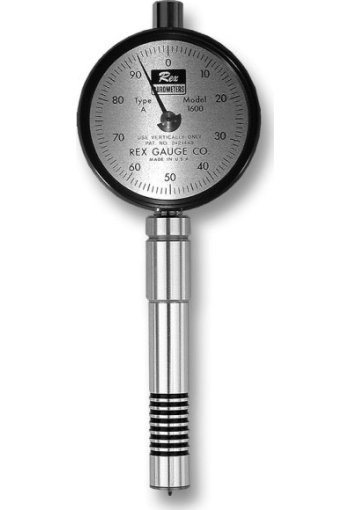
Rex® Type A durometer (Shore A)


Soremag — official Rex® distributor
- Regular calibration: check the Rex durometer against a reference block to keep it accurate.
- Variation between instruments: readings can differ by 4 points or more from one durometer to another.
- Technique matters: how you apply the gauge changes the result — follow the method below.
1
Prepare the surface
The roller must be clean, smooth and dry. Any contamination or mark can distort the reading.
2
Position the durometer
Apply it perpendicular to the surface, without tilt, 25 mm from each end of the roller.
3
Apply pressure
Press smoothly, without jolts, at ≈ 1 kg, and read the value as soon as full contact is made (within 2 s).
4
Check the temperature
Measure at room temperature (≈ 23 °C): heat or cold change the apparent hardness.
In short — Rex Type A durometer, perpendicular, 25 mm from the ends, at ≈ 1 kg, read within 2 s, at ≈ 23 °C. A rigorous measurement ensures consistent, high-performing rollers.
Which scale for a rubber roller?
The Shore A scale in the vast majority of cases; the Shore D scale is reserved for very hard materials (such as ebonite).
Where to measure on the roller?
25 mm from each end, applying the durometer perpendicular to the surface.
Why do two durometers give different readings?
A difference of 4 points or more between instruments is normal: hence the importance of regular calibration and a consistent method.
| 🌐 soremag.com · ✉ info@soremag.com · 📞 450-664-4000 | Shore A hardness measurement — Official Rex® distributor REV. 2025-01 · © 2025 Soremag Inc. |