Covering & manufacturing · rubber and polyurethane · Quebec450 664-4000·1 800 361-5588·EN|FR
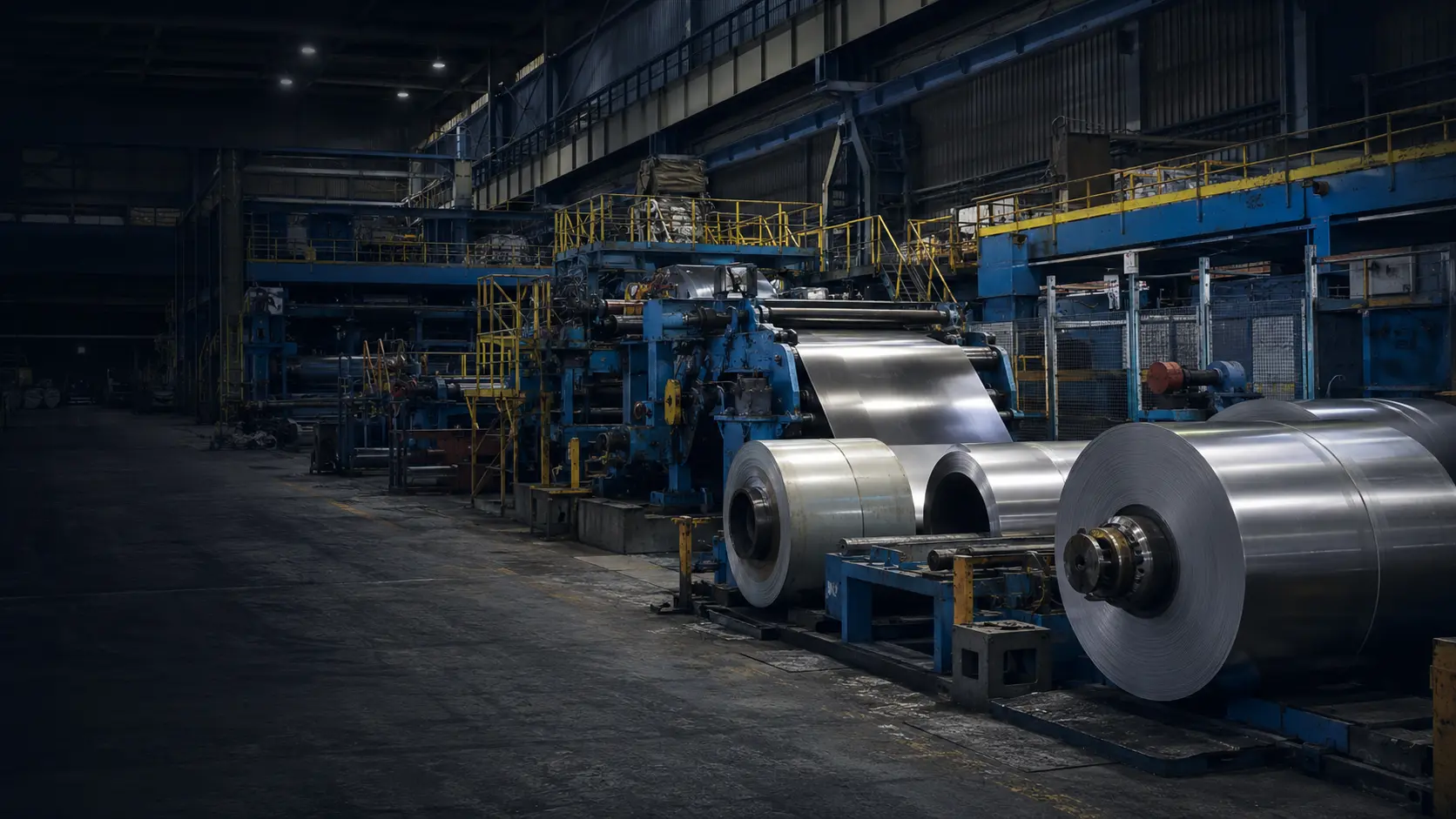
Ligne de traitement de bobines : bobines d'acier et d'aluminium et rouleaux de procédé sur une ligne de refendage
Industries · Acier, aluminium & métaux en feuilles

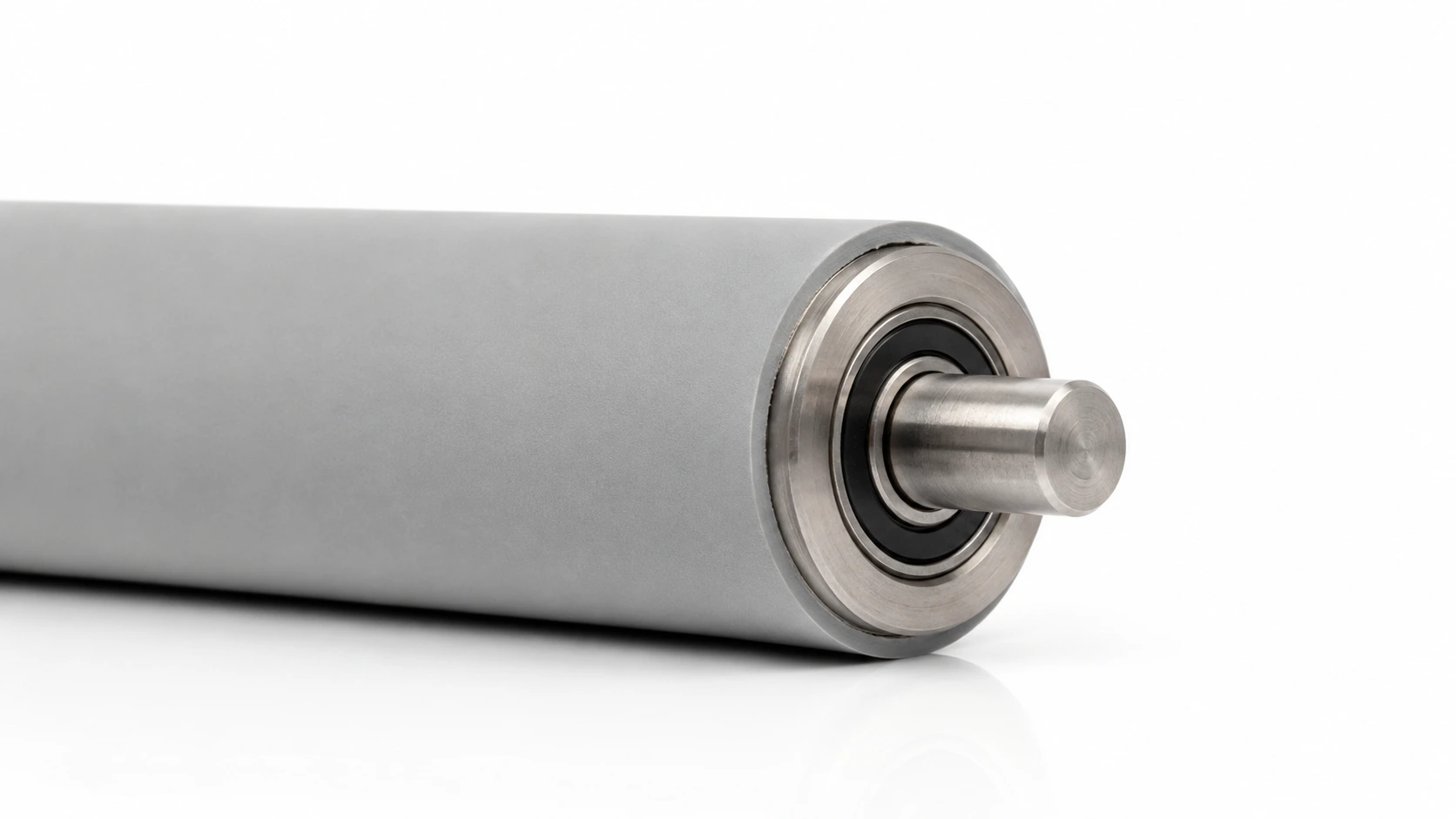
Covered rollers for steel, aluminum and sheet metal lines

Pickling, cleaning, galvanizing, coil coating, slitting, cut-to-length, temper rolling: a roller that marks the sheet, slips under tension, wears at the strip edges or stands up poorly to acid costs you in scrap and in downtime. We refurbish your rollers to tight tolerances to keep your lines running steady.

On coil lines, nothing is forgiving

The rollers work under tension, in contact with strip edges, rolling oils, rinse water, acid or caustic solutions and sometimes high temperatures (out of the bath). The slightest surface defect shows — especially on aluminum and on finish-grade steels.

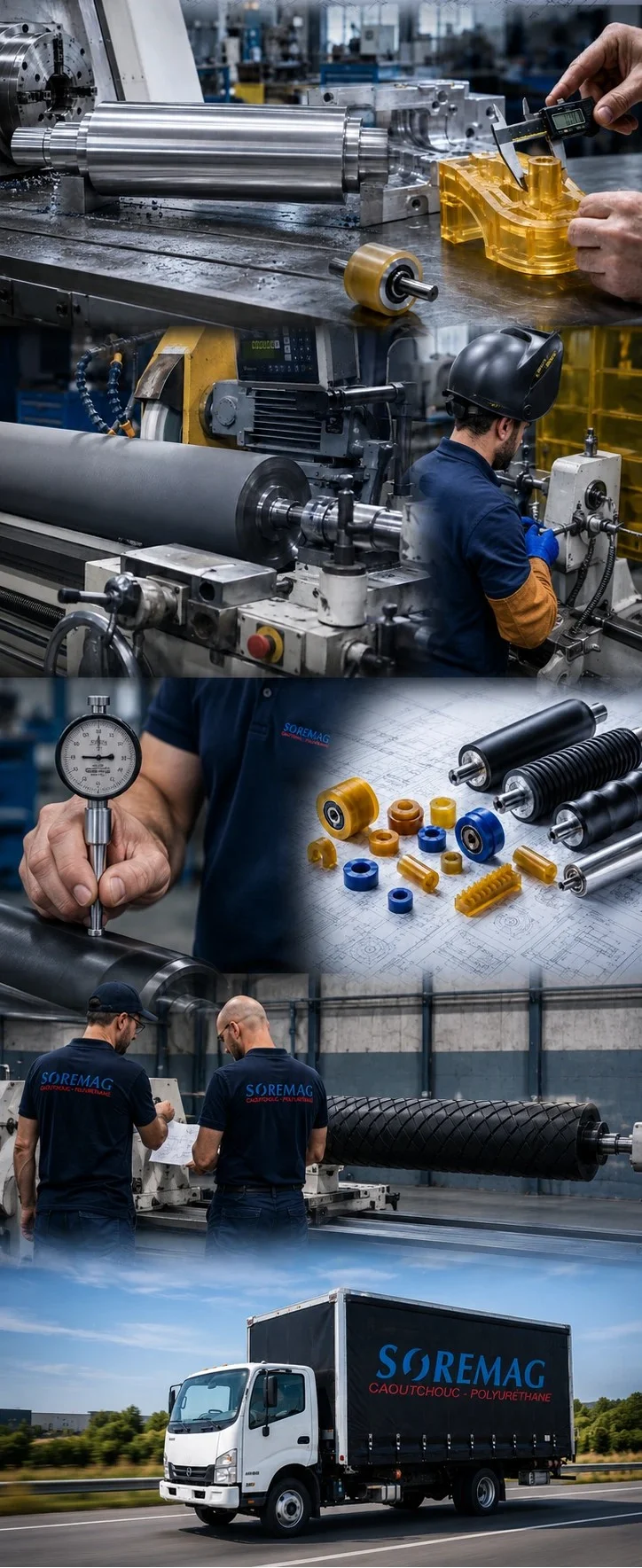
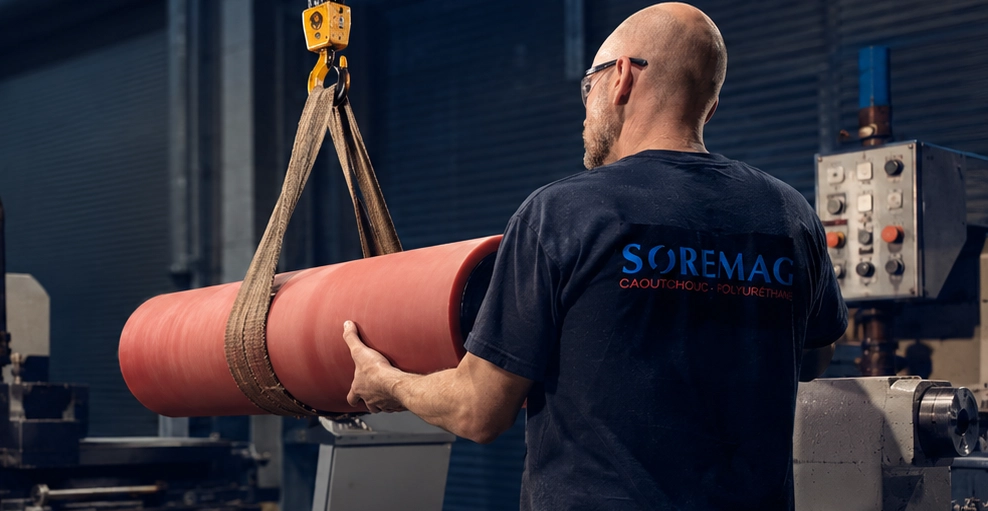
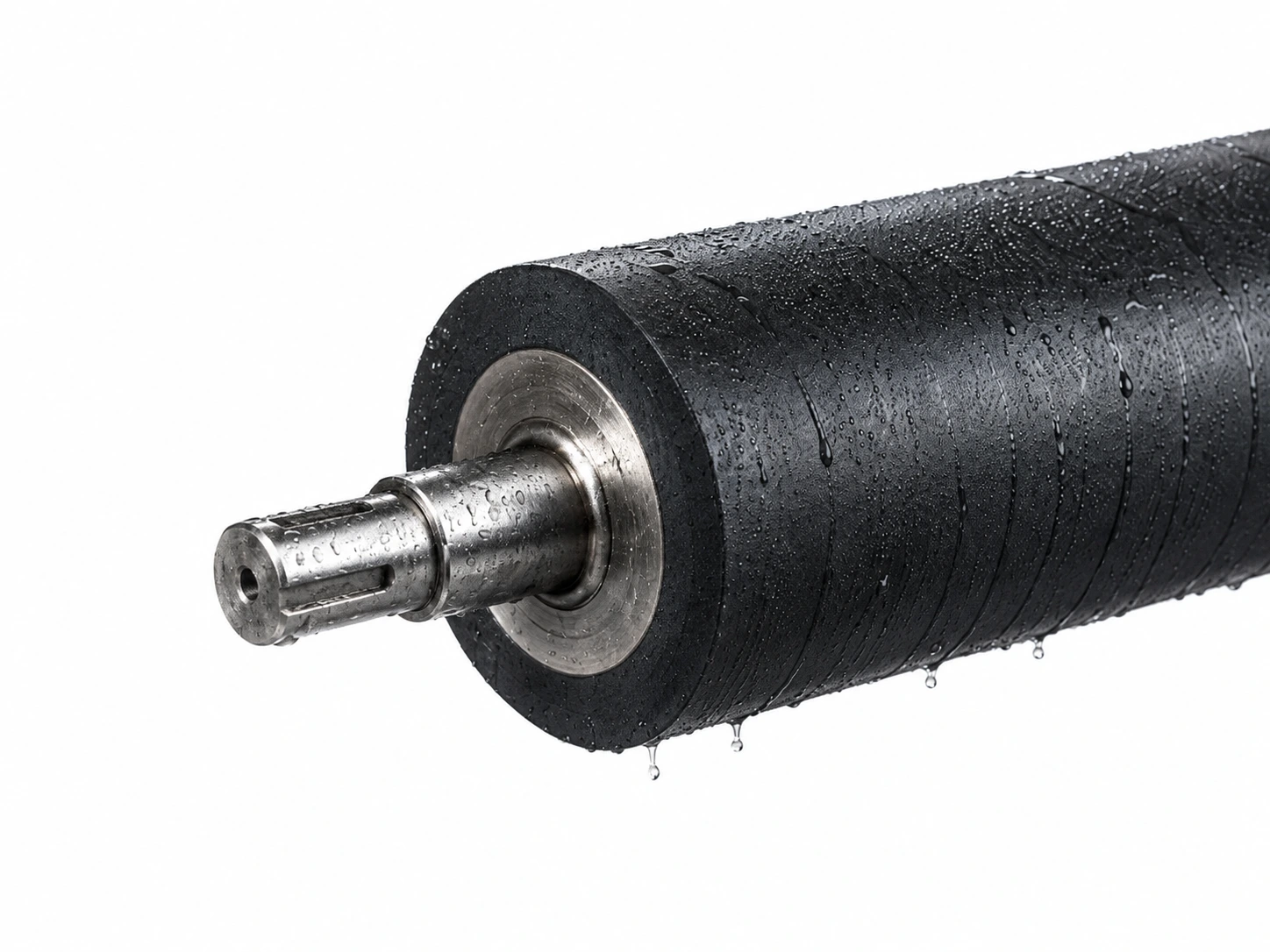
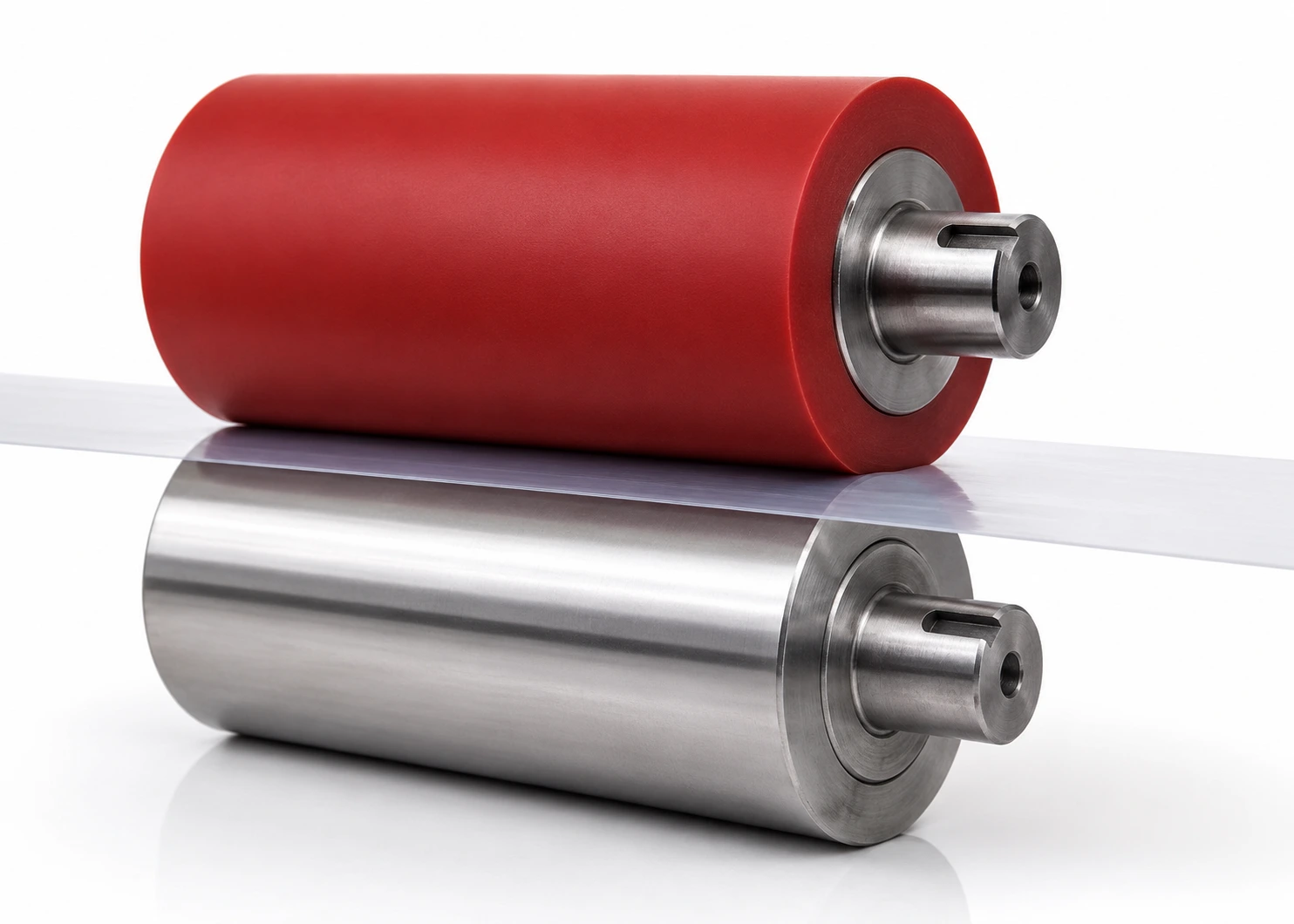
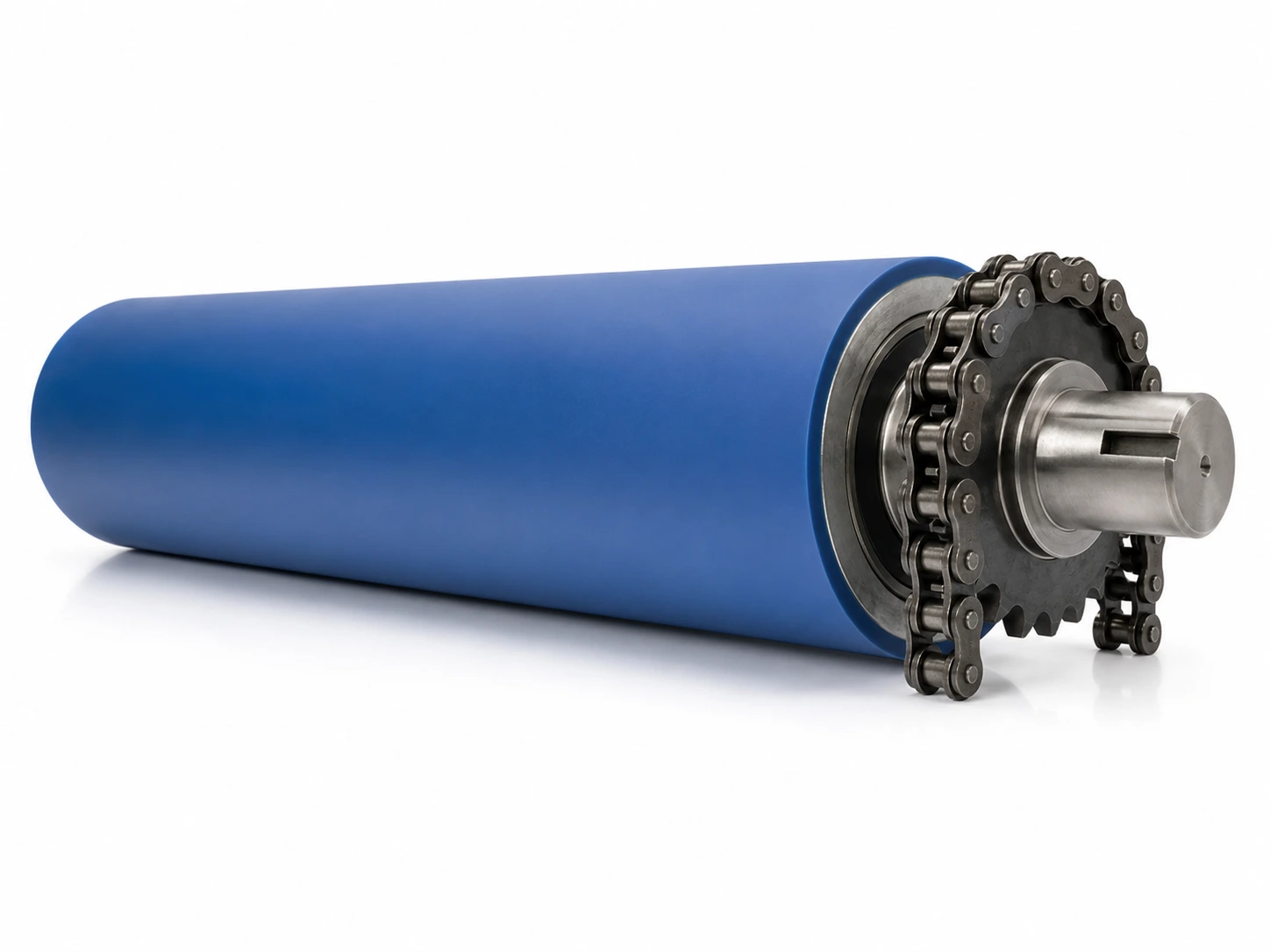
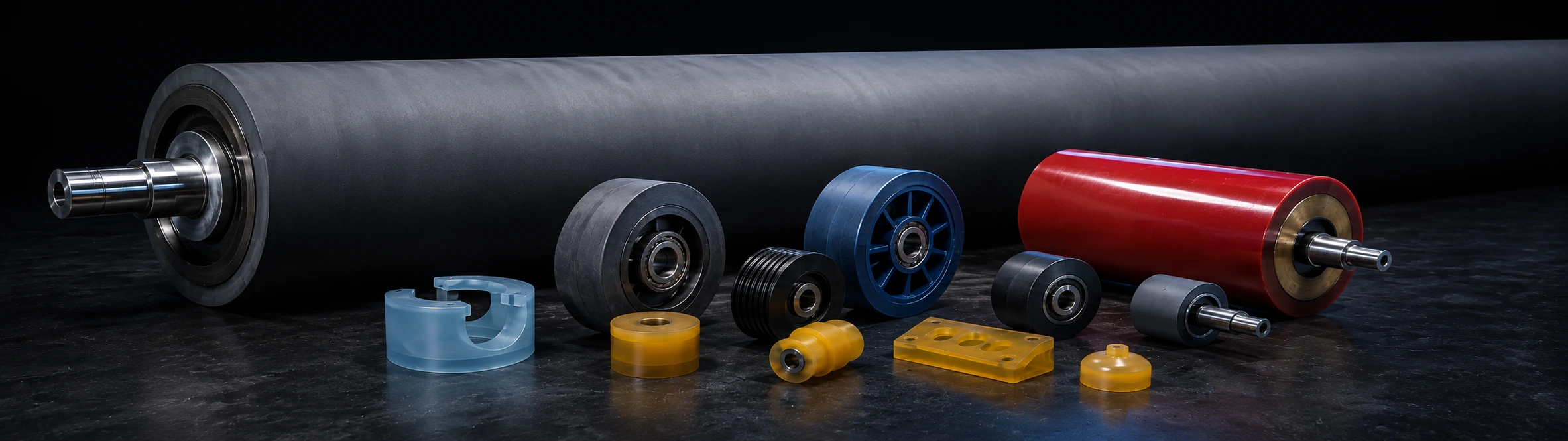
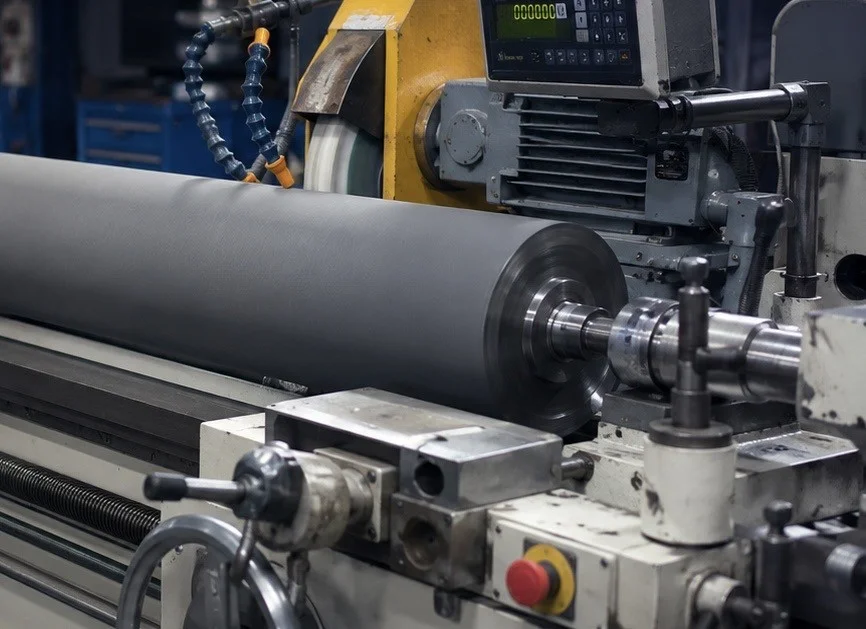
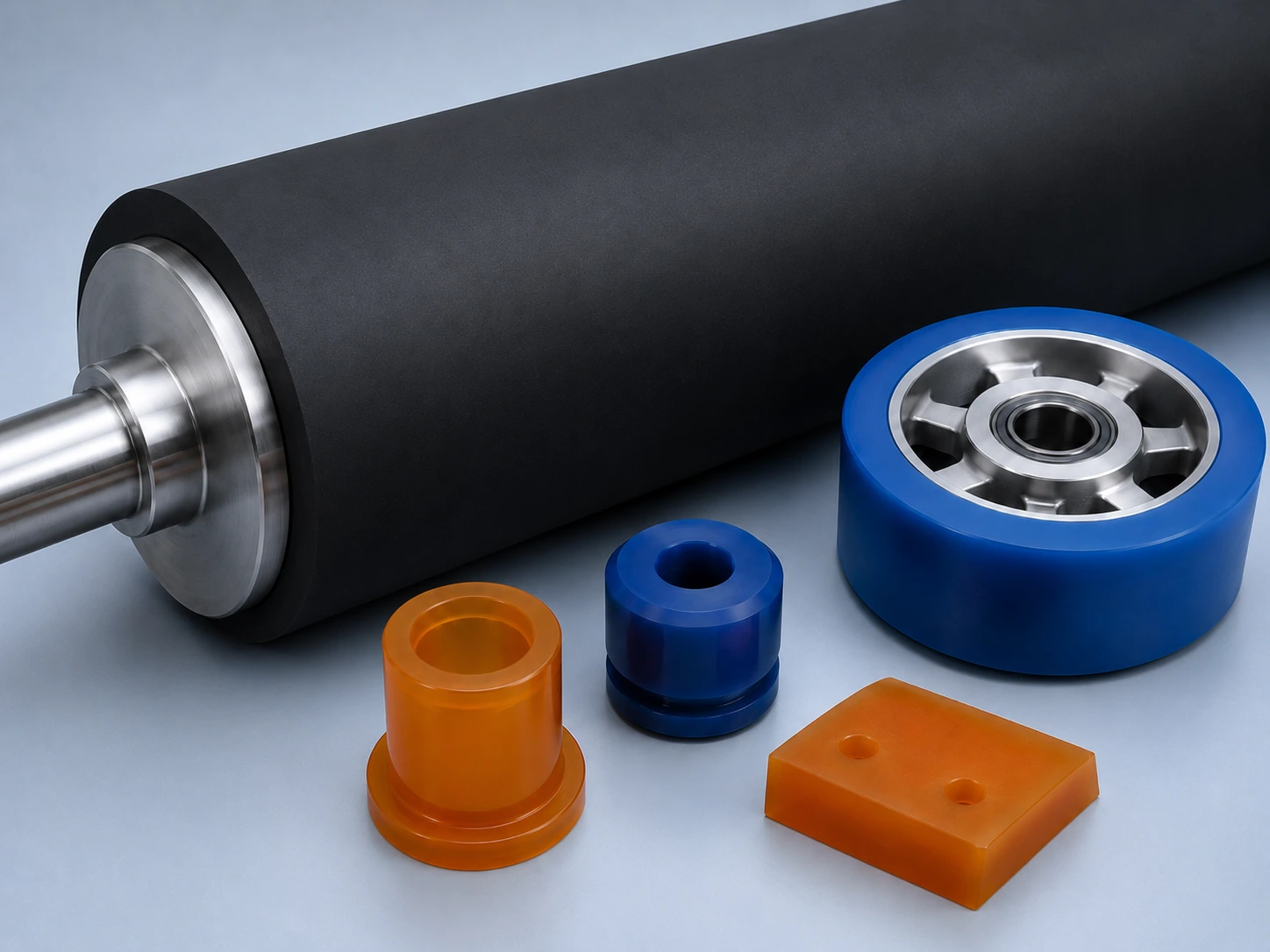
At Soremag, we cover, grind, groove and refurbish rollers in rubber or polyurethane. We can also build and repair cores, rework journals, do reverse engineering and produce wheels and cast polyurethane parts. The right cover is not chosen on hardness alone: surface finish (Ra), geometry, runout, crown, nip pressure, chemistry, temperature, abrasion and the risk of marking.

The processes we serve

Décapage & nettoyage

Pickling, degreasing, rinsing

Wringing (wringer/squeegee), wash/rinse, de-oiling and deflection — resistance to acids and to caustic solutions.

Galvanisation

Galvanizing & coating

Process rollers

outside the molten zinc bath
: pretreatment, rinse, quench, oiler, deflector, bridle, pinch.

Coil coating

Continuous painting

Applicator and metering rollers (to drawing and tolerances), plus process rollers.

Refendage

Slitting & cut-to-length

Pinch, braking, tension, guiding and hold-down — with no marking and no slipping.

Laminage

Rolling & finishing

Bridle rolls / S-rolls, deflectors, pass-line: stable tension and a steady surface.

Manutention

Coil handling

Wheels, cam followers, guides, bumpers and polyurethane wear parts to eliminate metal-to-metal contact.

Typical uses where our solutions make a difference

The rollers, wheels and parts you find on metal lines

Bridle rolls / S-rolls (traction, tension)

Stabilized friction and creep resistance to hold tension without marking.

Wringer rollers (wringer / squeegee)

Uniform wringing; grooving (spiral / herringbone / diamond) against hydroplaning.

Pinch / feed rolls

Strip drive and guiding, surface protection.

Deflector / steering / guide rolls

Deflection and alignment; concentricity (TIR) under control.

Wash / rinse, de-oiler & oiler rolls

Washing, rinsing, oil removal and oil application — materials compatible with the chemistry.

Hold-down / snubber & brake / tension rolls

Strip hold-down, braking and tension control in slitting and recoiling.

Applicator / metering rollers (coil coating)

Built and covered to drawing, hardness, Ra and TIR for a steady paint film.

Sleeves (sleeves)

Fast replacement on the existing shaft, when the assembly allows it.

Polyurethane wheels & molded parts

Cam followers, guides, bushings, bumpers, impact pads for coil cradles — often overmolded on metal; reverse engineering when the OEM part is not available.

Sélection des matériaux

The right material for the chemistry on the line

Acids, caustics, oils, temperature, speed, abrasion, sharp edges and the finish you need.

On metal lines,

chemistry drives the choice
. The position sets the family: pickling bath, oily zone, sharp edges at the slitter. Each zone is specified for what it actually contains, not for what the machine is called.

EPDM

Pickling, rinsing, alkaline degreasing

Handles acids (HCl, H₂SO₄), bases, hot caustics and steam.

Definitely not rolling oils or hydrocarbons.

NitrileNBR

Oily zones

Holds up to rolling oils, greases and cutting fluids — at the nip, at the mill exit.

Less comfortable with ozone, UV and concentrated strong acids.

Polyester urethane

Sharp edges and severe wear

Very high abrasion, cut and load resistance: dry slitting and cut-to-length.

Rule it out in wet service or hot acid — hydrolysis.

Nitrile PVCNBR/PVC

Oil mist

The oil resistance of nitrile, plus better abrasion and ozone resistance.

Suits semi-exposed positions and press rollers.

HNBR

Hot oils and hot rolling

The nitrile for the hot position, around 150 °C.

Our

HeatTuff
compound holds
160 °C (320 °F)
— the hottest of our rubbers outside silicone.

CSMHypalon®

Oxidizing acids

Stands up to the HNO₃ of stainless pickling, to oxidizing agents, to ozone and UV.

Also chemical baths and rollers exposed outdoors.

Polyether urethane

Wet squeeze and soluble fluids

The abrasion resistance of urethane, plus resistance to hydrolysis.

Takes over from the ester as soon as water is involved.

FKM / Viton®

Extreme chemistry and heat

Stainless pickling at high concentrations of hot mixed acids.

Studied on request, after validation — it is not compatible with every chemistry.

FKM is not a universal answer

FKM resists chemistries and temperatures nothing else will take, but it

does not suit every chemistry
— certain caustic solutions in particular. Each case is validated before we quote it.

Other families remain available depending on the position:

neoprene (CR)
,
SBR
,
natural rubber (NR)
, and
silicone
for hot exits outside the bath.

Problem observed → possible fix

Symptôme en usineCe qu'on ajuste le plus souvent
Marques / empreintes sur la tôle (surtout aluminium)Composé non-marquant + dureté et pression au nip + fini de surface (Ra) + contrôle du pickup.
Coupure du revêtement par les arêtes de bandeComposé anti-coupure (PU ester à sec, ou caoutchouc/polyuréthane haute densité si fluides) + gestion des rives + alignement.
Attaque chimique / gonflement du revêtementSélection EPDM / CSM / NBR / HNBR / PU éther selon chimie réelle + test de gonflement sur échantillon.
Essorage incomplet / traces de liquide (hydroplanage)Dureté + pression + parallélisme + rainurage (hélice/chevron) + crown + état de surface.
Patinage sous tension (bridle)Formulation à friction stabilisée + Ra (fini mat/texturé) + pression au nip + nettoyage + alignement.
Usure rapide (calamine / abrasion)Polyuréthane ou caoutchouc haute résistance selon milieu; validation chimie et température.
Vibration / faux-rond / marques cycliquesRectification, concentricité (TIR), équilibrage dynamique, réparation des portées.
Enduction irrégulière (coil coating)Ra + TIR de l'applicateur/doseur + dureté + parallélisme + crown.
Exemple terrain — essorage après décapage

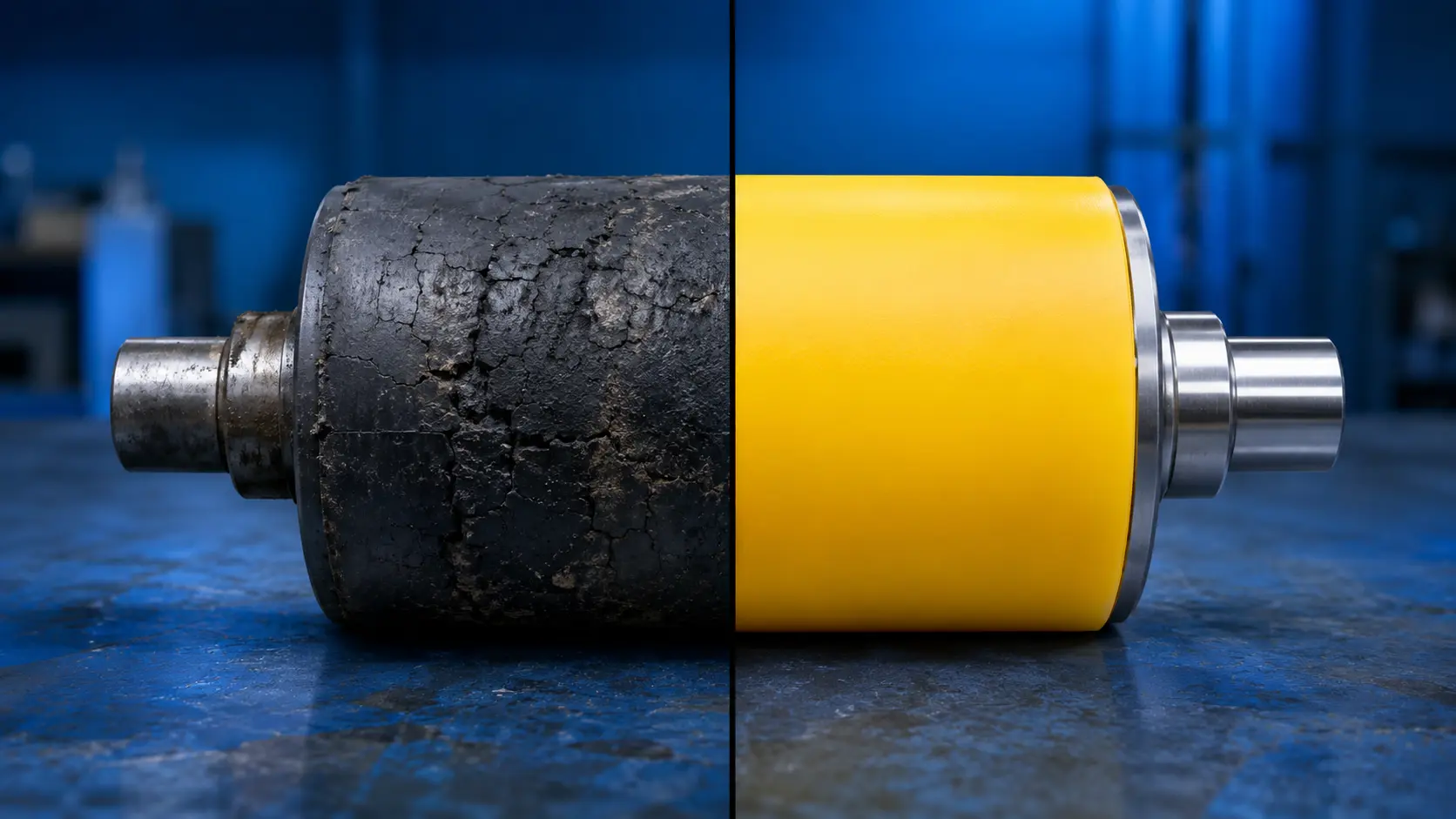
A film of acid stays in the center or at the edges coming out of the rinse, which gets in the way of drying and of the coating downstream. Often it is a loss of parallelism or a

deformation of the roller under load
(barrelling). We combine two corrections: a compensating
crown profile
machined in on the grinder, and a compatible compound (often
EPDM or CSM
depending on the chemistry)
grooved in herringbone
to push the liquid out toward the ends continuously.

What we measure and validate:
hardness (Shore A / D), surface finish (Ra), runout (TIR), cylindricity, profile / crown, grooving, dynamic balancing, condition and weld build-up of the journals, adhesion of the cover to the metal core, chemical compatibility (swelling/hardness/surface test), and defect inspection (glazing, swelling, crazing, delamination, pickup).

What we like to know to recommend the right cover (without guessing)

  • Process: pickling, rinsing, galvanizing, coil coating, slitting, cut-to-length…
  • Roller type: bridle, wringer, pinch, deflector, applicator, metering, oiler…
  • Strip material: carbon steel, stainless, aluminum, other.
  • Width, thickness and line speed.
  • Strip tension and nip pressure.
  • Chemistry: acid, caustic, oil, solvent — concentration, pH, temperature.
  • Current hardness and required surface finish.
  • Symptoms: marking, slipping, cuts, swelling, wear.
  • Drawing, photos, sample or the old roller.

Equipment and brands we see often

Even if your machines carry another name, describe the function: we will find our way around it.

FivesAndritz SundwigSMS groupDanieliTenovaPrimetalsHerr-Voss StamcoBranerRed Bud IndustriesBronx

Brands listed for reference only; Soremag is an independent manufacturer and repairer of rollers and elastomer/polyurethane parts, with no affiliation with these manufacturers.

Frequently asked questions — steel, aluminum & metals

Which cover for an acid pickling line? +

For HCl and H₂SO₄,

EPDM
is a standard; for oxidizing acids (HNO₃, stainless),
CSM
. The choice depends on the concentration, the temperature, the contact time and the presence of oil. An
FKM
option can be evaluated on request for very aggressive cases, after validation.

How do you avoid marks on aluminum sheet? +

Non-marking compound, hardness and nip pressure matched to the job, controlled surface finish (Ra) to prevent the suction effect, and pickup control. Grinding and cleanliness count as much as the material.

The coil edges are cutting my cover: what can I do? +

We cut the risk with a more cut-resistant compound (polyester PU when dry, or high-density rubber/polyurethane when fluids are present) + edge management, pressure and alignment. No compound makes up for a very aggressive edge that is out of alignment.

My wringers leave liquid streaks at high speed? +

It is usually

hydroplaning
. We machine grooving (spiral/herringbone/diamond), we grind the crown profile to compensate for the deflection, and we pick the right compound (often EPDM or CSM).

My bridle rolls are slipping under tension: what should I check? +

Coefficient of friction, hardness, Ra, nip pressure, presence of oil, actual tension, TIR and alignment. The cover helps, but slipping is usually a combination of material + surface + mechanics.

Difference between polyester and polyether polyurethane? +

The

ester
resists abrasion, cutting and load better, but degrades by hydrolysis (moisture/heat/acid): keep it for dry service. The
ether
tolerates moisture better — without replacing EPDM/CSM in hot acid or caustic.

Do you cover coil coating applicator and metering rollers? +

Yes. We build and cover them to your drawing, with controlled hardness, surface finish and tolerances (Ra and TIR) — on top of the process rollers (wringer, pinch, bridle, deflector).

Do you do custom grooving? +

Yes: spiral, herringbone or diamond for wringing and drainage, depending on the material, the hardness, the speed, the pressure and the liquid to be removed.

My bearing journals are damaged: do I have to scrap the roller? +

No. We inspect the core, and we can repair, build up and remachine the journals before covering.

Can you remake a part if the OEM one is not available? +

Yes. Through reverse engineering, we remake wheels, cam followers, guides, bushings, bumpers and cast polyurethane parts.

Marked sheet, a roller that slips or a cover attacked by the chemistry?

Talk to a Soremag expert: we identify the most solid lead — material, hardness, surface finish, profile, grooving, precision grinding or mechanical repair. Service in Quebec, Ontario and the Maritimes, with shipping available.

➔ Talk to a technical expert