Covering & manufacturing · rubber and polyurethane · Quebec450 664-4000·1 800 361-5588·EN|FR
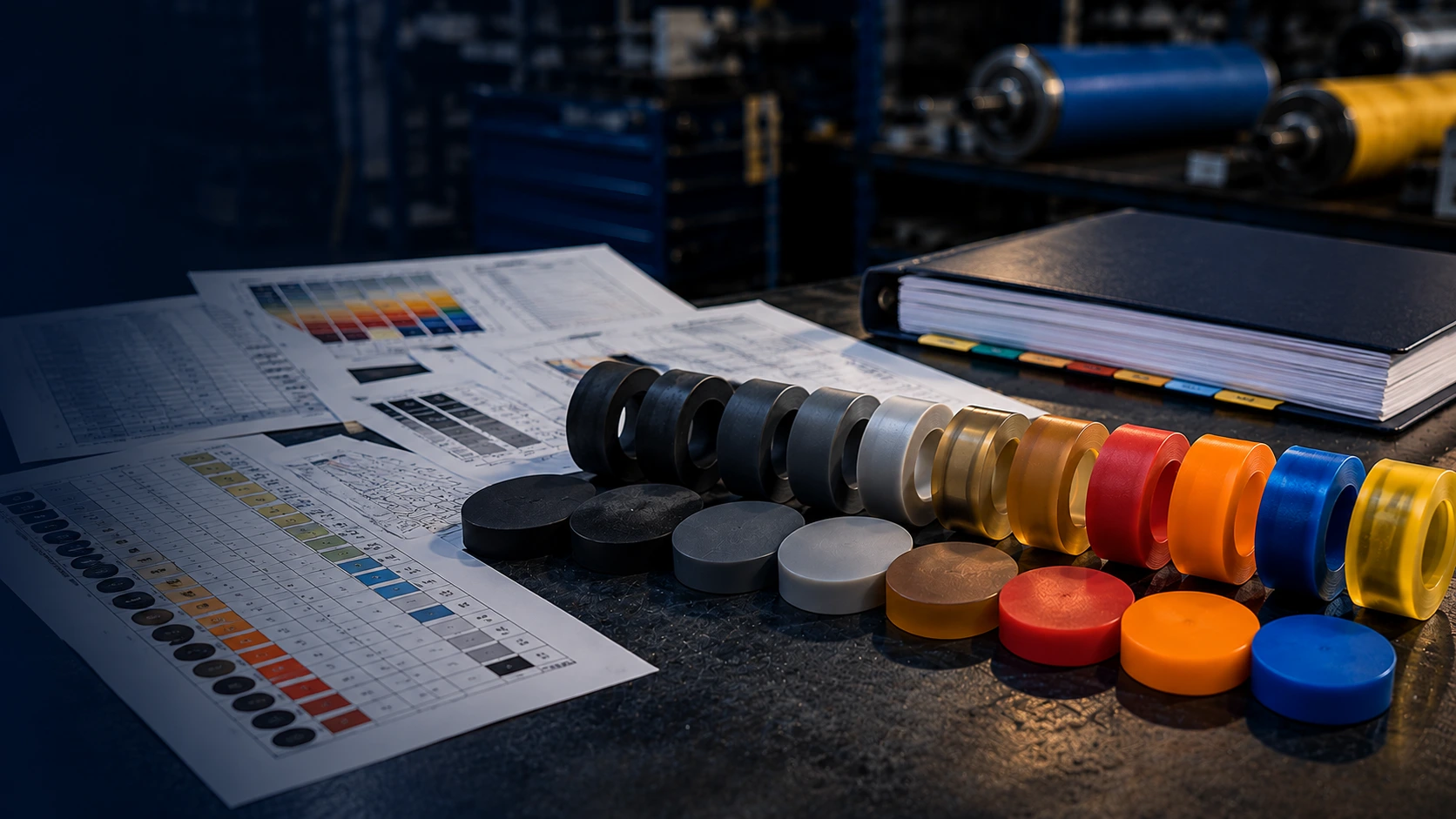
Nuancier d'échantillons Soremag, du caoutchouc noir aux polyuréthanes colorés, alignés du plus tendre au plus dur
Ressources · Guide des matériaux

Material Selection Guide

Rubber or polyurethane, hardness, families: choosing the right material for your actual production conditions.

Chart of the rubber compounds generally in stock

Twenty Soremag series, spread across the main families: nitrile (NBR), EPDM, neoprene (CR), SBR, CSM (formerly sold as Hypalon®), silicone and natural rubber. Each family has its strengths: NBR for oils, EPDM for water, steam and chemicals, neoprene and CSM for outdoor use and ozone, silicone for high temperature and natural rubber for flexibility and abrasion.

NIT-1NIT-2NIT-3NIT-4XN-1HN-1NIT-5NIT-6NPV-1NPV-2EP-1EP-2ES-1NEO-1PU-1CSM-1CSM-2SBR-1SIL-1NR-1
Série SoremagNitrile NBR StandardNitrile NBR Haute ACNNitrile NBR TextileNitrile NBR Extra ToughNitrile Carboxylé XNBRNitrile Hydrogéné HNBRNitrile NBR Aqua OffsetNitrile NBR Web OffsetNitrile/PVC NBR-PVCNitrile/PVC Print NBR-PVCEPDM StandardEPDM AdvantageEPDM/Silicone HybrideNéoprène StandardUréthane Millable PUHypalon StandardHypalon AquaSBR StandardSilicone Haute TempératureCaoutchouc Naturel NR
ProduitOilShieldAromatGuardTextiGripNitroForceTuffWearHeatTuffAquaGripSpeedGripPrintFlexInkSealWeatherTuffSmoothGuardHybridFlexNeoGuardSoreMillChemShieldChemAquaBaseGripThermoSilPureElast
Propriétés physiques
Dureté Shore A20–9540–9540–9550–9545–9550–9825–4020–5015–9520–5020–9550–9840–955–9540–9530–9545–9830–9540–9025–99
Dureté P&J0–20020–18520–18510–20020–17015–185N/AN/A90–275N/A10–30010–20010–14010–30010–25020–25020–20020–23025–1855–250
Résistance à l'abrasion33245523434333544315
Résistance à la déchirure33245533333324544315
Résistance en charge44445543333324555415
Faible hystérésis (peu d'échauffement)21231525152234522355
Résistance au marquage33342324143432522355
Temp. max (°C/°F)121°C / 250°F121°C / 250°F121°C / 250°F121°C / 250°F135°C / 275°F160°C / 320°F121°C / 250°F121°C / 250°F121°C / 250°F121°C / 250°F177°C / 350°F177°C / 350°F185°C / 365°F121°C / 250°F100°C / 212°F149°C / 300°F149°C / 300°F121°C / 250°F260°C / 500°F100°C / 212°F
Résistance à l'ozone11111513445553455151
Résilience32242435254444432515
Résistances chimiques
Acides22222322335543125343
Caustiques33433433335544125343
HC paraffiniques55555555551113233121
HC aromatiques34333333442222122131
HC chlorés11111411111121111131
Eau44543434445543235545
Cétones22222212115553133435
Alcools55554555555544344545
Esters11111111115533153435
Applications recommandées
Coating / Vernissage✓✓✓✓✓✓✓
Gaufrage / Embossing✓✓✓✓✓
Flexographie✓✓✓✓✓✓
Laminage✓✓✓✓✓✓✓✓✓✓✓✓✓
Gravure laser✓✓
Décoration métal✓✓✓✓✓
Impression offset✓✓✓
Industrie papier✓✓✓✓✓✓✓
Plastiques✓✓✓✓
Processeurs de plaques✓✓✓
Rouleaux acier✓✓✓✓✓✓✓✓✓✓
Rouleaux textiles✓✓✓✓✓✓✓
Industrie du bois✓✓✓✓✓✓✓✓
Légende des cotes : 5 = Excellent · 4 = Au-dessus de la moyenne · 3 = Moyen · 2 = Faible · 1 = Très faible | ✓ = Application recommandée
Indicative values, not contractual. Soremag ref. codes. P&J = Pusey & Jones (hardness scale for soft rollers).

Polyurethane Chart

At Soremag, polyurethanes are hot cast. The diisocyanate forms the rigid backbone — heat resistance, load, fatigue — while the polyol (polyester or polyether) governs resistance to water, chemicals and solvents. Here are the six main systems: MDI polyester, MDI polyether, TDI polyester, TDI polyether, PPDI and NDI.

PropriétéMDI esterMDI étherTDI esterTDI étherPPDINDI
Caractéristiques générales
Dureté typiqueLarge gamme, du souple (Shore A) au dur (jusqu'au Shore D) selon formulation
Polyol (résistance eau/chimie)EsterÉtherEsterÉtherselon formulationselon formulation
Coût matière relatif$$$$$$$$$$
Propriétés physiques & mécaniques
AbrasionTBB–TBTBTBEE
Résistance à la coupure / déchirureTBBTBB–TBEE
Rebond / résilienceM–BTBM–BTBTB–EE
Faible hystérésis (peu d'échauffement)MB–TBMB–TBTB–EE
Capacité de chargeB–TBB–TBB–TBB–TBB–TBE
Fatigue dynamique (flex)M–BTBBTBEE
Tenue à chaud (service)BBB–TBB–TBETB
Résistance à l'eau & aux produits chimiques
Immersion / humidité permanenteF–MEF–METBM–B
Hydrolyse / eau chaudeFTBFTBTBM–B
Huiles & graissesTBBTBBTBTB
Solvants aliphatiques / dieselB–TBM–BB–TBM–BB–TBB
Solvants aromatiquesFFFFM–FM–F
Cétones, MEK, solvants chlorésDDDDF–DF–D
Usages typiques
Application recommandéePièce d'usure économique hors eauRoue ou galet standard, milieu humideRacleurs, bavettes, milieux abrasifs et grasRoue ou galet standard, milieu humide / lavéJoints haute performance, tenue thermique et fatigueRoue lourde de manutention intensive, haute vitesse / NVH
Légende : E ExcellentTB Très bonB BonM MoyenF FaibleD Déconseillé| Coût : $ économique → $$$ premium.
Indicative values, not contractual, taken from the Soremag polyurethane guide. Each system comes in many hardness and formulation variants; FDA / food-contact and antistatic grades on request. Low hysteresis “E” = little heat build-up (an advantage).

How to choose

The right material and the right durometer follow from your actual conditions. Here are the factors that drive the decision — give them to us and we will recommend the material, durometer and finish as a package.

🧪

Product in contact

Water, steam, oils, solvents, acids, inks, food: that is the first filter. Polyester for oils; polyether and EPDM for water and steam.

⚙️

Abrasion

Friction, particles, greasy and cutting environments: a clear advantage to polyurethane (PPDI / NDI at the extreme), otherwise NBR XNBR / HNBR.

⬇️

Load & pressure

Heavily loaded guide rollers, high nip pressures: NDI first, otherwise PPDI; hard rubbers for moderate loads.

⏩

Speed

At high speed, heat build-up from hysteresis becomes critical: favor low-hysteresis systems (NDI, PPDI, polyether).

🌡️

Temperature

High continuous service → PPDI on the polyurethane side, silicone (up to 260 °C) or EPDM/HNBR on the rubber side. Cold → polyether and silicone.

🧼

Chemicals & cleaning

Frequent washdowns and hot water → polyether (hydrolysis-resistant) or EPDM. Ketones / chlorinated solvents → polyurethane is not suitable.

✨

Surface finish

Polished, matte, micro-textured, grip or non-marking: this drives the durometer and the family (silicone for release).

📐

Geometry

Cover thickness, diameter, profile (crown/taper) and tolerances affect the durometer and the process chosen.

At Soremag, we help you make the right choice

We are rubber and polyurethane experts. With thousands of formulations available in both materials — adjustable with anti-UV or antistatic additives, several FDA-compliant formulations, and the option of making a polyurethane more slippery or more abrasive — there is almost always a solution suited to your application. The right choice often comes down to communicating your needs clearly, understanding your application well and, sometimes, running trials in real conditions. Tell us your problem: we will find the right material with you.

Not sure which material is right?

Share your actual conditions with us — product in contact, abrasion, load, speed, temperature, chemicals and finish — and we will recommend the material, durometer and finish best suited to your process.

➔ Get a technical analysis