Covering & manufacturing · rubber and polyurethane · Quebec450 664-4000·1 800 361-5588·EN|FR
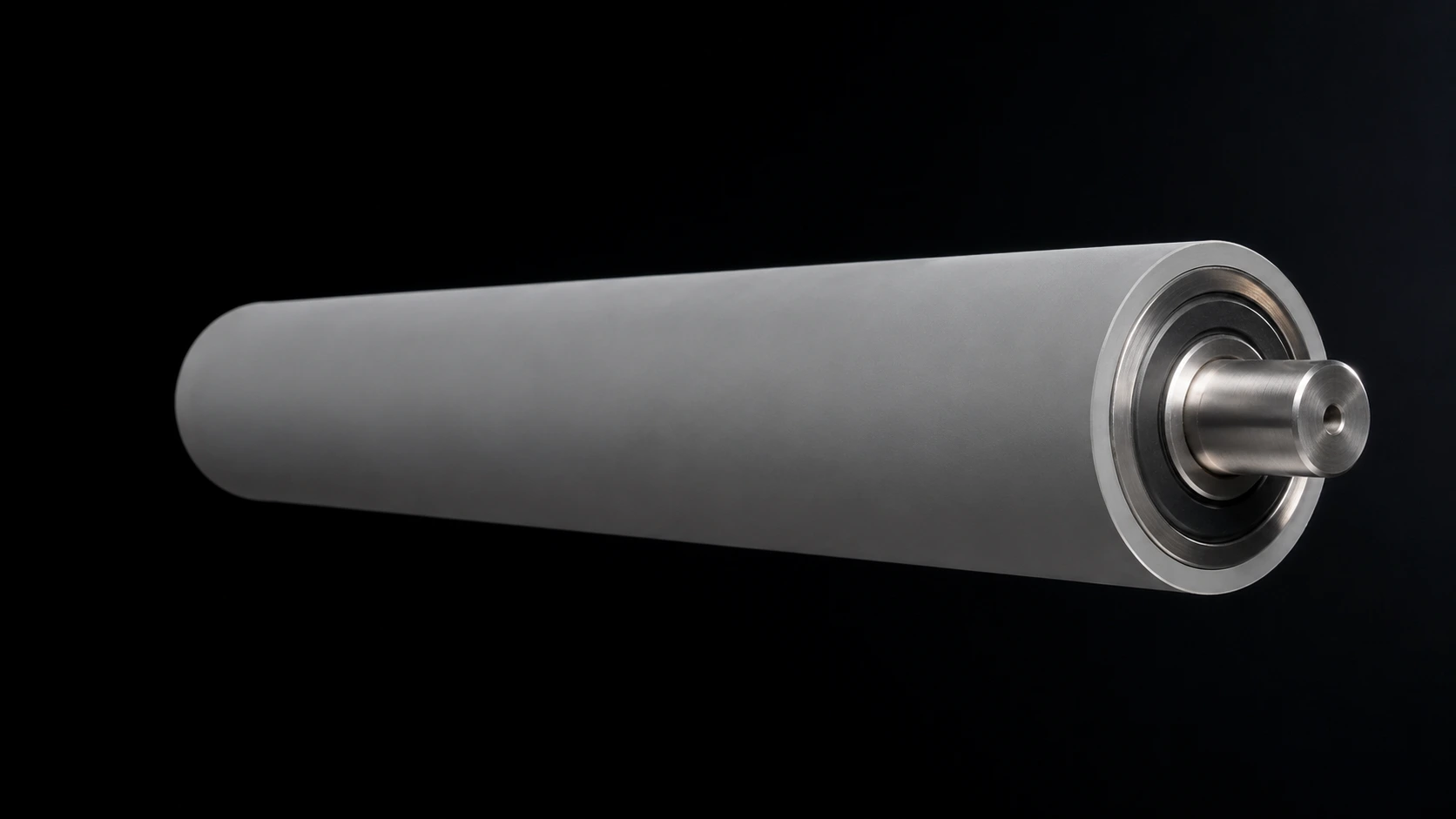
Rouleau de guidage libre à recouvrement mince gris sur mandrin d'acier, roulement étanche visible au bout
Produits · Spécialité

Guide, idler and dancer rollers in rubber and polyurethane

Guide rolls, idler rolls, dancer rolls, turning rolls and deflector rolls: the rollers that are not driven. We cover them, grind them and balance them so they turn without resistance — because an idler roller that drags scratches your product.

Roller covering for rollers that are not driven

An idler roller —

idler roll
— is a non-driven roller, turned only by contact with the product running over its surface. In film, paper, textile, metal sheet and other continuous processes, its performance depends on the traction available between the product and the roller, the wrap angle, the moment of inertia, the condition of the bearings, runout and surface finish.

This family is judged the other way around from the rest. Other rollers do work. This one has to stay out of the way — and anything extra you put on it turns against it.

The classic mistake: a thick cover, because thick feels safe. More inertia, more torque to supply at every acceleration — and at the end of it, the very defect you wanted to avoid:

scratching
.

Related expertise: roller covering, grinding and surface finish, dynamic balancing, drive rollers — the mirror image of this page — and roller troubleshooting.

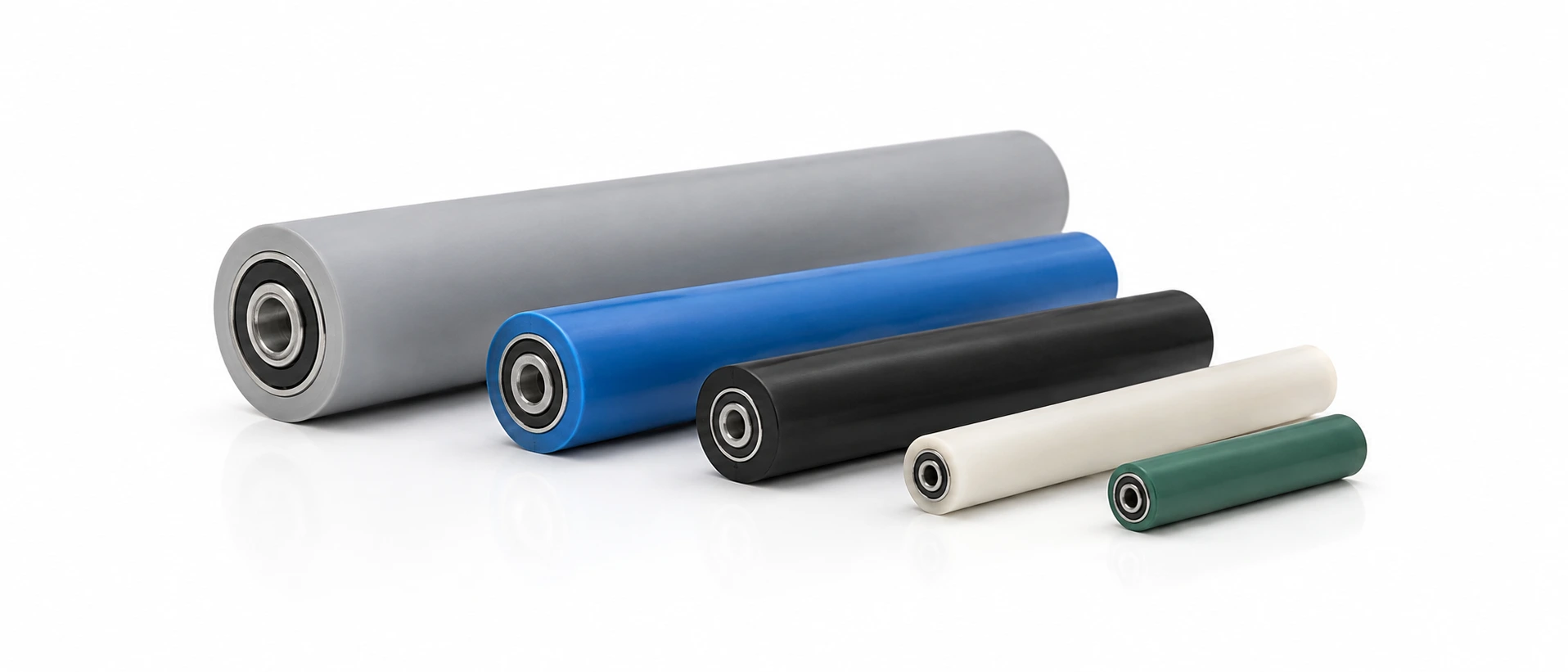
Cinq rouleaux porteurs (idler rolls) de formats et de couleurs différents — gris, bleu, noir, crème et vert
Cinq porteurs, cinq formats — et la même construction partout : un recouvrement mince dont la coupe se lit au bout, et un roulement étanche qui fait le vrai travail. Sur cette famille, la pièce maîtresse n'est pas la gomme, c'est ce qui tourne dedans.

What decides whether an idler roller follows or slips

It is a balance, and it can be calculated. On one side, the torque the product can supply to turn the roller. On the other, everything that resists. As long as the first comfortably exceeds the second, the roller follows the line. When the margin closes, the surface starts to slip — and it scratches.

What makes it turn

Available torque

  • L'angle d'enroulement — plus le produit enveloppe le rouleau, plus il a de prise sur lui.
  • La tension du produit — c'est elle qui l'appuie contre la surface.
  • Le frottement au contact — la seule des quatre que nous fabriquons.
  • Le rayon du rouleau — un plus grand diamètre donne plus de bras de levier.
versus
What holds it back

Roller resistance

  • Le frottement du roulement — un couple de démarrage à vaincre, puis une résistance qui varie avec la vitesse, la charge et la lubrification.
  • L'inertie — la masse et le diamètre à accélérer chaque fois que la ligne change de vitesse.
  • Le balourd et le faux-rond — ils ne freinent pas, mais ils marquent et font fouetter.
  • Les joints et l'étanchéité — souvent sous-estimés, ils peuvent peser lourd dans le couple de démarrage.
Le moment où ça casse

This margin is not the same at steady state as it is during transients. At constant speed the inertial term disappears: the losses come mainly from the bearings, the seals and other mechanical drag. But at every

start-up, acceleration or stop
, the inertial torque is added all at once — and that is exactly where the product starts to slip.

Hence a very useful piece of diagnosis: if your scratches show up mainly

at start-ups and speed changes
, it is not a surface problem, it is an inertia and bearing problem. No change of compound will fix it.

The most common mistake on an idler roller

A thick cover. It looks generous, it feels safe, and it hurts — here are the three reasons.

Moment d'inertie

More mass to accelerate — and in the worst place

Weight alone does not tell the whole story: two rollers of the same mass do not have the same

moment of inertia
, because what counts is the distance of the mass from the axis. Every millimeter of cover is added at the largest radius, where it costs the most — while an idler roller, unlike a nip roller, is not built to transmit a nip load.

Faible hystérésis (peu d'échauffement)

More thickness, more heat

Even with no nip load, a thick cover flexes slightly under product tension and heats up. On a fast line, that ages the material with no function to justify it.

Faux-rond

More material, more to grind

Thickness you do not need is thickness that will wear unevenly and have to be reworked. On an idler roller, where nothing damps runout, you pay for it in repeating marks.

So the right question is not "how thick to make it last" but

"what is the thinnest cover that does the job"
. On an idler roller, less material well chosen beats more material.

What a cover brings to an idler roller

Four functions, and the choice of compound follows from the one you are after — rubber, polyurethane or silicone depending on the case.

La fonctionCe que le recouvrement apporte
Rétablir le frottementQuand le produit n'arrive plus à entraîner le rouleau — surtout à grande vitesse, où un film d'air s'installe au contact. Un élastomère bien choisi rend la prise que le métal nu n'a pas.
Protéger un produit fragileUn film mince, une feuille imprimée ou un métal poli n'aime pas le contact acier. Un recouvrement souple évite les micro-rayures et les marques d'arête.
Évacuer l'électricité statiqueSur les films plastiques, un composé antistatique ou conducteur, selon disponibilité, draine la charge par le mandrin au lieu de la laisser s'accumuler.
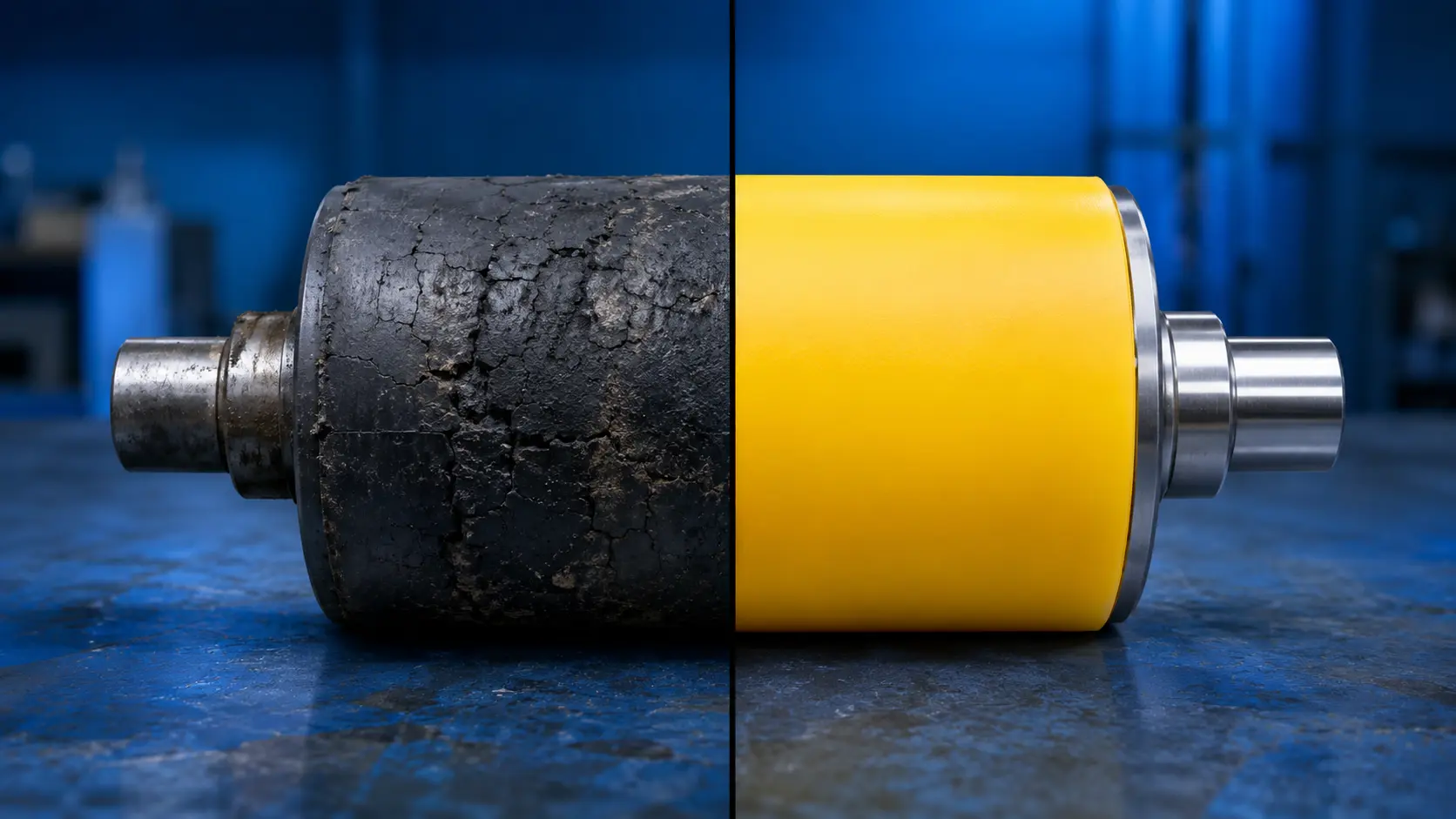
Sauver un mandrin abîméUn rouleau piqué, corrodé ou marqué redevient neuf en surface sans qu'on ait à le remplacer. Souvent la raison la plus économique de toutes.
Et la bonne épaisseurLa plus mince qui remplit la fonction. C'est la règle propre à cette famille : on vise le frottement, la douceur ou la conductivité voulus avec le minimum de matière, pour ne pas charger le rouleau en inertie. Un recouvrement de rouleau presseur posé sur un porteur est un mauvais recouvrement.

The idler rollers we cover

Guiding, carrying, turning, regulating — a quiet family, present in every line and rarely named.

Guide rollers — guide rolls

They carry the product through the line without driving it. They are the most numerous, and often the most neglected in maintenance.

Idler or free-turning rollers — idler rolls

They support the product between two drive points. Their only job is to turn while offering as little resistance as possible.

Dancer rollers — dancer rolls

Mounted on a moving arm, they travel to absorb tension variations and their position serves as the control signal. When we cover one, every gram counts : the cover goes on thin and soft, only for grip or to protect the product.

Turning rollers — turning rolls

They change the path of the product. Wrap angle is often large, so grip is good — but they also take more tension out of the web.

Deflector rollers — deflector rolls

Metal line vocabulary: they deflect the strip from one plane to another, sometimes under high tension.

Steering rollers — steering rolls

Mounted on a pivoting frame, they correct lateral drift. Their alignment and their straightness matter more than their surface.

Snub rollers — snub rolls

Small rollers set right next to another one to increase the wrap angle — often the cheapest fix for a grip problem.

Tension rollers — tension rolls

Free-turning but deliberately braked to create a measured drag. The one case where resistance is wanted.

Accumulator rollers — accumulator rolls

They store product length to absorb a stop upstream. Numerous, light, and every one of them needs maintenance.

Live shaft or dead shaft — live shaft / dead shaft

On a live shaft, the roller and the shaft turn together in external pillow blocks. On a dead shaft, the shaft stays fixed and the bearings sit inside the roller — more compact, lower inertia.

Low-inertia rollers — lightweight / low-inertia rolls

Thin cores, aluminum, lightened walls. For delicate products and lines that accelerate often.

What about conveyor idlers? — carrying / return idlers

A different world: this page deals with the idler rollers of continuous processes — film, paper, textile, sheet metal. Conveyor belt rollers belong to material handling: see conveyors and material handling.

Your position goes by another name? Send a photo or a drawing. See also the other roller families.

What Soremag does on an idler roller

On this family, half the work is mechanical — and that is often where the real cause is.

InterventionCe que ça règle sur un rouleau libre
Remplacement des roulements et des jointsLa première cause d'un rouleau qui traîne. Un roulement contaminé ou grippé fait glisser le produit, quel que soit l'état de la surface.
Recouvrement mince, dosé pour la fonctionLe frottement nécessaire pour se laisser entraîner, sans ajouter d'inertie inutile.
Rectification de précisionFaux-rond, cylindricité et fini remis aux cotes — sur un rouleau libre, rien n'amortit un défaut de géométrie.
Équilibrage dynamiqueÉlimination du fouettement et des marques cycliques sur les rouleaux rapides.
Réparation du mandrin, des portées et des tourillonsUne portée usée crée du jeu, et le jeu crée du battement — souvent pris à tort pour un problème de surface.
Allègement quand c'est possibleRéduction d'épaisseur, choix de mandrin, pour baisser l'inertie sur les lignes rapides ou les produits fragiles.
Formulations antistatiques ou conductricesSelon disponibilité, pour drainer la charge sur les films plastiques.
Reverse engineeringReproduction d'un rouleau libre à partir de la pièce usée, sans plan — dimensions, roulements et matière relevés.
Contrôle et traçabilitéFaux-rond, dureté, rugosité, dimensions et vérification de la rotation libre avant retour.

Capabilities: from

10 Shore A to 85 Shore D
· parts from
2 mm to 20 ft. long
· machining up to
Ø 42 in. × 240 in.
,
Ø 68 in. × 175 in.
or
Ø 76 in. × 36 in.
· machining to within ±0.001 in. (±0.025 mm) depending on the compound · dynamic balancing in-house. See quality control.

Which cover for an idler roller

Here we are after friction and softness, not load capacity. And the thinnest cover that does the job.

Natural rubber (NR) — high grip on dry product SBR — all-around compromise, controlled cost Nitrile (NBR) — oils or inks present EPDM — hot water, steam, washdowns Silicone — heat and release Cast polyurethane — abrasion and cutting, in thin sections Antistatic or conductive formulations — subject to availability

On this family, the

surface finish
can matter as much as the compound — and in some applications more: it is what sets the grip and the risk of marking. To compare the families, see the material selection guide and the page on rubber rollers.

The technical detail

The mechanisms specific to idler rollers — the ones behind most of the scratching described to us.

La marge de sécurité en traction, correctement posée

The torque the roller demands is written:

required torque = bearing torque + seal torque + J × α
, where
J
is the moment of inertia of the roller and
α
its angular acceleration. That torque is supplied by the product, as a difference in tension on either side of the roller:
ΔT = required torque ÷ radius
. You can see right away why the problem turns critical during accelerations — the J × α term appears all at once.

The traction the contact can transmit also has a limit, described by the classic Euler-Eytelwein relation: T₂/T₁ ≤ eμθ. This is a simplified model, valid with no air film : at high speed, the air dragged in between the product and the roller cuts the effective traction, and a friction coefficient measured at low speed no longer predicts how the line actually behaves.

What the model shows in practice: you can act on the wrap angle, the tension and the radius before you touch the material — adding a snub roller often costs less than a cover. And when the margin gets too thin, it is better to cut the resistance — new bearings, weight reduction — than to raise the tension, which damages the product.

Le micro-glissement, presque toujours présent

Driving a roller takes a little tension out of the product. That difference in tension on either side of the roller creates a small difference in strain, and therefore

microslip in the trailing part of the wrap
.

The effect shows up on most rollers, not just driven ones, and how large it gets depends on the traction available, the dynamics of the line and the product-roller interface. So the realistic goal is not zero slip: it is a comfortable margin, so the slip stays negligible.

It is also why a line running many idler rollers loses tension from one roller to the next — each one takes a little.

Le diamètre : un compromis, pas une amélioration

Increasing the diameter gives the product more leverage: more torque to turn the roller, and a smaller change in tension across it. That is the good side.

But a bigger roller is heavier, so its

inertia goes up
, and it calls for bigger bearings, whose friction is higher. The two effects pull in opposite directions.

So there is no "bigger is better". The right diameter follows from the speed, the tension available and the sensitivity of the product — and sometimes the right answer is a smaller but lighter roller.

Le rouleau danseur : une pièce mécanique et un instrument

A dancer moves to absorb tension variations, and its position serves as the signal for the line's tension control. So it is not just a roller: it is part of the control loop.

Direct consequence:

the lighter it is, the more sensitive it is
. Its mass, its inertia and the friction in its pivot all work against the control loop. A thick cover on a dancer degrades the machine's response, not just the life of the part.

So when a dancer comes to us, we always ask whether the original thickness was intended or inherited.

Le film d'air, ici aussi

At high speed, a layer of air builds up between the product and the roller and friction drops. On an idler roller, the effect is worse than on a driven roller: there is nothing else to turn it.

A roller that followed perfectly at 200 ft./min. can start slipping at 600 with nothing else changed. This is one of the cases where grooving or a surface texture is justified even on an idler roller.

The full mechanics of the air film is detailed on the page drive and pull rollers.

Électricité statique

A plastic film running over insulating rollers builds up a charge. It attracts dust, makes the product cling, disturbs stacking and can be a safety issue near solvents.

There are

antistatic or conductive formulations
exist, subject to availability, to drain the charge through the core. Since this requirement constrains the choice of compound, put it on the table with the request.

One point the formulation alone does not settle: the charge needs a

complete path to ground
— cover, core, shaft or bearings, frame, ground connection. A conductive cover mounted on a machine that does not provide that electrical continuity drains nothing.

Le test le plus simple : la rotation libre

Before any instrumented measurement, an idler roller is judged by hand. We spin it gently and watch: the

time it takes to stop
, any tight spot as it passes a given position, bearing noise, perceptible play at the ends.

A healthy roller coasts down for a long time and stops smoothly. A quick stop gives away a dragging bearing. Stopping always at the same position gives away unbalance. A tight spot gives away a damaged or contaminated bearing.

It is the first thing we do when an idler roller comes in, and the last before it goes back. In between, instrumented measurement takes over.

Remise à neuf, étape par étape

1. Check of

free rotation
by hand and a reading of the starting torque you can feel — the most revealing test in this family.

2. Condition survey: runout, hardness, surface roughness, diameter, condition of the core and the journals.

3. Disassembly, stripping of the old cover, inspection of the bearings and the seals.

4. Bearing and seal replacement, mechanical repair as needed.

5. Covering at the right thickness, if a cover is justified.

6. Precision grinding to the target diameter and finish, then dynamic balancing.

7. Final inspection, including another free-rotation check. Process details in our roll covering process.

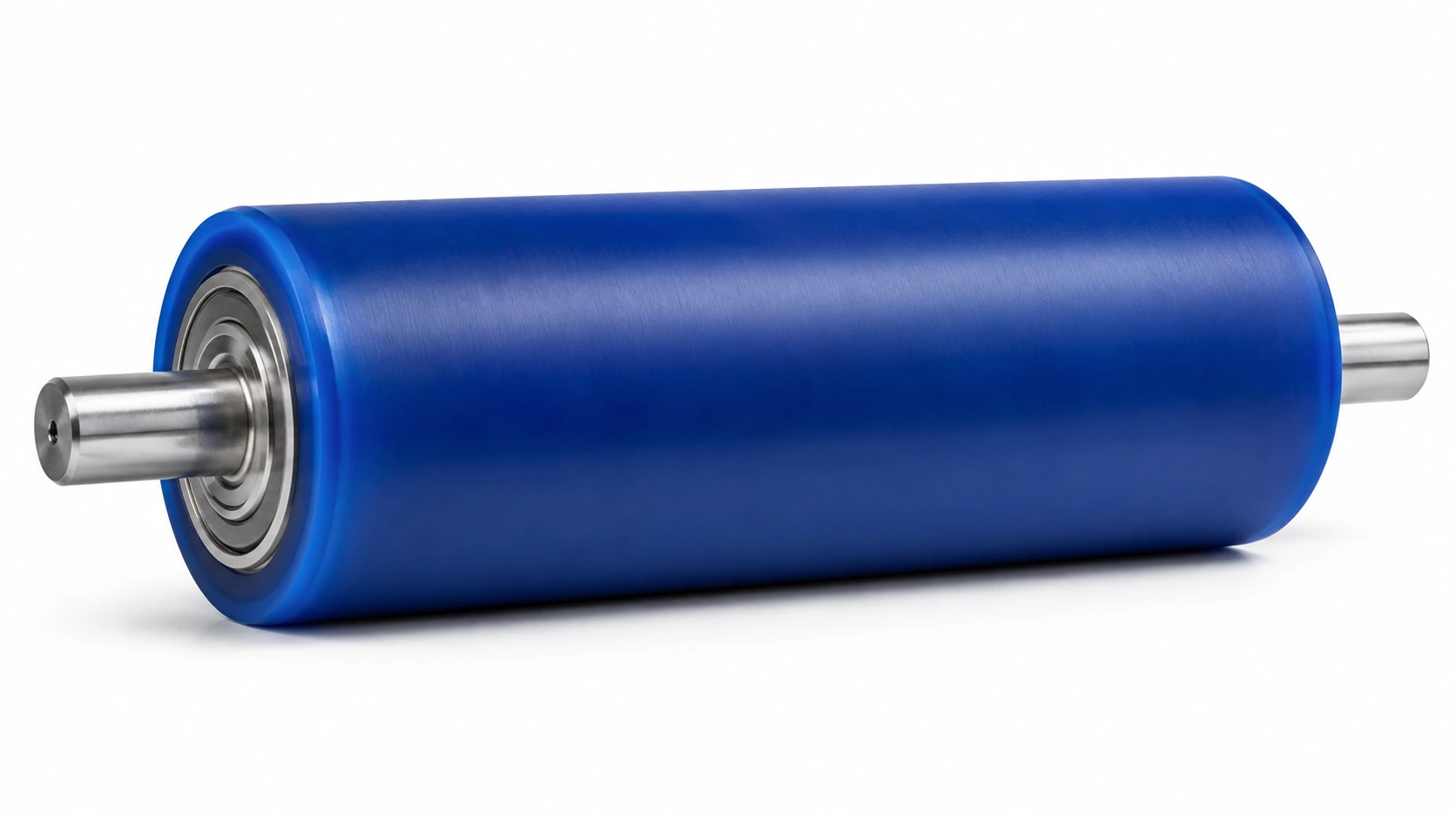
Rouleau de guidage recouvert de polyuréthane bleu, 80 Shore A — recouvrement mince sur mandrin d'acier
Rouleau de guidage en polyuréthane bleu, 80 Shore A : un recouvrement mince, à l'épaisseur juste pour glisser sans ajouter d'inertie inutile.

The data that lets us size an idler roller

Here is what we will ask you for — and why each item counts. The more complete the list, the more the recommendation is right the first time.

DonnéePourquoi on la demande
Produit en contactFilm, papier, foil, textile, feuille métallique — chacun a sa fragilité, sa rive et son frottement propre.
Vitesse de ligneElle gouverne le film d'air, l'équilibrage requis et le comportement dynamique.
Accélérations et arrêtsC'est la demande inertielle : une ligne qui change souvent de vitesse exige un rouleau plus léger.
Tension du produitC'est elle qui fournit le couple d'entraînement — la capacité du produit à faire tourner le rouleau.
Angle d'enroulementIl multiplie la traction disponible; un rouleau à peine effleuré est le premier à glisser.
Diamètre et constructionArbre vivant ou mort, paroi mince ou pleine — ils déterminent le moment d'inertie.
Type et état des roulementsIls fixent le couple résistant, au démarrage comme en régime.
Dureté Shore et épaisseur viséesL'épaisseur se dose pour la fonction — traction, protection, conductivité — sans charger l'inertie.
Rugosité (Ra) souhaitéeElle règle la prise, la libération et le risque de marquage.
Température et chimie du posteElles restreignent les familles de composés admissibles.
Besoin antistatiqueIl contraint la formulation — et suppose une continuité électrique jusqu'à la terre.
Faux-rond toléré (TIR)Il fixe l'exigence de rectification et le risque de marques cycliques.

What we measure before the roller goes back

An idler roller goes back to you inspected — and the readings are recorded for the part.

Free rotation — hand spin, coast-down time, tight spots Shore hardness, taken at several points across the face Final diameter and face width Runout / TIR with a dial indicator Taper Surface roughness (Ra) Condition of the journals and the bearings Dynamic balancing when required Surface finish conformity

Industry references: hardness measurement on covered rollers is the subject of standard

ISO 48-7
, the balancing of rigid rotors of standard
ISO 21940-11
, and the performance of idler rollers — traction, drag, inertia — is covered in the technical work of
TAPPI
on web handling. Our methods sit within these frameworks; the exact requirements are defined with each project. See also our quality control and our "Standards and Test Methods" guide in the document center.

Diagnosis → cause → correction

What we hear described most often, and what it usually means on an idler roller.

SymptômeCause probableCorrection
Rayures qui apparaissent aux démarrages et aux arrêtsInertie trop élevée, couple de démarrage du roulementRoulements et joints neufs, allègement, réduction d'épaisseur.
Rayures à vitesse constanteFrottement insuffisant, film d'air, surface glacéeReprise du fini, texture ou rainurage, angle d'enroulement augmenté.
Le rouleau ne tourne pas du toutRoulement grippé ou contaminé, joint qui traîneDémontage, roulements et joints neufs, protection contre l'ingress.
Méplat sur le recouvrementLe rouleau est resté immobile pendant que le produit défilaitChercher la traction, non l'usure — voir pull rollers.
Marques cycliques régulièresFaux-rond, méplat local, balourdRectification puis équilibrage dynamique.
Fouettement, vibration à haute vitesseBalourd, jeu de portée, roulement en fin de vieRéparation des portées, roulements neufs, équilibrage.
Dérive latérale du produitDéfaut d'alignement, rouleau non parallèle, conicitéContrôle de la géométrie et de l'alignement avant de toucher à la surface.
Perte de tension le long de la ligneNombreux rouleaux libres, chacun prélevant sa partRéduction du frottement global : roulements, allègement, révision du nombre de rouleaux.
Poussière collée, produit qui adhèreCharge électrostatique accumuléeFormulation antistatique ou conductrice selon disponibilité.

Every wear signature is covered in detail in the roller and wheel diagnostic guide.

Where these rollers are found

In every line, without exception — it is the most numerous family and the least noticed.

Frequently asked questions — guide and idler rollers

Why does an idler roller scratch my product? +

Because it doesn't turn at exactly the speed of the product. An idler is driven only by the product, by friction. If its resistance — bearing friction plus inertia — exceeds the available torque, it turns too slowly or not at all, and the surface slides over it. That's why scratches show up mainly

at start-ups and stops
.

What makes an idler roller turn? +

Four quantities: the

wrap angle
,
tension
of the product, the
friction
at the contact and the
radius
of the roller. Their product gives the available torque. Against that, the roller opposes its bearing friction and its inertia. As long as the first comfortably exceeds the second, the roller follows.

Should an idler roller be heavy or light? +

Light
, almost always. Mass on an idler roller brings nothing and is paid for in inertia, and therefore in torque the product has to supply at every change of speed. It is the exact opposite of a nip roller, where mass and thickness work for you.

Which cover for a guide roller? +

It depends on the function you are after:

restore friction
so the roller lets itself be driven,
protect a fragile product
from metal contact,
drain static
off a film, or
save a damaged core
. Natural rubber or SBR for grip and softness, nitrile if oils are present, silicone for heat and release, polyurethane if abrasion comes into play. And in every case,
the thinnest cover
that does the job.

Is a larger diameter better? +

It is a trade-off. More diameter gives the product more leverage and a smaller change in tension. But the roller is heavier, its inertia rises, and it calls for bigger bearings, which drag more. The right diameter follows from the speed, the tension available and the sensitivity of the product.

Why does a dancer roller have to be as light as possible? +

Because it is also a

measuring instrument
: its position is the signal for tension control. The lighter it is, the more sensitive and the faster it is. Its mass, its inertia and the friction in its pivot all work against the control loop. A thick cover on a dancer degrades the machine's tension control.

Can slip be eliminated completely? +

In practice, rarely. Driving a roller takes a little tension out of the product, which creates a small difference in strain in the trailing part of the wrap: some

microslip
usually remains, depending on the traction available and the dynamics of the line. The goal is not zero slip, it is a comfortable margin so the slip stays negligible.

My roller vibrates at high speed, what should I do? +

Almost always three sources: an

unbalance
, a
runout
or an
bearing at the end of its life
. An idler roller has nothing to damp these defects. The correction goes in this order: precision grinding, new bearings, then dynamic balancing.

An idler roller that drags, scratches or vibrates?

Tell us one very simple thing first: does it turn freely by hand, with no tight spot? Then the dimensions, the line speed, the product in contact and where the scratches show up — at start-up or at running speed. We will tell you whether it is the surface, the bearing or the inertia, and whether a cover is justified.

➔ Request a quote