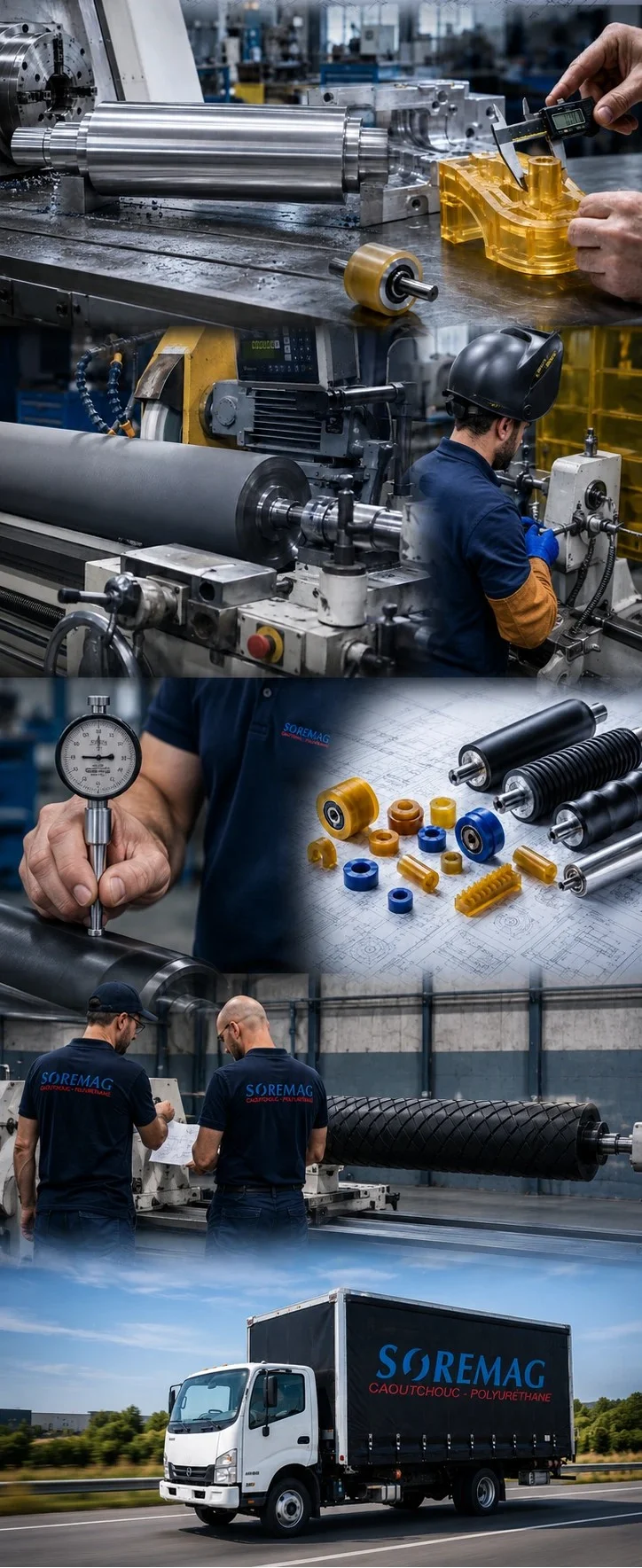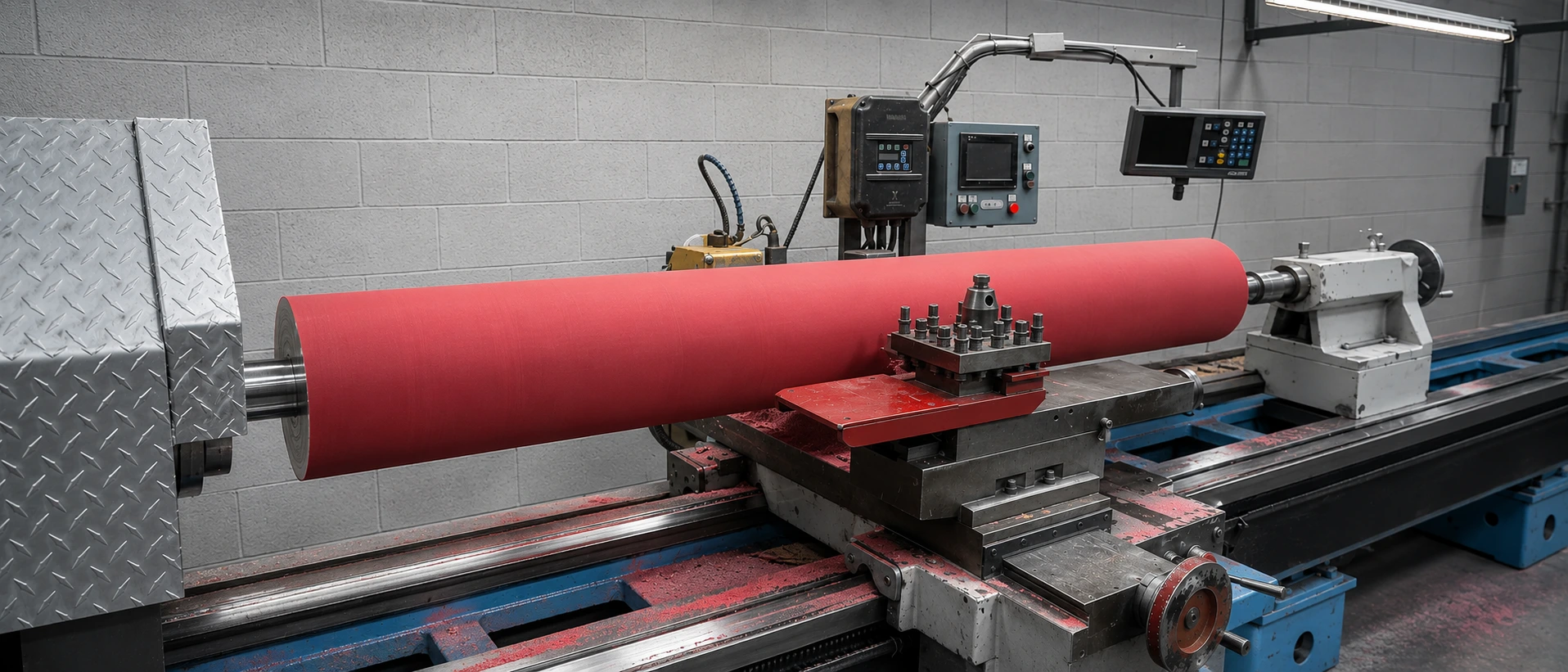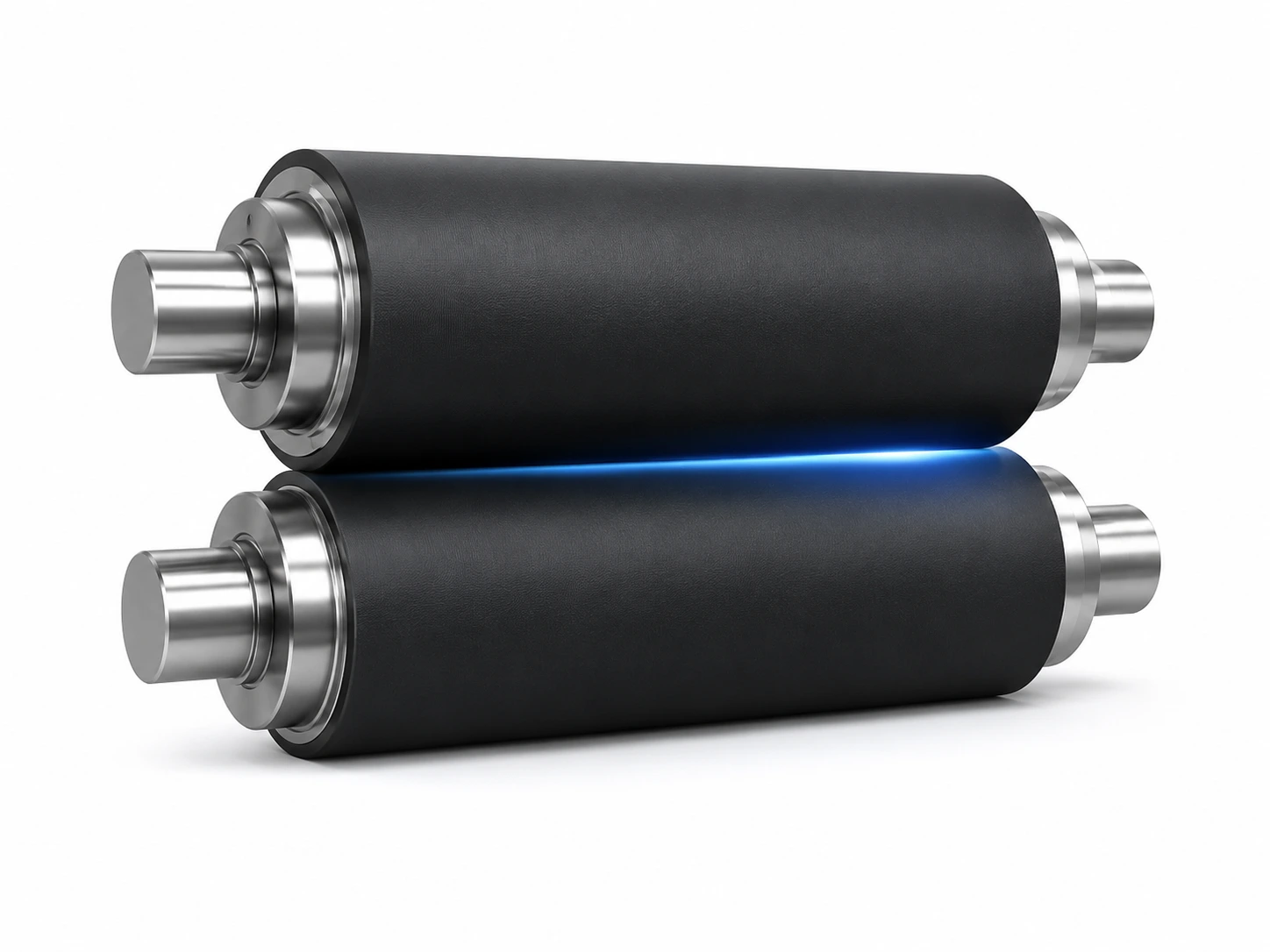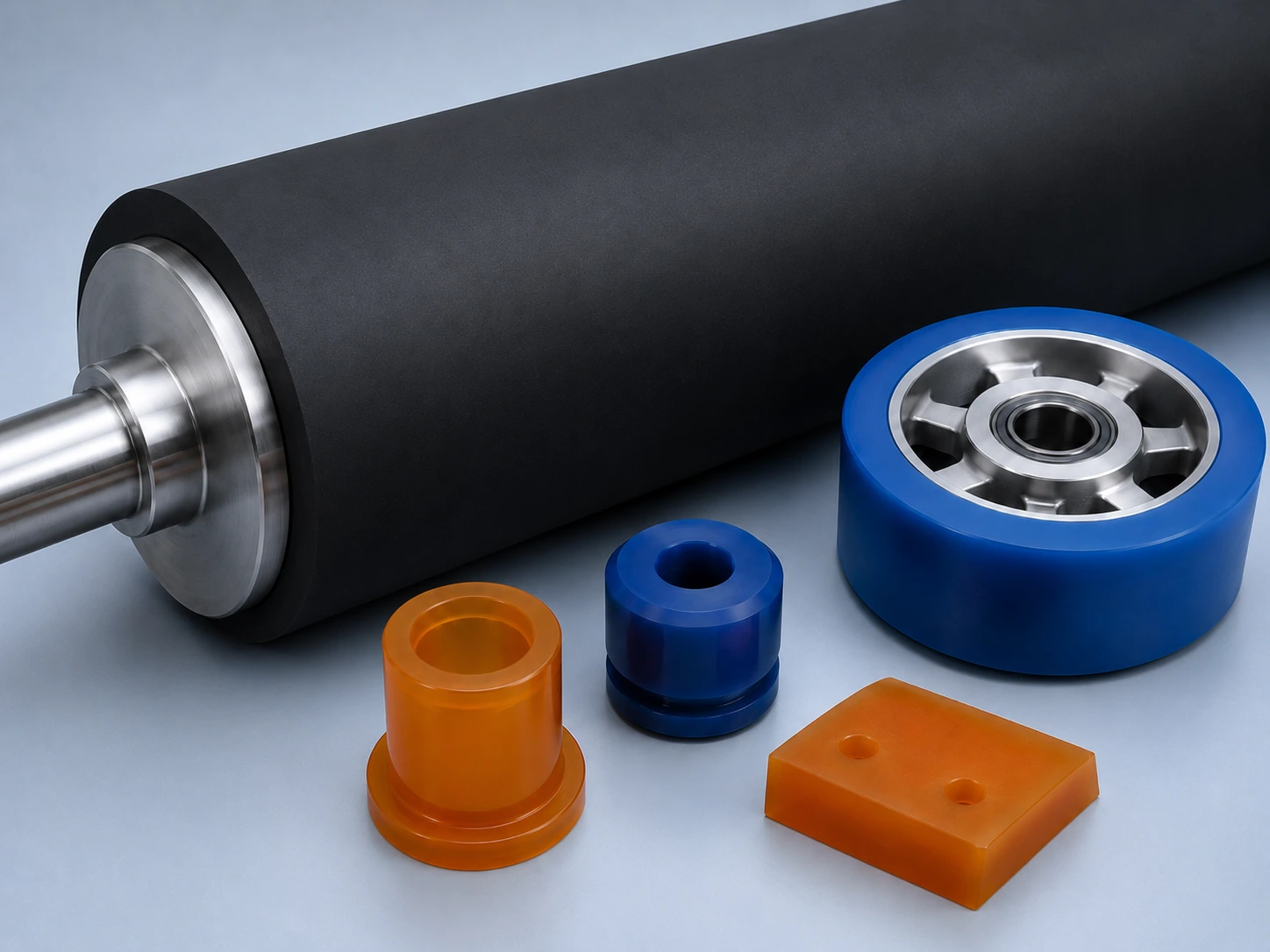
Nip rolls, pinch rolls, pressure rolls, backing rolls, lay-on rolls: we cover, grind, crown, groove and balance your nip rollers — for even pressure from edge to edge, without marking the product.
A nip is the contact line between two rollers pressing on the product. Everything the line produces downstream — thickness, adhesion, flatness, gloss, bond strength — is decided on that line a few millimeters wide.
And that line is almost never even by accident. It becomes even because the diameter, the concentricity, the durometer, the thickness and the profile of the cover were chosen and executed for the real load on your machine. That is exactly the work Soremag does on your existing rollers:
Related expertise: roller covering, grinding and profiles, grooving, dynamic balancing and reverse engineering when there is no drawing left.

A nip roller is not a rigid tube: loaded along its whole length and supported at both ends, it deflects. So the pressure drops at the center of the face, right where nobody measures it. The cover does the opposite: it flattens and absorbs what the mechanics let through.
Long face, small-diameter core, high nip load: the deflection at the center is enough to create a soft band down the middle of the product. We compensate with a crown calculated for the working load — not for the machine's maximum load.
As it flattens, the elastomer swallows variations in product thickness, differences in roller diameter, local hardness variation and part of the deflection. The thicker and softer it is, the more it swallows — and the hotter it runs.
It sets the local pressure and the contact time. Too narrow: slippage, streaks, marking. Too wide: friction, heat build-up, a cover that softens and bearings that wear out.

Uneven nip pressure: the footprint gets narrower at the center of the face. The classic symptom of uncompensated deflection.
One function — applying pressure — under different names depending on the industry and the position in the machine.
The pair that pinches the product between two parallel axes. Most often a metal roller and a covered roller that does all the adapting.
Same principle, the vocabulary of metal lines and conveying: pinching to drive or hold back the strip at the entry and the exit of a section.
Loaded against a process cylinder to press, drive out air or hold contact. Here we are after a steady load rather than grip.
They serve as the backing surface for another element: a printing plate, an applicator, a blade, a rotary tool. Their finish and their runout show up directly in the product.
Bonding two or more layers under pressure, often with heat. The cover has to take the temperature without softening or transferring adhesive.
Permanent contact with a heated, chilled or driven cylinder. Cover chosen for conduction, release and dimensional stability.
They press on the roll as it builds to drive the air out from between the wraps. A soft cover and careful balancing keep them from marking the first wraps.
Paper machine vocabulary: pressing the sheet and the felts, hot and wet. Compound selected for hydrolysis resistance and repeated compression.
Against a hard cylinder, they smooth and satin the surface without crushing it. Durometer, thickness and surface consistency drive the visual result.
Backing surface for rotary die cutting of board and labels. It takes a material that absorbs the cut without grooving out too fast, and that can be reground.
Drilled or flow-through cores. The cover has to take the thermal cycling without debonding at the interface, and that comes down to the bonding system.
Interchangeable sleeves mounted on a carrier shaft, so you can change durometer or finish without tying up the machine. Bore and concentricity machined tight.
This list is not closed. If your position goes by another name, send us a photo or a drawing: what determines the cover is the function and the service conditions, not the name. See also the other roller families.
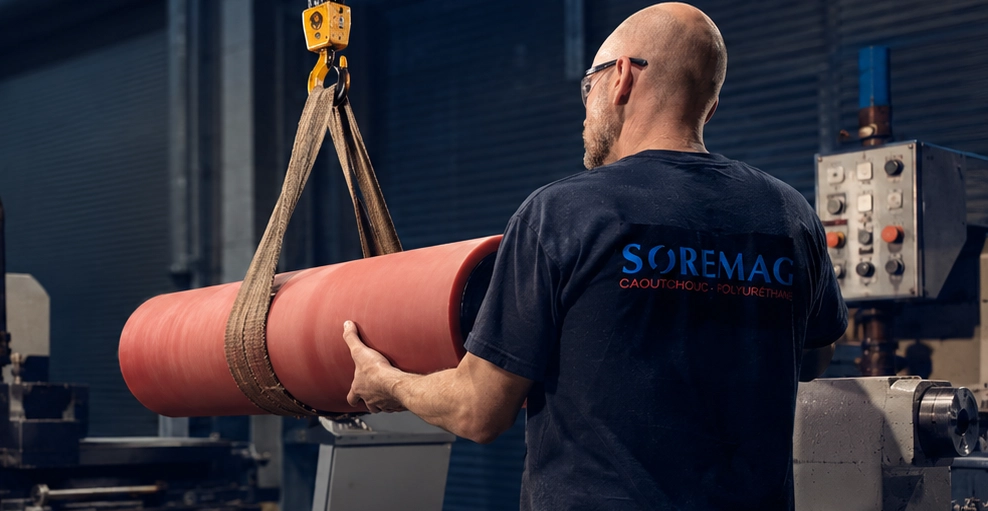
We start from your existing roller: core kept, cover redone, geometry brought back to spec.
| Intervention | Ce que ça règle sur un nip |
|---|---|
| Recouvrement caoutchouc ou polyuréthane coulé | Dureté, épaisseur et composé choisis pour la charge, la vitesse, la température et le produit en contact. |
| Rectification de précision | Diamètre, cylindricité, faux-rond (TIR) et fini de surface — l'origine de la plupart des marques répétitives. |
| Profil bombé (crown) ou conique | Compensation de la déflexion pour retrouver une pression égale d'une rive à l'autre, calculée pour la charge de service. |
| Soulagement des rives (end relief) | Réduction de la surcharge aux extrémités, là où les rouleaux se rencontrent hors du produit et où le recouvrement se fissure d'abord. |
| Rainurage | Évacuation de l'air et de l'eau emprisonnés dans le nip à grande vitesse, quand la traction ou la mise à plat se perd. |
| Équilibrage dynamique | Élimination du broutage et des marques cycliques sur les nips rapides. |
| Réparation du mandrin, des portées et des tourillons | Un recouvrement neuf sur un mandrin faussé ou des portées usées reproduit le défaut en quelques semaines. |
| Reverse engineering | Reproduction de la matière, de la dureté et du profil à partir du rouleau usé, sans plan ni documentation. |
| Contrôle et traçabilité | Relevés de dureté sur la face, faux-rond, rugosité, dimensions — consignés pour la pièce. |
Capabilities: from
On a nip roller, two levers come back again and again: what the cover is made of, and the shape we give it. The four cases below split exactly between the two — and in each one, the obvious reflex was the wrong one.
Same durometer, same size, same machine — and completely different behavior. The formulation is what decides.
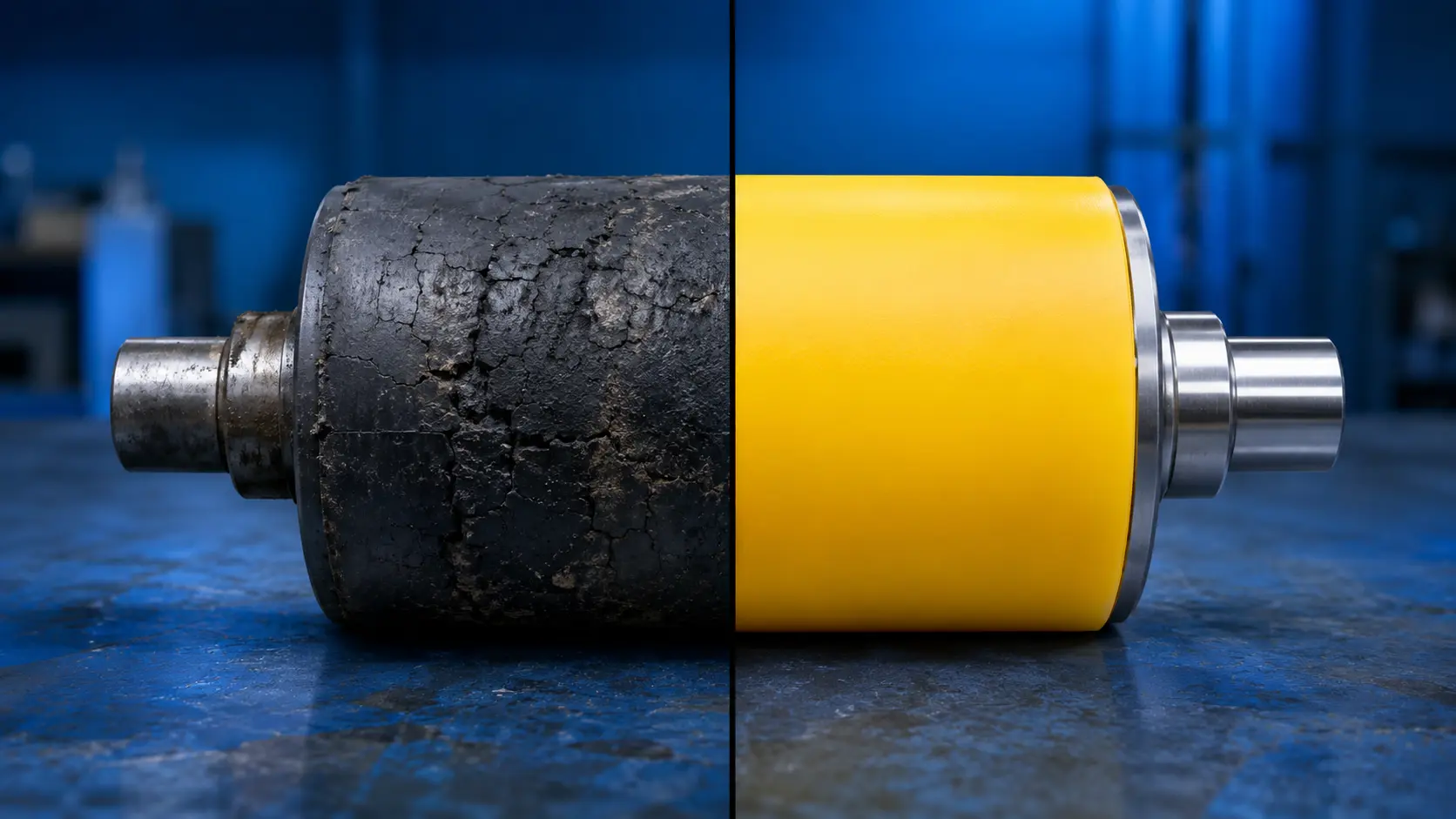
A calendered rubber nip where the knife cuts kept widening and marking the film. Cast polyurethane at the same durometer — 60 Shore A — fixed the marking and extended the service life.
Read the case study →Undriven wringer rollers that slipped and flat-spotted. A nitrile reformulated from 80 to 60 Shore A widened the footprint, brought back the traction and quadrupled the service life.
Read the case study →Two rollers within spec on durometer and diameter that still produce a defect. Because a measurement with no load says nothing about what happens under load.
A padder press roller that checked out perfectly at rest, but deflected under its working load. A parabolic crown brought back even wringing pressure from edge to edge.
Read the case study →An original part copied faithfully, worn at the positions of the film edges. A material matched to the wear mode plus a revised crown: service life doubled on the existing core.
Read the case study →The thread running through all four: nobody changed the mechanics of the machine. It all came down to the cover and its geometry. See all case studies.
On a nip, we look first at elastic recovery under cyclic load, then temperature resistance, then chemical compatibility — in that order.
The exact compound is chosen with your real conditions. To compare the families, see the material selection guide, the page rubber rollers or the page polyurethane rollers.
The mechanisms specific to nipping — the ones behind most of the nip rollers that come back to the shop too soon.
Under load the cover flattens and the contact stops being a line: it becomes a band a few millimeters wide. Its width depends on the load, the diameter, the thickness and the durometer of the cover.
That is why we do not “harden” a roller because it marks, and do not soften it because it slips, without having looked at the real load.
Supported at both ends and loaded across its whole face, the roller deflects. The pressure drops at the center: the product comes out thicker in the middle, or less well bonded.
A
Two options go with it: a
On every revolution the contact zone compresses, then releases. The elastomer does not give all the energy back: the difference turns into heat, inside the cover. The higher the speed, the heavier the load and the thicker the cover, the hotter it runs.
The consequences show up in the shop: a cover that
The answer is not just a “harder” material: it is a low-hysteresis compound, a thickness that is just enough and sometimes a chilled core. It is also why a roller that lasted five years at 200 ft./min. may not last a year at 600.
When the product is narrower than the face, the two rollers touch bare at the ends. There the cover takes the whole load with nothing in between, and on top of that works against the edge of the product — a corner that cuts.
Hence the cracks, the chips and the debonding that always start at the edges. The answer to that is
We can take these readings at your plant: see the on-site technical service.
1. Receiving, measurements and condition survey: durometer, diameter, runout, existing profile.
2. Stripping the old cover and inspecting the core, the bearing seats and the journals.
3. Mechanical repair if needed, then surface preparation and bonding.
4. Application of the new cover — vulcanization for rubber, hot cast for polyurethane.
5. Precision grinding to the target diameter, crown and finish.
6. Grooving and edge relief if the application calls for it.
7. Dynamic balancing, final inspection and traceability. Full detail in our roll covering process.
The symptoms people describe to us most often on the phone, and what they usually mean.
| Symptôme | Cause probable | Correction |
|---|---|---|
| Produit plus épais ou moins collé au centre | Déflexion non compensée, ou bombé calculé pour une autre charge | Relevé d'empreinte, recalcul du profil bombé pour la charge de service, rectification. |
| Marque répétitive à intervalle régulier | Faux-rond, méplat local, joint de recouvrement ou balourd | Rectification; équilibrage dynamique si l'intervalle correspond à un tour. |
| Glissement, stries dans le sens de marche | Empreinte trop étroite, surface glacée ou encrassée | Révision de la charge et de la dureté, nouveau fini, rainurage si l'air est en cause. |
| Recouvrement gonflé ou ramolli | Incompatibilité chimique, ou chaleur d'hystérésis accumulée | Changement de composé, révision de l'épaisseur, parfois mandrin refroidi. |
| Fissures et éclats aux extrémités | Contact à vide hors produit et coupure par la rive | Soulagement des rives, composé plus résistant à l'entaille. |
| Recouvrement décollé du mandrin | Adhérisation dégradée, cycle thermique, mandrin corrodé | Retrait complet, remise en état du mandrin, nouvelle adhérisation. |
| Broutage, bruit ou vibration cyclique | Balourd, roulement endommagé, portée usée | Réparation des portées, roulements neufs, équilibrage dynamique. |
Not sure where it comes from? The roller and wheel diagnostic guide goes through each symptom in detail.
Anywhere two rollers pinch a continuous product — and the vocabulary changes at every plant door.
The most direct method is the
As soon as the roller deflects enough under load for the pressure to drop at the center. The risk goes up with a long face, a small-diameter core, a high load or a thin cover. The crown is calculated for the
Three families of causes.
It reduces indentation, so the footprint gets narrower and local pressure goes up. That is not always what you want: a narrow nip marks more, slips more and runs hotter. A softer cover widens the footprint and absorbs thickness variation and deflection better, at the cost of more hysteresis heat at high speed. The trade-off is settled by the load, the speed and the sensitivity of the product.
Yes, and it is the most common case: a nip often pairs a metal roller with a covered roller. You have to check that the finished diameter still fits the center distance and the travel of the nip system, otherwise the real load changes. When both are covered, we prefer to redo them
Yes, if there is enough thickness left and the bond to the core is sound. Grinding fixes runout, flat spots and finish, and lets us re-cut a crown. It does not fix a cover that is swollen, hardened, cracked or debonded: there, you have to recover. See roller grinding.
Yes. On a nip, grooving is mostly there to vent the air or the water trapped in the contact zone at high speed, which brings back traction and lay-flat. Patterns and pitch are chosen according to the function: see the grooved rollers.
Yes. We take the dimensions, identify the compound family and its durometer in the lab, and reproduce it — or improve it if your conditions have changed since the original. That is the job of reverse engineering.
Send us the roller dimensions, the current material and durometer, the nip load, the line speed and the product in contact — with a photo or a nip impression if you have one. We come back to you with the compound, the durometer, the thickness and the profile that suit your position.
➔ Request a quote