
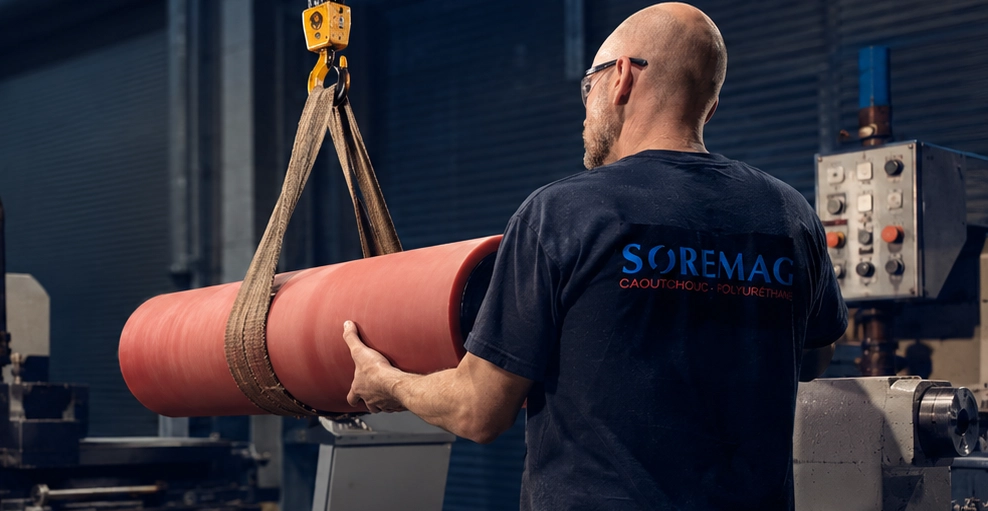
The customer brought its replacement rollers in from Europe, from the machine manufacturer. Long lead times, a large safety stock — and a service life it could never predict. We could have reproduced the original part exactly. We would have reproduced the failure just as exactly.
The context
A plastic film production and converting line, equipped with a European machine. On that line runs a covered roller that handles several product widths depending on the order.
That operating detail, ordinary as it looks, is the key to everything that follows.
The problem
Historically, the customer bought its replacement rollers from the machine manufacturer, in Europe. Lead times forced it to keep a large inventory on hand to avoid extended downtime. And despite that costly precaution, roller service life stayed hard to predict: you never really knew when the next replacement would come due.
The wear, for its part, had a very clear signature. It concentrated at the ends of the contact area. The spots matching the film edges broke down much faster than the center of the roller.
Over time, the roller built up a whole string of symptoms: pronounced wear at the ends, a gradual loss of profile, less consistent traction, a surface harder to keep clean, less stable production quality — and above all, a growing risk of unplanned downtime.
The original setup
The roller had a reusable metal core, a covering matching the equipment manufacturer's configuration, a durometer that reproduced the original part, a standard profile — and a face length greater than some of the film widths being run.
That last point was what would explain everything.
Our analysis
We reviewed the different film widths being run, the exact position of the wear marks, the rotation speed, the film tension, the direction of rotation, the existing durometer, the roller profile, the difference in wear between the center and the ends, the condition of the core, the shafts and the bearing journals, and the replacement history.
First finding: temperature and chemistry were not the main causes of the failure. Second finding, more telling: the wear marks matched exactly the places where the film edges worked continuously against the surface.
A film edge is a sharp edge. When the product is narrower than the roller face, its two edges always pass at the same two places — thousands of times an hour, over a few millimeters of covering. Those strips take a load the rest of the face never sees. And because the line alternates between several widths, there is not one pair of critical zones but several. A profile drawn for a single width cannot serve them all.
So the wear mode came from a combination: different film widths, repeated edge contact at the same places, load concentration at the ends, a profile not adapted enough to real production conditions, and a material that did not hold up long enough against that particular wear mode.
In other words: the problem did not come from the material alone. Reproducing the original roller exactly would have reproduced exactly the same failure mode — just a little later, and a little further along. Reading the wear pattern this way to trace it back to its cause is the heart of our roller and wheel diagnostics.
The first job
We started by refurbishing the existing core. The work included complete removal of the old covering, inspection of the metal core, a check of the shafts and the bearing journals, preparation of the metal surface, application of a material better suited to the wear mode, grinding to final diameter, a check of runout and concentricity, then a final inspection before return to service.
That first step answered a question that was strategic before it was technical: is the core salvageable? It was. And from that point on, local refurbishment became a real alternative to buying original parts every time. That is the very principle of roller covering : changing the working surface without buying the whole part again.
Optimizing the roller
After watching the wear in service, we also changed the crown profile of the roller. The new crown was designed to spread the contact better and reduce the load concentration in the zones matching the film edges.
The final solution combined a material with better resistance to that wear mode, a durometer matched to the traction required, a revised crown profile, precision grinding, a concentricity check and reuse of the existing metal core.
The exact details of the formulation and the profile stayed proprietary to the customer's application — that is our rule whenever a solution has been developed for one particular line.
At a glance
- Client
- Producteur et transformateur de film plastique — machine d'origine européenne
- Application
- Rouleau recouvert travaillant plusieurs largeurs de film
- Symptôme
- Usure concentrée aux extrémités de la zone de contact, aux positions des rives du film
- Avant
- Rouleau d'origine acheté en Europe · configuration et dureté du fabricant d'équipement · profil standard
- Ce qui n'était pas la cause
- Température et chimie du procédé
- Après
- Mandrin existant remis à neuf · matériau adapté au mode d'usure · profil bombé révisé · rectification de précision
- Résultat
- Durée de vie doublée par rapport à la configuration précédente
The result
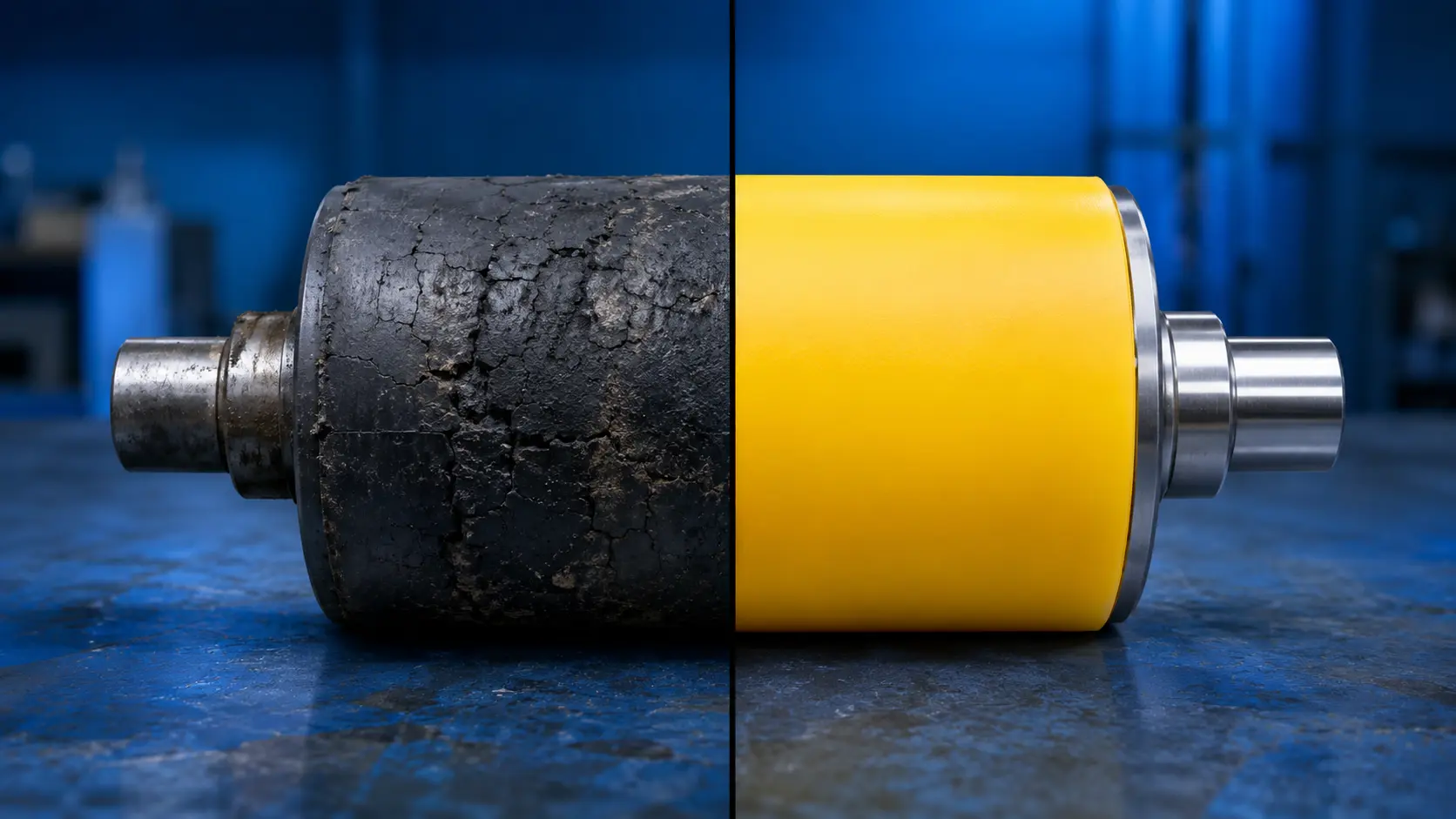
After the change of material and crown, the service life of the roller doubled compared with the previous setup.
The customer also got more even wear, steadier traction, fewer unplanned replacements and better maintenance planning. The most lasting gain may not be the service life itself, but taking back control of a schedule that used to depend on a supplier six thousand kilometers away.
In a later phase, Soremag was also able to build complete rollers for new machines.
What this case shows
A short service life does not automatically mean the covering is too soft or of poor quality. Here, the result came from two complementary corrections: a formulation better suited to the wear mode, and a geometry adjusted to the film widths actually run. Either one alone would have given half a result.
And there is one thing we rarely say out loud in this trade: the original part is not necessarily the best part. It was drawn for a machine, not for your production. The designer knew neither your widths, nor your speeds, nor the materials you run today. Copying the original means carrying forward a decision someone else made, years ago, without ever seeing your line run. That is exactly what our reverse engineering lets you get past: we can reproduce, but we can also improve.
Refurbishment also brought the overall cost down, by making it possible to reuse the existing cores and to cut the number of parts kept in inventory.
To go deeper into this family of rollers — contact footprint, deflection, crown profile, edge relief —, see nip, press and laminating rollers, and for the industry, packaging, film and extrusion.
Still buying your rollers from the machine manufacturer? Send us the worn part or a photo of the wear. We will tell you whether the core is salvageable — and whether the original geometry really suits your production.
Get my roller evaluated