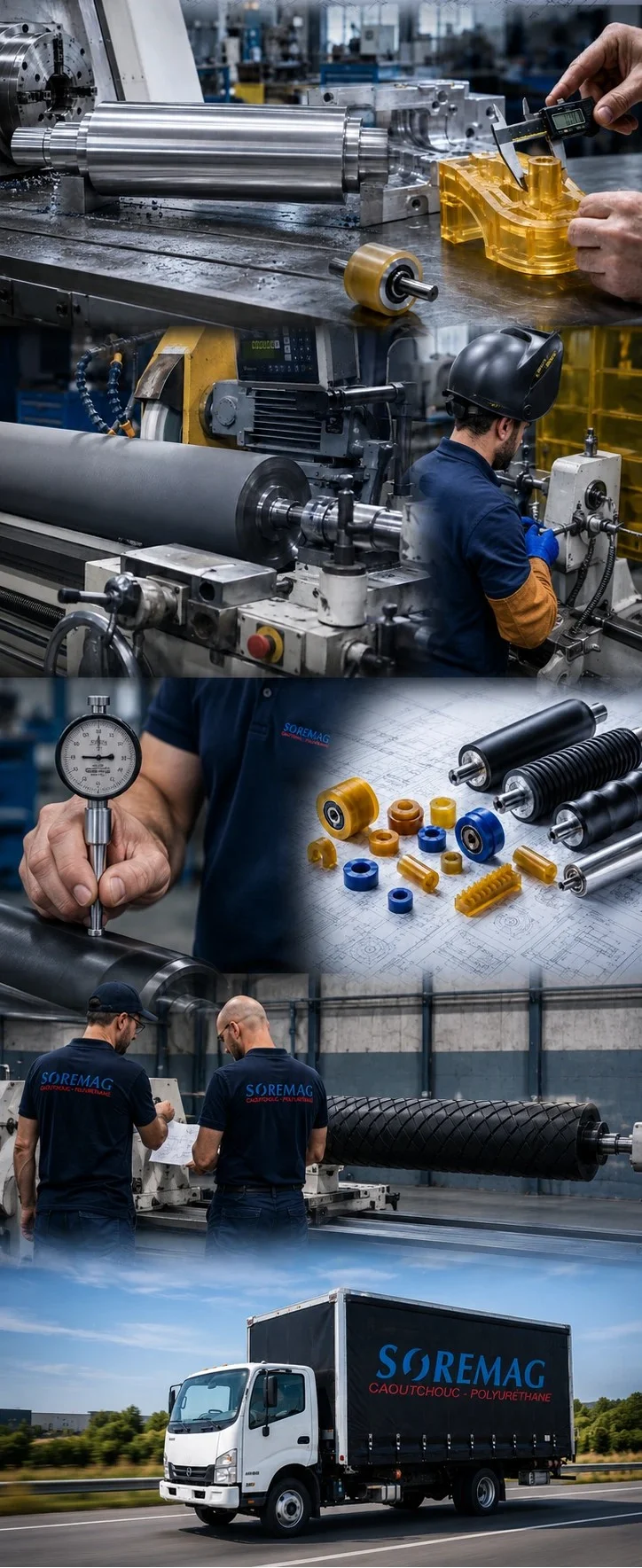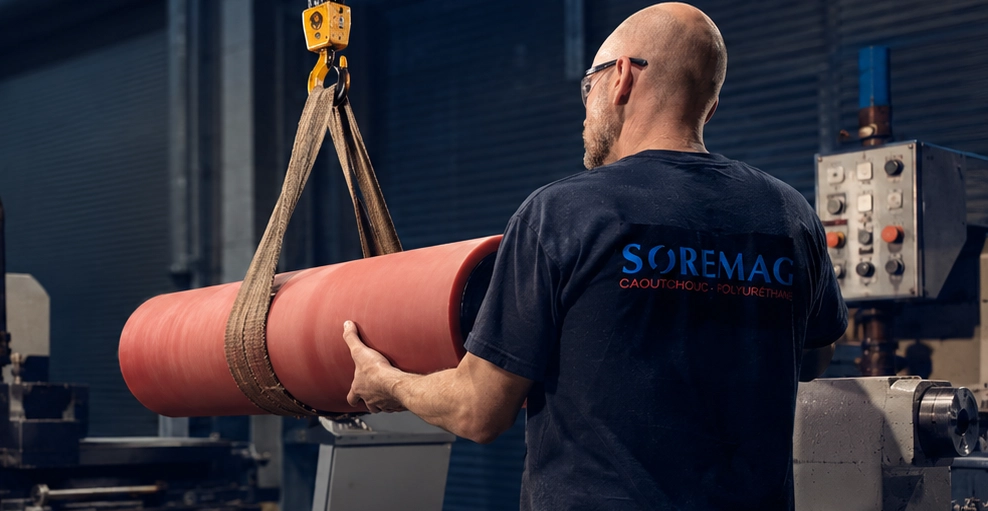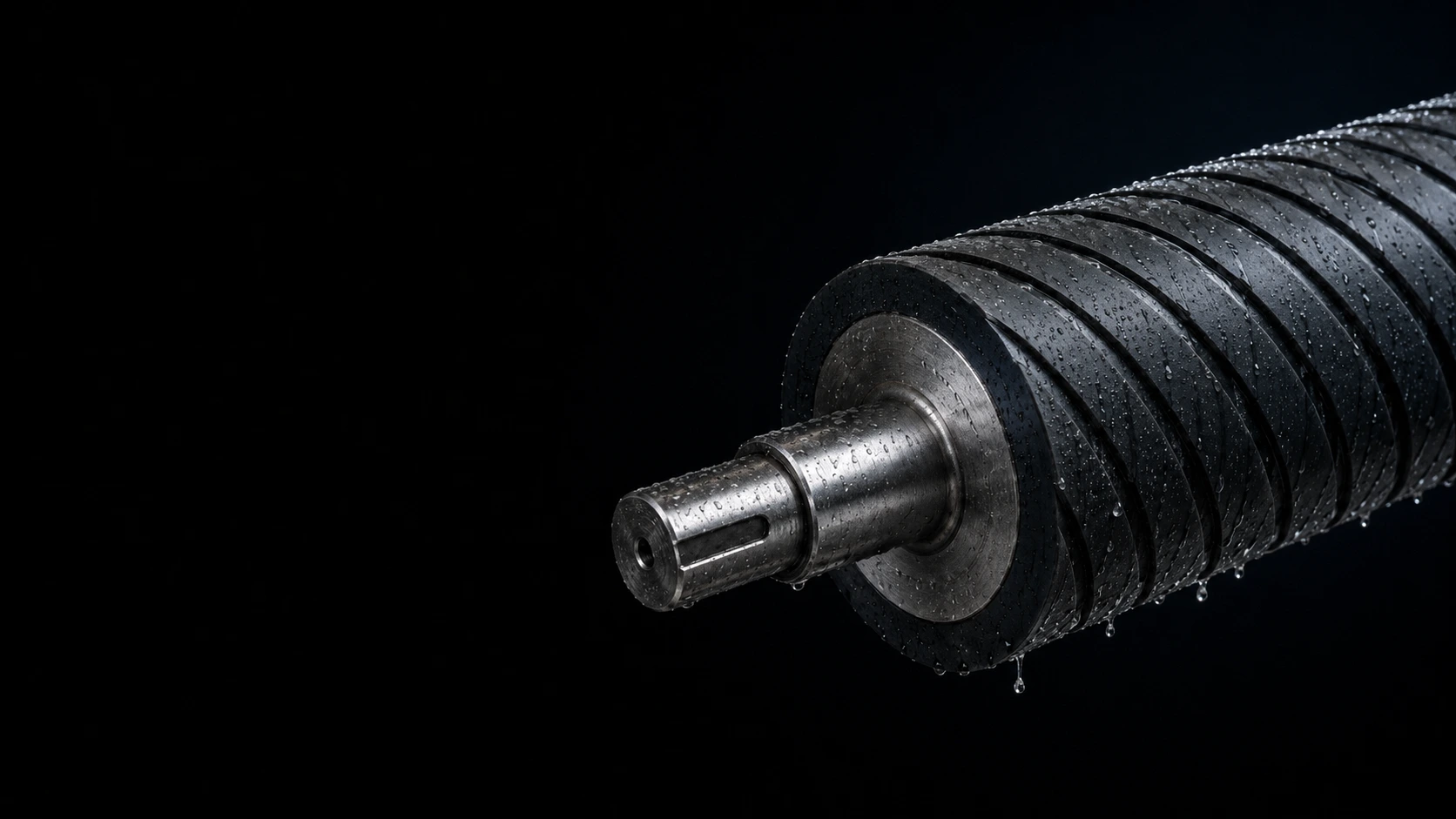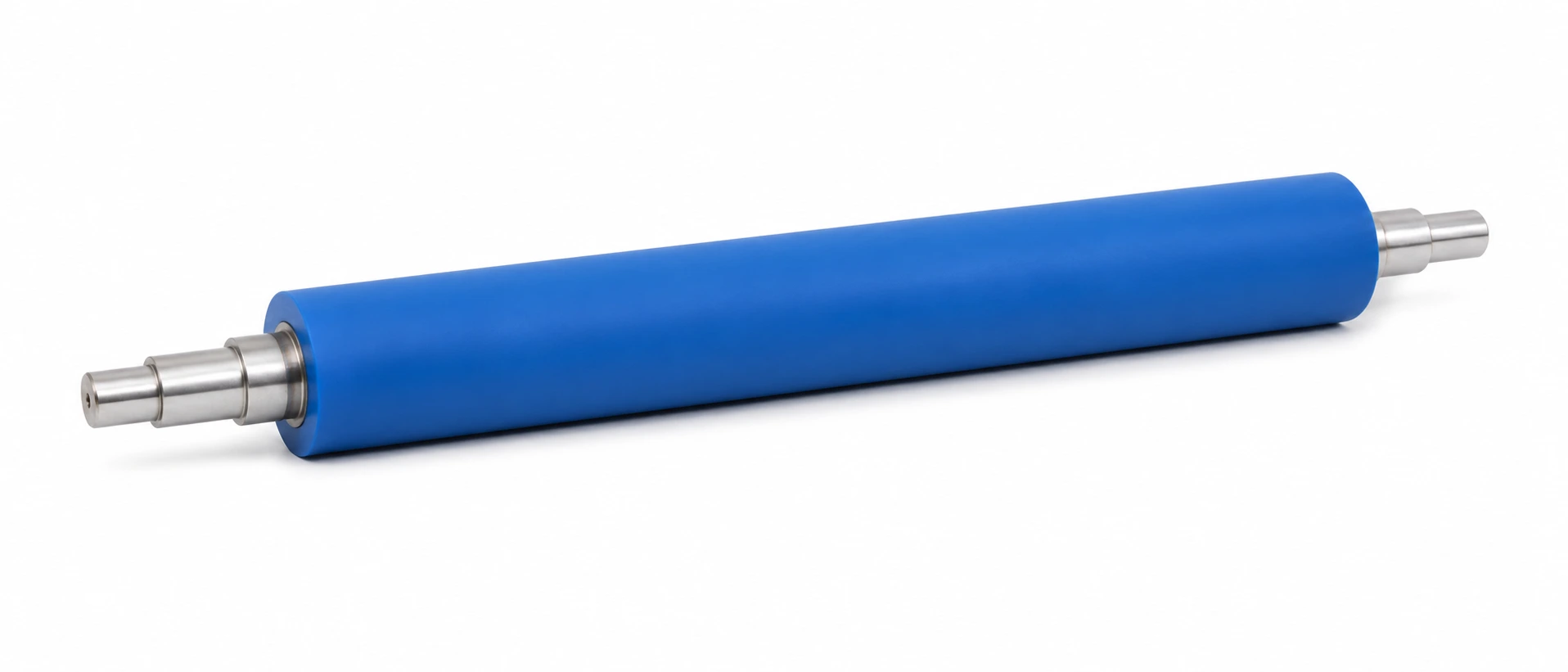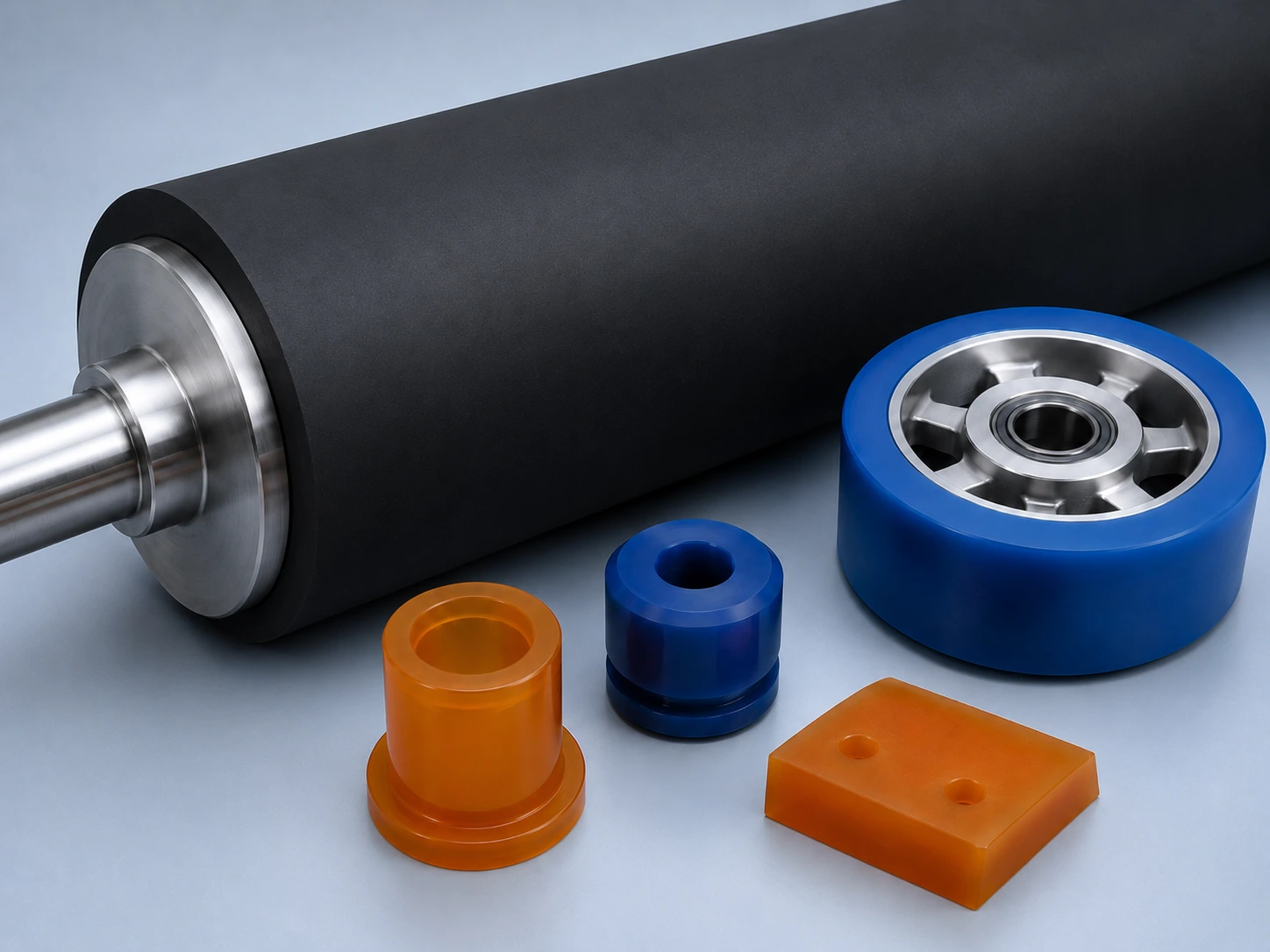
Wringer rolls, squeeze rolls, squeegee rolls, wash and rinse rolls: we cover, grind and groove the rollers that pull the water, the bath or the excess liquid out of your product — and that have to survive a wet environment.
A wringer roller works against two enemies at once: the liquid it has to drive out, and that same liquid attacking it. It's the only family of rollers where the product being processed is also what destroys the cover.
Hence two questions that decide everything, and that we ask every time.
Related expertise: roller covering, grooving, grinding and profiles, molded scrapers and blades, nip and pressure rollers and material selection.
That's the physical constraint you start from, and it changes how the problem is framed. When two wet surfaces separate, the liquid bridging them splits between the two. So a film always stays on the product — and squeezing harder doesn't remove it, it only shifts the trade-off.
Coming out of the nip, the liquid splits in two: some leaves with the roller, some stays on the product. The realistic target is never zero, it's a low residual level and above all one that's
If the water you drive out stays trapped in the contact zone or in the grooves, it goes back into the product right after the nip. The roller squeezed it out, then gave it all back. It's the most frustrating defect, because you can't see it on the roller.
On a wide, smooth face the water can't escape out the sides. Hydraulic pressure builds and the liquid is driven ahead of the nip in a wave instead of being expelled. You load it harder, and the wave gets bigger.
So the useful question isn't “how do I squeeze harder,” it's
A wringer roller needs void volume to take in the liquid and carry it out of the contact zone. Three ways to create it — and one rule that governs all three.
No void volume: the water you drive out has only the edges to escape through. That works on a short face or a lightly loaded product. On a wide face, hydraulic pressure drives it ahead of the nip.
Spiral, herringbone or axial grooves open a path for the water and take it out to the edges. It's the most common answer as soon as the face is wide or the speed is high.
Drilled holes increase the void volume available on every revolution. Very effective, on one absolute condition: that volume has to be
A void volume is only useful if it's
Which is why what happens over the rest of the revolution matters: doctor blade, rinse nozzle, gravity, compressed air. So we look at the roller
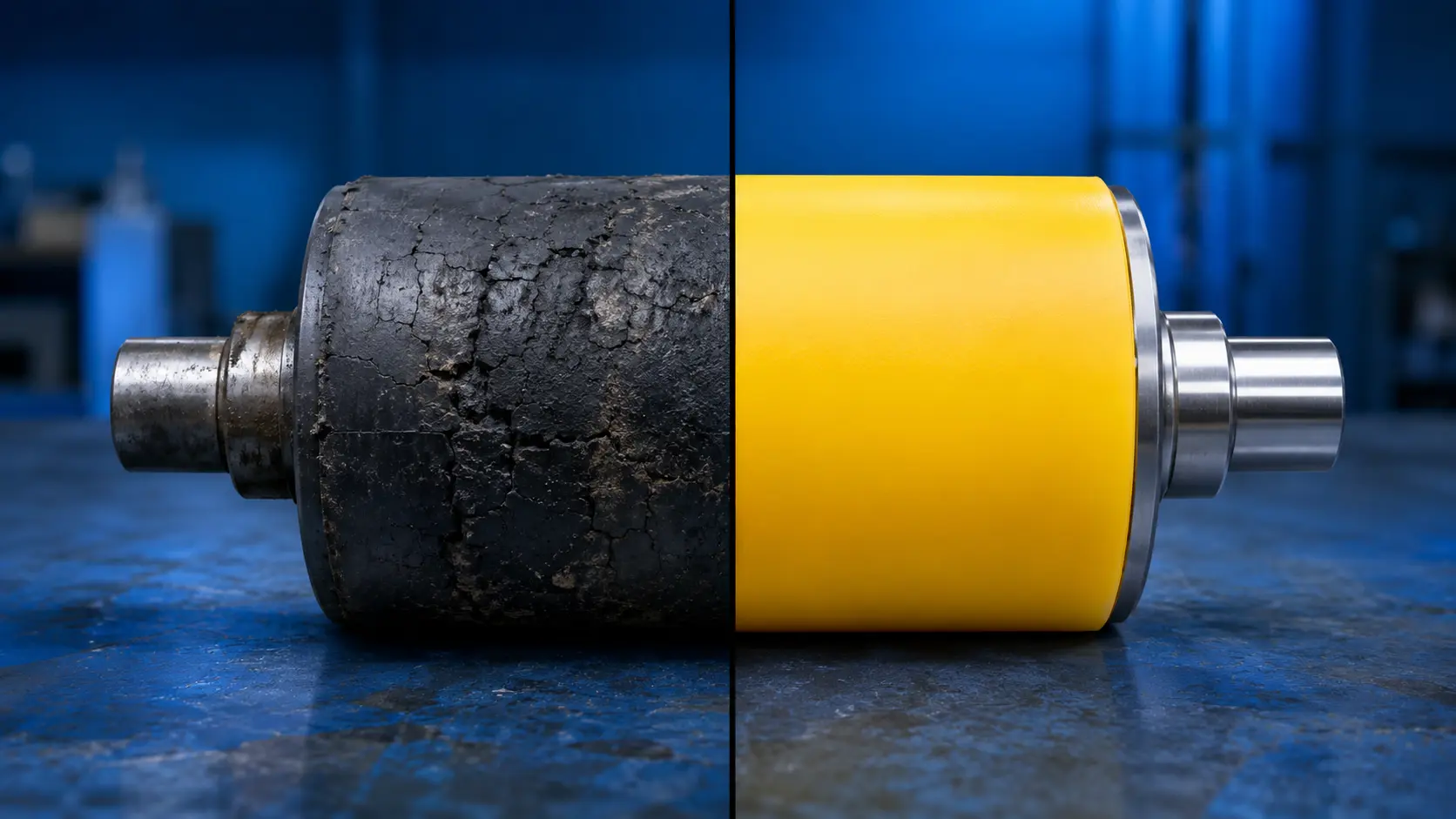
It's the choice with the heaviest consequences in this family, and the one many suppliers keep quiet about. Not all polyurethanes react to hot water the same way — the difference is in the polyol, not in the hardness.
| Critère | Polyuréthane polyester | Polyuréthane polyéther |
|---|---|---|
| Eau chaude, exposition prolongée | S'hydrolyse. La liaison ester se rompt, et l'acide libéré accélère la réaction — la dégradation s'auto-entretient. | Résiste nettement mieux, y compris en température. La liaison éther reste stable en milieu humide. |
| Vapeur, milieu saturé | À éviter sans validation. | Généralement le bon choix. |
| Abrasion et coupure | Souvent supérieur. | Bon, généralement en retrait sur ce point. |
| Capacité de charge | Excellente. | Bonne. |
| Oxydation | Moins sensible. | Un peu plus sensible — le revers de la médaille. |
| Verdict sur un rouleau d'essorage | Réservé aux milieux secs ou à l'eau froide et brève. | Le point de départ dès que l'eau est chaude ou permanente. |
We formulate with
The perfect counterexample to the reflex “it wears fast, let's make it harder”.
A coil steel processing line, up to thirteen pairs of wringer rollers after a caustic bath. The rollers lasted barely a few weeks and didn't wring properly — the steel came out streaked and lost value.
On inspection, the wear wasn't abrasion: they were
The transferable lesson:
Drive out the water, rinse, wipe, scrape — one and the same intent under names that change from one industry to the next.

The pair that presses the product to get the liquid out. Most often one covered roller against one hard roller, and it's the cover that does all the work.
The vocabulary of continuous lines and paper mills. Here the void volume and its draining often count for more than the load applied.
They wipe the surface film rather than press deep. The finish and the straightness of the contact edge decide the result.
In permanent contact with the wash bath. Chemical compatibility, not mechanics, sets their service life.
Between two baths, they have to keep one chemistry from carrying over into the next. Insufficient wringing contaminates the following bath.
They pick up an excess already laid down — water, oil, lubricant — without marking the product and without leaving streaks.
Metal lines: we take off the residual oil, or lay down a metered film of it. The compound has to handle oil without swelling.
Textiles: they set the wet pickup after impregnation. Here the wringing directly determines the color of the fabric.
Paper mills: pressing the sheet and the felts, hot and wet. Hydrolysis resistance and resistance to repeated compression head the list of requirements.
Pattern sized for the flow of liquid to be removed, not for traction. See the page on grooved rollers.
Drilled holes that increase the void volume. Keep them for setups where draining between two passes is assured.
Acids, alkalis, high temperatures. The most demanding case in the family, where the immersion test isn't optional.
Your position goes by another name? Send a photo and the bath data sheet. See also the other roller families.
We start again from your core, and we choose the chemistry for the bath, not for what's in stock.
| Intervention | Ce que ça règle sur un rouleau d'essorage |
|---|---|
| Choix du polyol — polyester, polyéther ou polycaprolactone | Résistance à l'hydrolyse adaptée à la température et à la durée d'exposition de votre bain. |
| Essai d'immersion sur échantillon | Validation avant de refaire la pièce : variation de masse, de volume, de dureté et état de surface dans votre liquide réel. |
| Recouvrement caoutchouc ou polyuréthane coulé | Composé et dureté retenus pour l'essorage voulu — sans oublier que le rouleau doit aussi pouvoir être entraîné. |
| Rainurage d'évacuation sur mesure | Motif, pas et profondeur dimensionnés pour le volume de liquide à sortir, pas copiés au hasard. |
| Rectification de précision | Diamètre, cylindricité et faux-rond : une ligne d'essorage continue exige une géométrie propre. |
| Soulagement des rives | Réduction de la surcharge aux extrémités, là où le recouvrement se fissure d'abord sur une ligne humide. |
| Réparation du mandrin, des portées et des tourillons | En milieu humide, le mandrin corrode et les portées souffrent — un recouvrement neuf sur une base attaquée ne dure pas. |
| Reverse engineering | Identification du composé existant et de sa dureté à partir du rouleau usé, sans documentation. |
| Contrôle et traçabilité | Relevés de dureté sur la face, diamètre, faux-rond, rugosité — consignés pour la pièce. |
Capabilities: from
Here compatibility with the bath comes before mechanical performance. A compound that swells, breaks down or hydrolyzes won't last, however good it looks on paper.
No family is good everywhere, and each one has fluids that destroy it. That's why we ask for the bath data sheet, its concentration, its temperature and your cleaning products — then we validate by test. See the material selection guide and the page on rubber rollers.
The mechanisms specific to wringing — the ones behind most of the rollers that come back too soon from a wet line.
There are two ways to increase wringing, and they work against each other. A cover that's
On many lines it's the second that wins — and that's counter-intuitive. Our steel case study documents exactly that case: the wringing improved by lowering the hardness.
The right trade-off depends on the viscosity of the liquid, the line speed and the load available. That's why we ask for all three.
In a polyester-based polyurethane, water attacks the
The signs in the shop: a surface that turns
The
A wringer roller spends its life being compressed and released, often under heavy load. Some compounds end up not returning fully to their shape: that's
The effective diameter then changes, the load redistributes, and the wringing turns uneven across the width with nothing looking damaged.
We limit it through the choice of compound and an appropriate cover thickness — no thicker than necessary, because a thick layer deflects and heats up more.
When the product is narrower than the face, the two rollers touch bare at the ends: the cover takes the full load with nothing in between. And the edge of the product — a metal sheet especially — works like a blade that cuts in the same place every time.
The result: cracks, chunking and debonding start at the edges. We answer with
Many wringer rollers have no motor and no chain: the product has to drive them by friction. If the grip isn't enough, the product slides over a roller that isn't turning and leaves a
The mark looks like wear, but the story it tells is one of a roller that stopped turning. We correct it with durometer, compound and finish — never by looking for a more abrasion-resistant material, which only makes the slipping worse.
The full mechanics are on the page for drive and pull rollers.
1. Condition survey: durometer at several points, diameter, runout, state of the pattern, and a look for signs of chemical attack.
2. Identification of the existing compound, and validation of the compound selected by immersion test in your bath.
3. Stripping of the old cover, inspection of the core — corrosion included — of the bearing journals and the shaft journals.
4. Mechanical repair as needed, surface preparation and bonding system.
5. Application of the new cover — vulcanization for rubber, hot cast for polyurethane.
6. Precision grinding to the target diameter and finish, then grooving or edge relief depending on the application.
7. Final inspection and traceability. Full detail in our roll covering process.
What we hear most often about a wet line, and what it usually means.
| Symptôme | Cause probable | Correction |
|---|---|---|
| Il reste de l'eau, malgré une charge élevée | Pas de volume vide, ou remouillage après le nip | Rainurage d'évacuation dimensionné; vérification de la vidange du motif au retour. |
| Une vague de liquide devant le nip | Pression hydraulique : l'eau ne peut pas s'échapper | Rainurage ou perçages; révision de la charge, qui aggrave le phénomène. |
| Essorage inégal sur la largeur | Déformation rémanente, usure inégale, déflexion | Rectification; profil revu — voir grinding and profiles. |
| Surface collante ou spongieuse, dureté chutée | Hydrolyse d'un polyuréthane polyester en eau chaude | Changement de polyol vers un polyéther, ou passage à un caoutchouc adapté. |
| Recouvrement gonflé | Incompatibilité chimique avec le bain ou le nettoyant | Essai d'immersion, changement de composé validé sur les deux liquides. |
| Méplats sur un rouleau non motorisé | Traction insuffisante pour le mettre en rotation | Baisse de dureté avec composé reformulé; révision du fini. |
| Fissures et éclats aux extrémités | Contact à vide hors produit et coupure par la rive | Soulagement des rives, composé plus résistant à l'entaille. |
| Rainures comblées ou arrondies | Usure du motif, dépôts, fluage sous charge | Reprise du rainurage; motif ou pas révisé si le comblement récidive. |
| Recouvrement décollé, mandrin corrodé | Liquide infiltré à l'interface | Retrait complet, remise en état du mandrin, nouvelle adhérisation. |
Every wear signature is covered in detail in the roller and wheel diagnostic guide.
Anywhere a product comes out of a bath wet and has to keep going dry.
Because a nip can't wring dry. When the two surfaces separate, the liquid splits: some leaves with the roller, some stays on the product. And if the water you drive out has nowhere to go, it can even
To give the water somewhere to go. In a smooth nip on a wide face, the water can't escape out the sides: the pressure builds and the liquid is driven ahead of the nip in a wave. Grooves or drilled holes create a
Not necessarily, and sometimes it's the opposite. Harder, the cover concentrates the pressure into a very narrow band: the local load goes up but the contact time drops. Softer, it conforms to the product over a wider, continuous wringing line, which drives the liquid out instead of stepping over it. One documented case shows the wringing improving on a move from 80 to 60 Shore A.
Normal wear takes diameter off evenly and the surface stays sound. Hydrolysis makes the surface
Two reasons stack up. When the product is narrower than the face, the rollers touch bare at the ends and the cover takes the full load there with nothing in between. And the edge of the product, metal especially, acts like a blade that cuts in the same place on every pass. We answer with
It depends on the concentration, the temperature and the exposure time. EPDM handles alkalis, steam and hot water well but not oils. Nitrile handles oils. CSM, formerly sold as Hypalon®, is the pick for more aggressive chemistries. A polyether polyurethane suits many aqueous environments. The only reliable answer is an
Look at traction before wear. Many wringer rollers aren't driven: the product has to turn them. Without enough grip, it slides over a roller that isn't turning and leaves a flat spot on every pass. The fix comes from durometer, compound and finish — not from a more abrasion-resistant material. See drive and pull rollers.
Send us the bath data sheet with its concentration and temperature, the line speed, the product width, the roller dimensions and its current durometer. We validate the chemistry by immersion test before we propose a compound — and we'll tell you straight if your environment calls for a rubber rather than a polyurethane.
➔ Request a quote