Covering & manufacturing · rubber and polyurethane · Quebec450 664-4000·1 800 361-5588·EN|FR
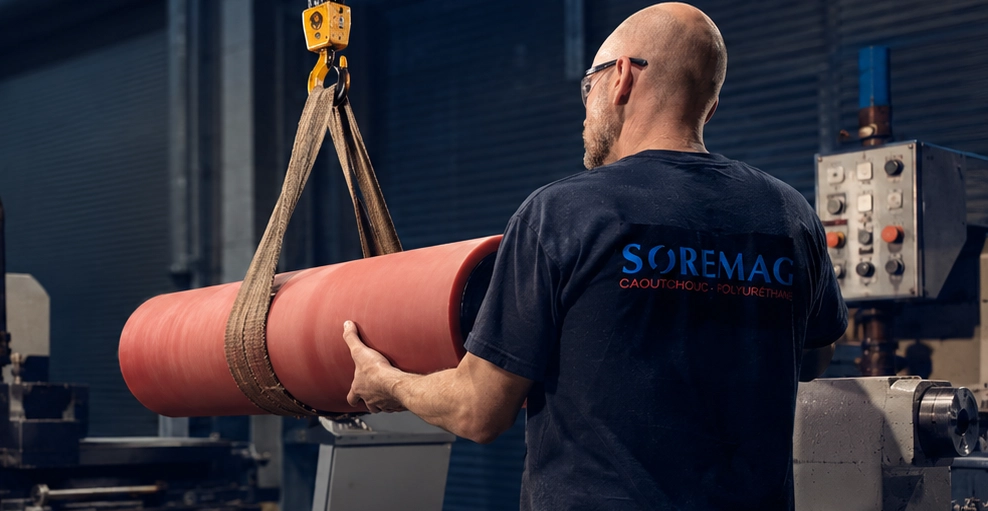
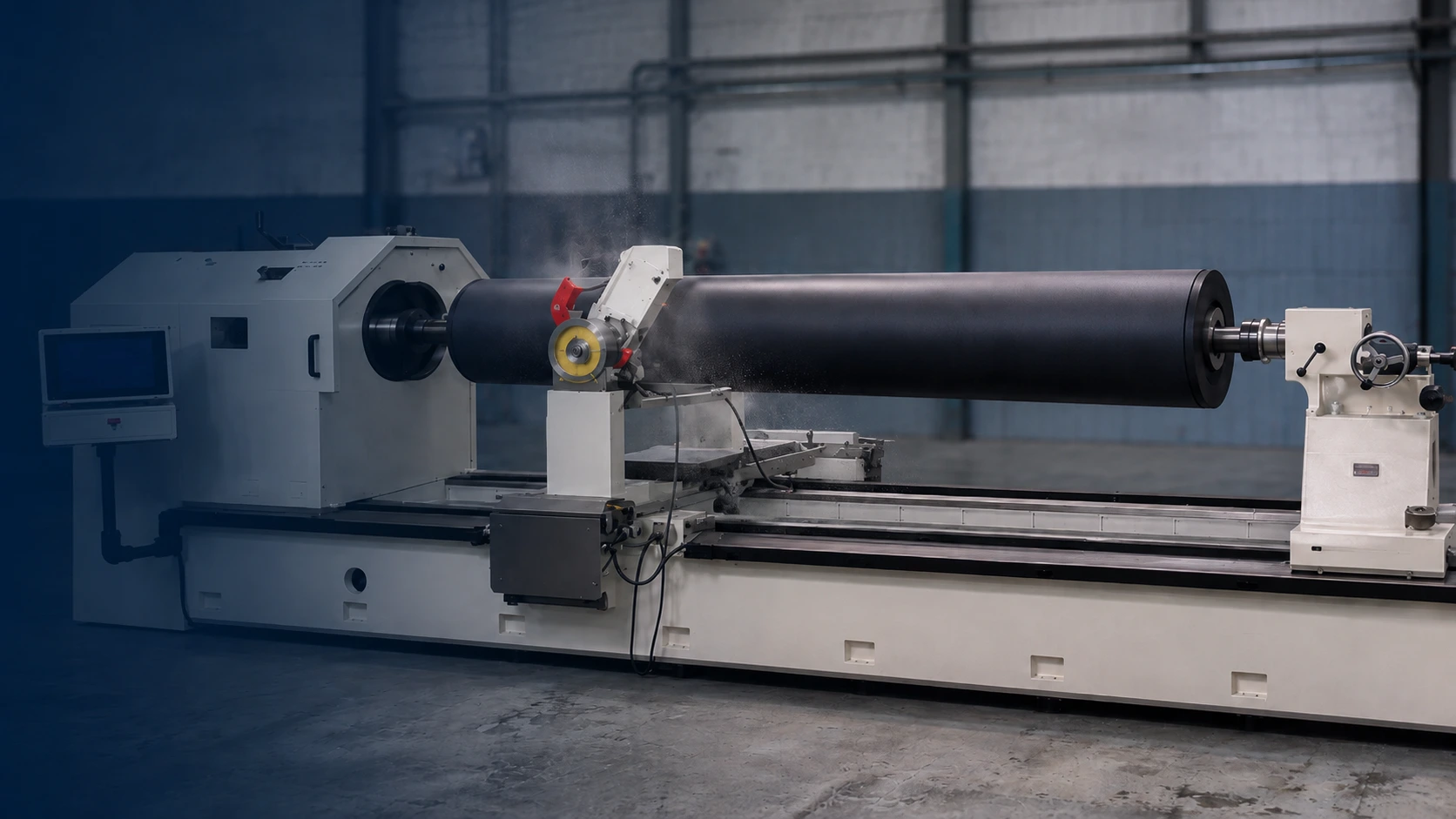
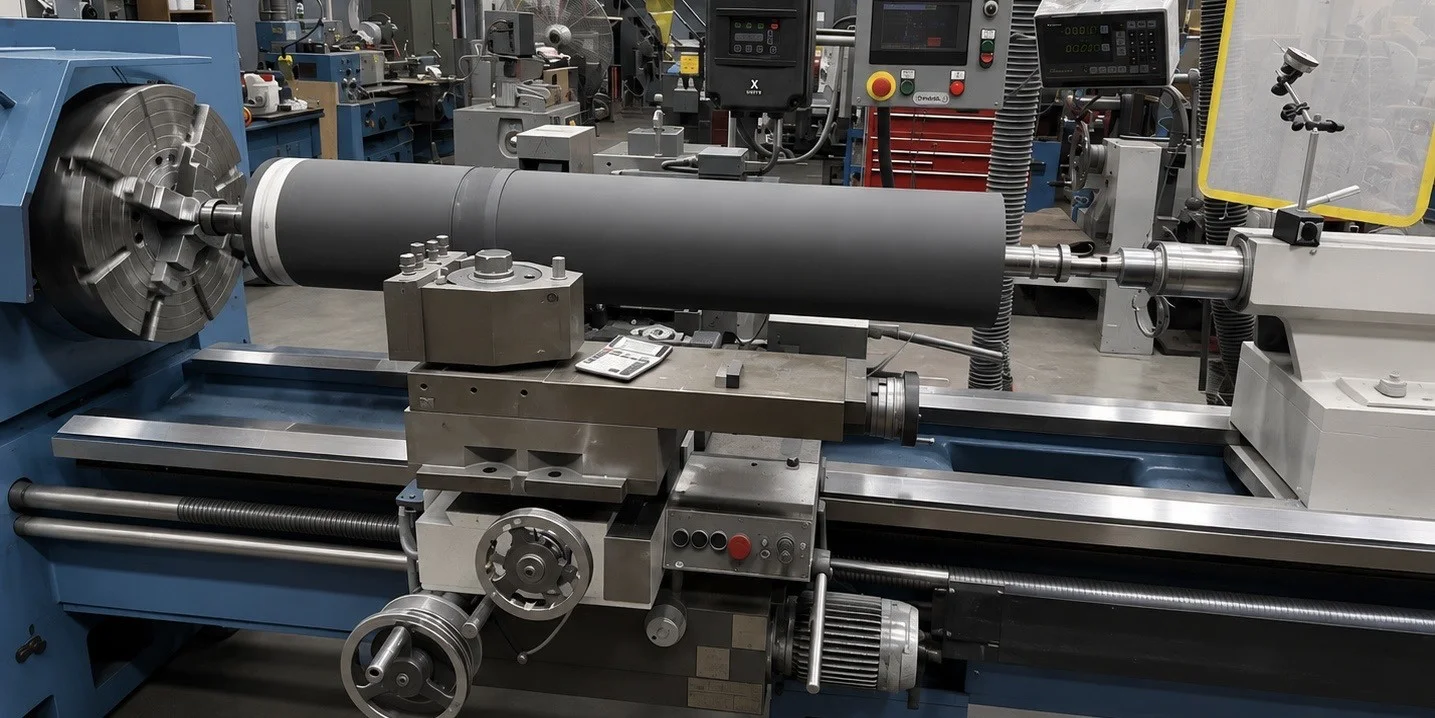
Meulage et rectification CNC d'un rouleau recouvert de caoutchouc sur rectifieuse — CNC rubber roller grinding
Services · Rectification & profilage

Precision grinding of rollers in rubber and polyurethane

Bring your rollers back to the right geometry and the right finish: straight, crowned, concave, tapered, relieved ends or a custom profile. We don’t just “grind a roller” — we restore its function in the machine. Machining capacity up to Ø 42 in. × 240 in., Ø 68 in. × 175 in. or Ø 76 in. × 36 in., with 10 metric tons (22,000 lb) of lifting. Need grooving? We have a page for that.

Grinding and profiling: restoring the roller’s function in the machine

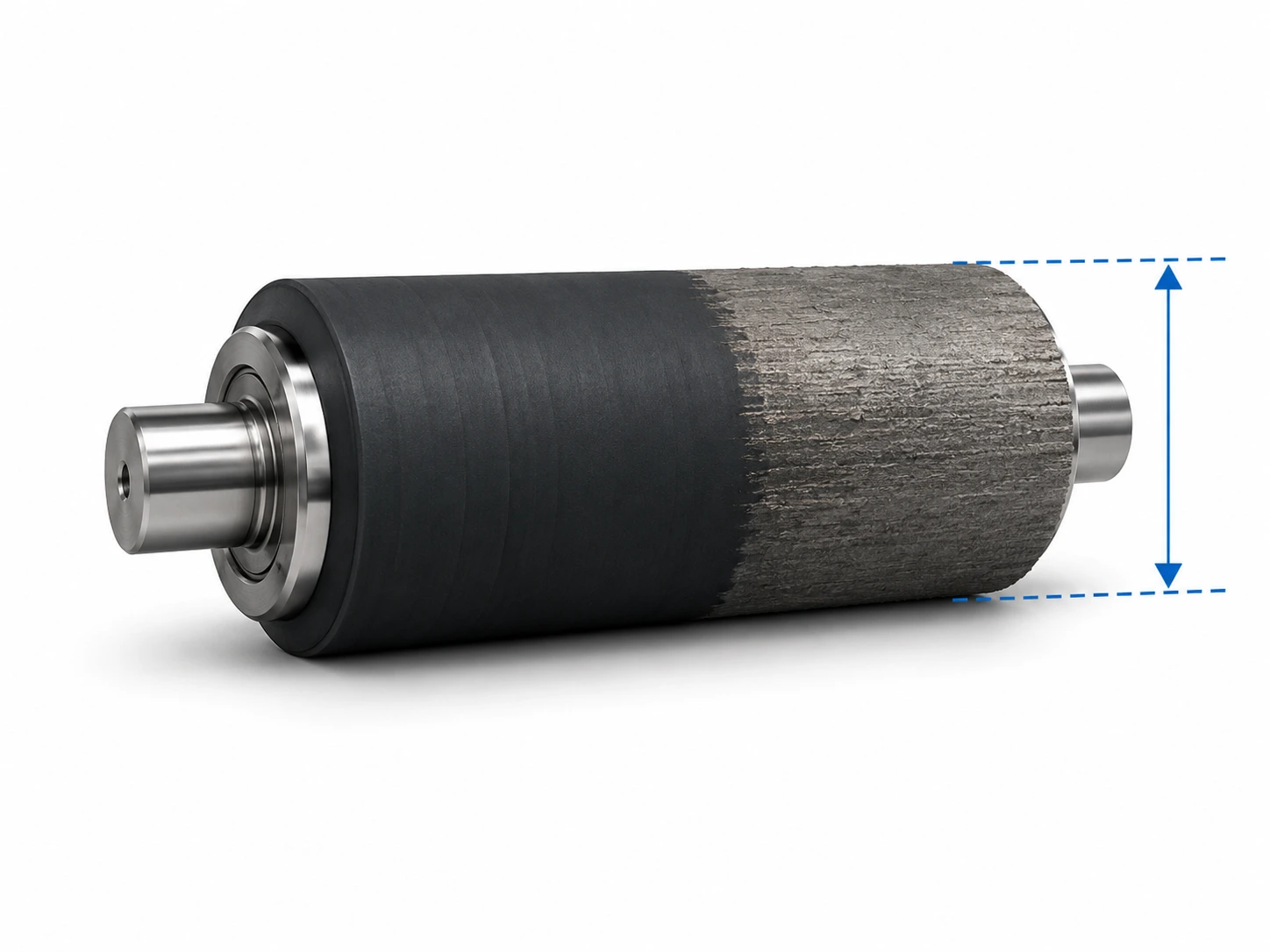
Grinding a roller means precision machining its cover to bring back the diameter, the roundness (runout/TIR), the profile (crown, concave, taper) and the surface finish (Ra).

A good grind does not just change how the roller looks: it restores

uniform pressure
, better
drive
, better
drainage
, less
vibration
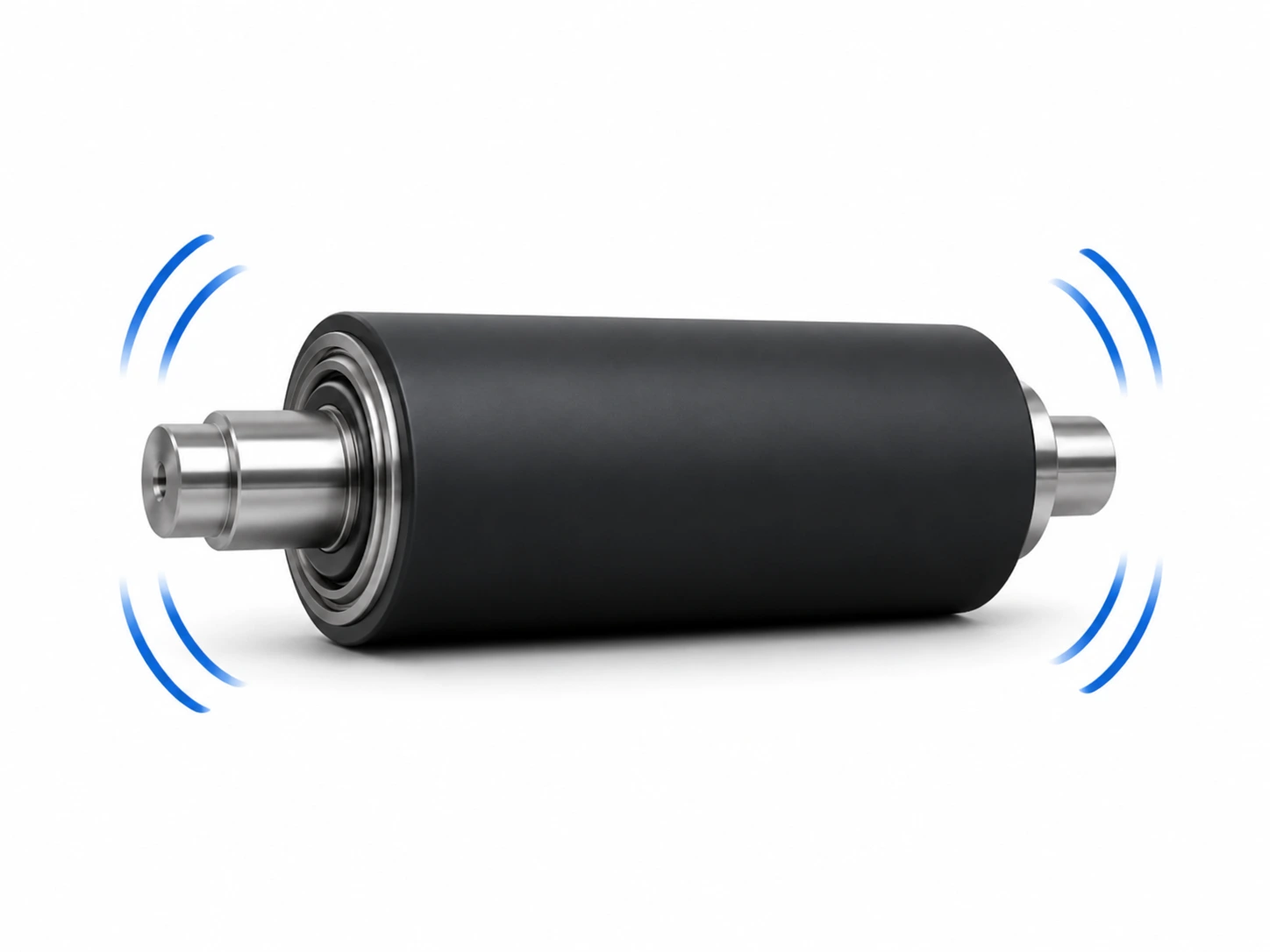
and steadier production. On new rollers as much as in refurbishment after covering, in rubber as in polyurethane.

Diameter profiles: crown, concave, taper

The diameter profile along the face corrects contact pressure and compensates for deflection — from straight to a calculated crown, by way of concave, taper and double tapers.

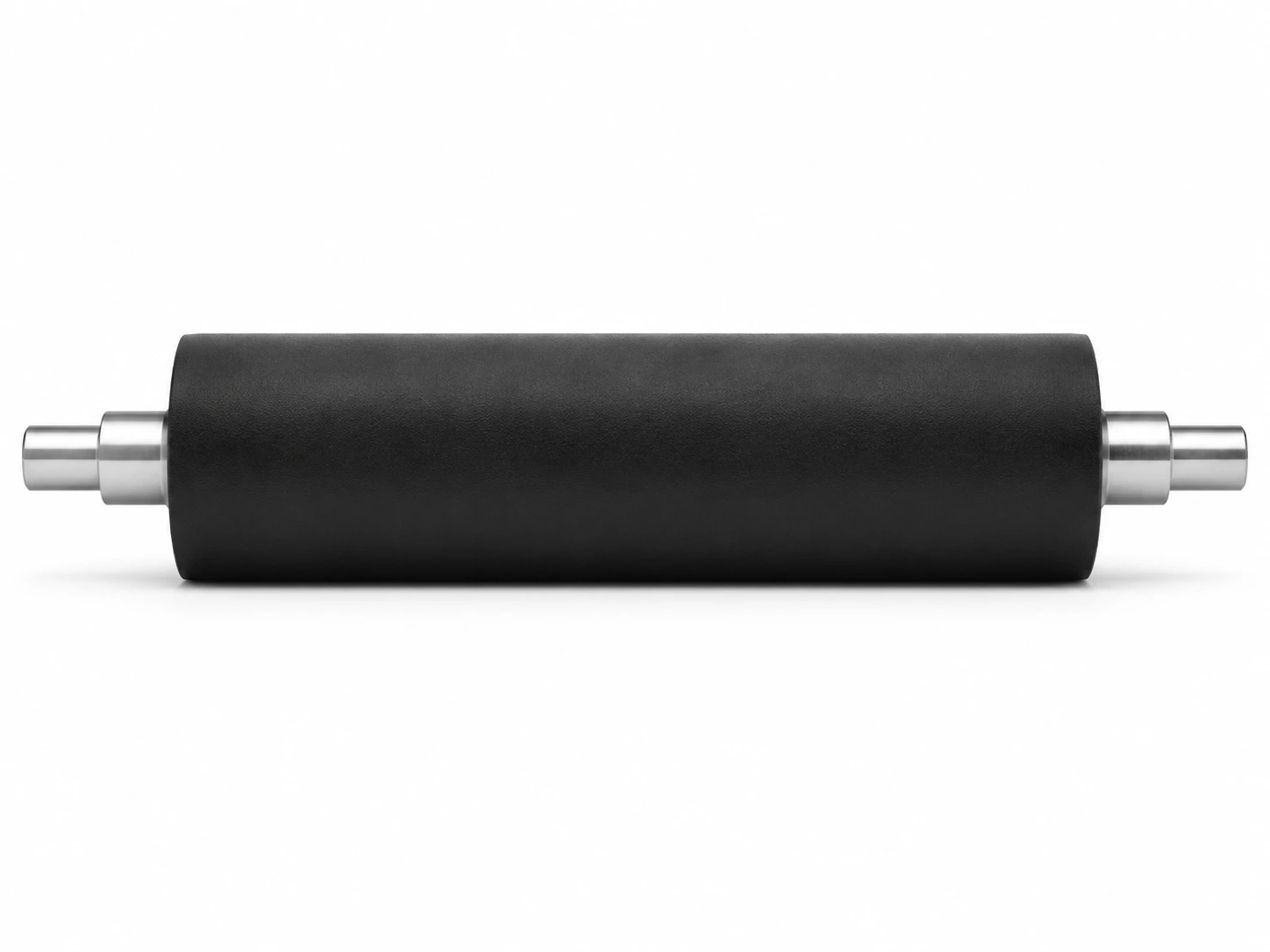
Rouleau industriel recouvert de caoutchouc à profil cylindrique droit — straight covered roller

Straight (cylindrical)

Constant diameter across the whole face, ground to a tight tolerance — the baseline.

Rouleau recouvert à profil bombé circulaire (radial crown) — radius crowned roller — Soremag, Laval (Québec)

Circular / radial crown (crown)

Crown on a constant radius (circular arc): larger diameter at the center to compensate for deflection under load and even out the pressure at the nip.

Rouleau recouvert à bombé parabolique/cosinus (parabolic/cosine crown) — CNC calculated crown roller

Parabolic / cosine crown

Crown on a A calculated curve (parabola or cosine) rather than an arc: it follows the real deflected shape of the loaded roller closely, for pressure that is genuinely uniform.

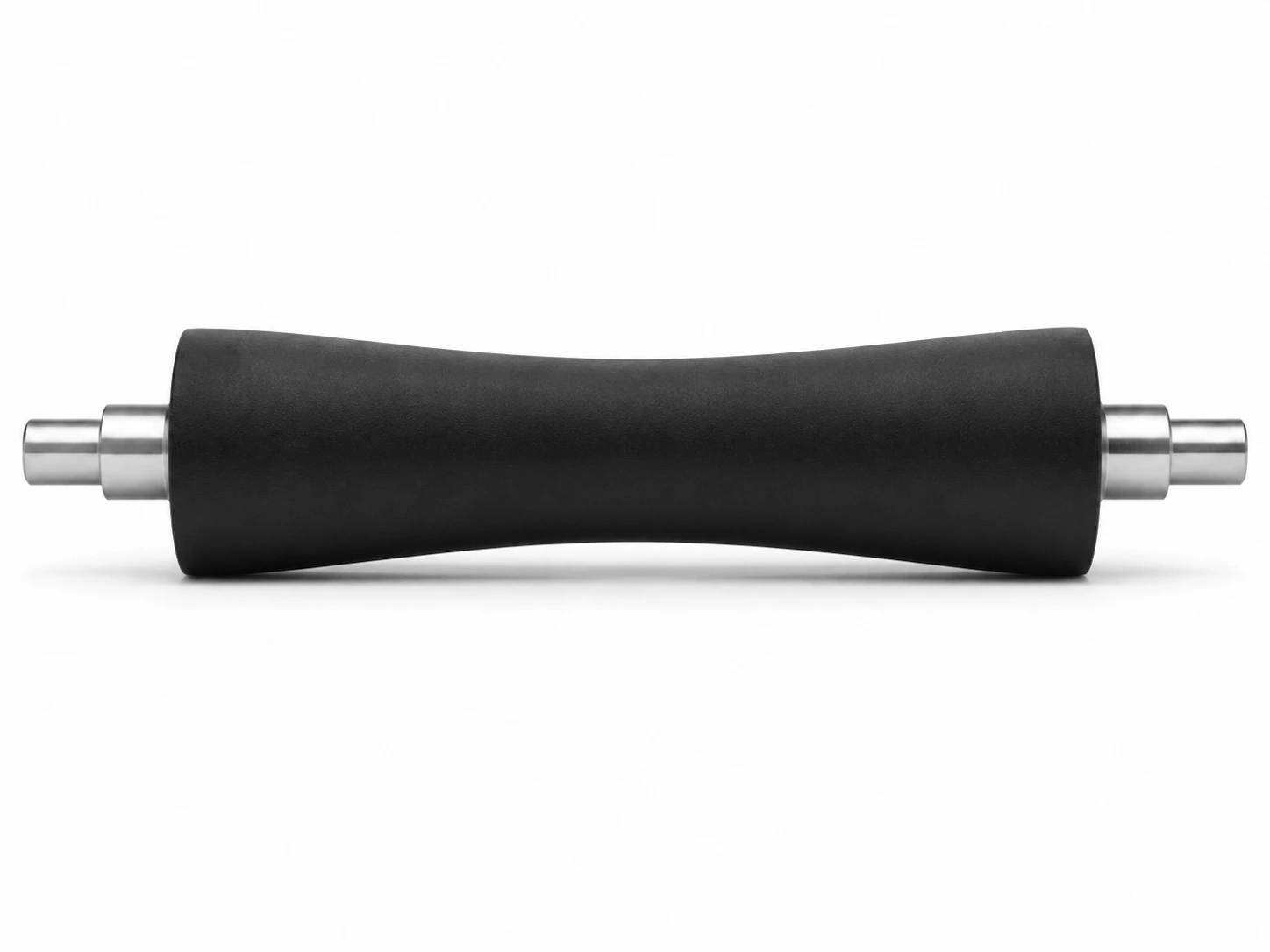
Rouleau recouvert à profil concave (reverse taper) — concave roller — Soremag, Laval (Québec)

Concave (reverse taper)

Smaller at the center: helps with guiding / centering of the web, and works for spreader rollers.

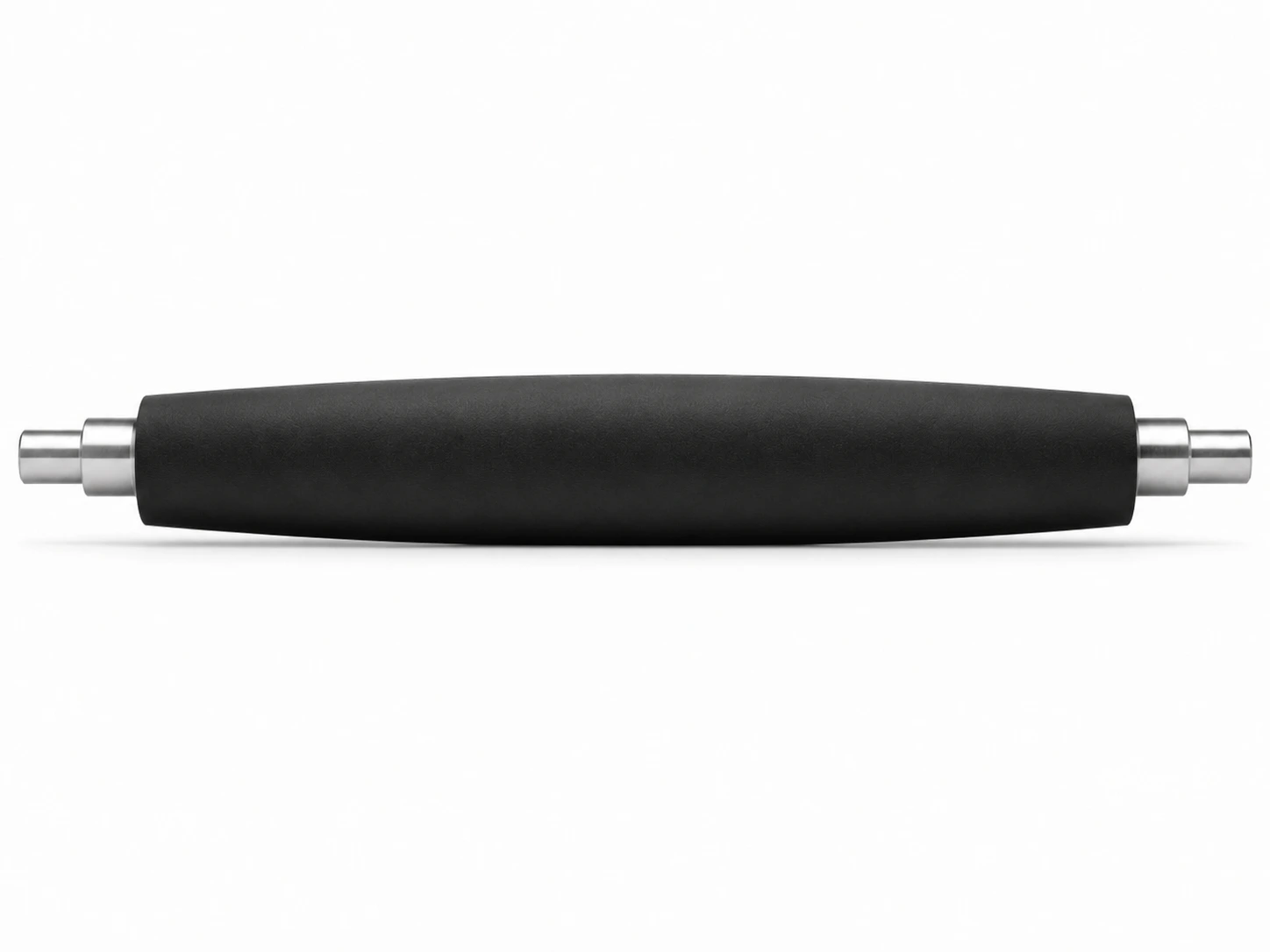
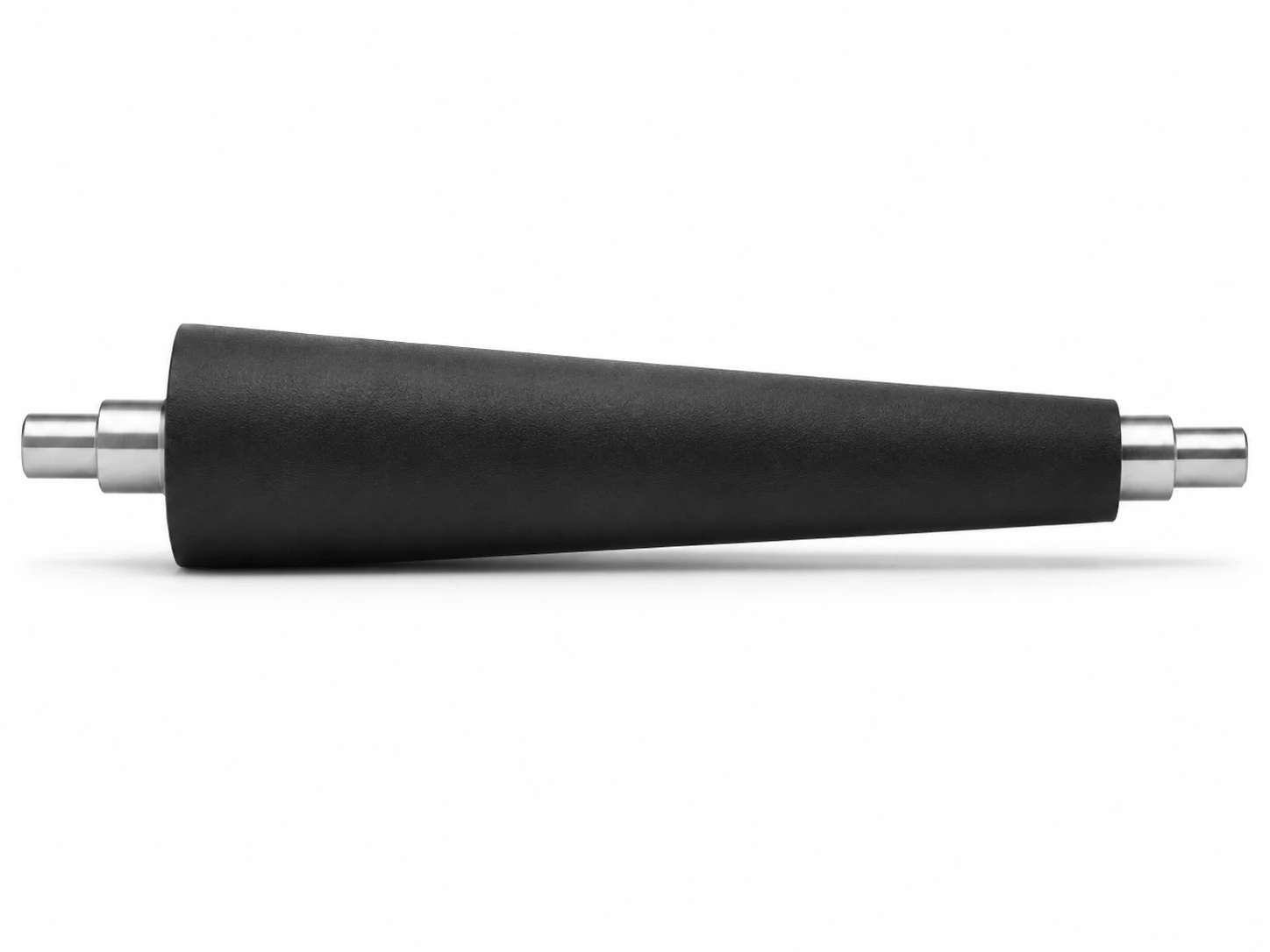
Rouleau recouvert à profil conique (taper) — tapered roller — Soremag, Laval (Québec)

Tapered (taper)

Steady change in diameter from one end to the other, for tension or an exact geometry.

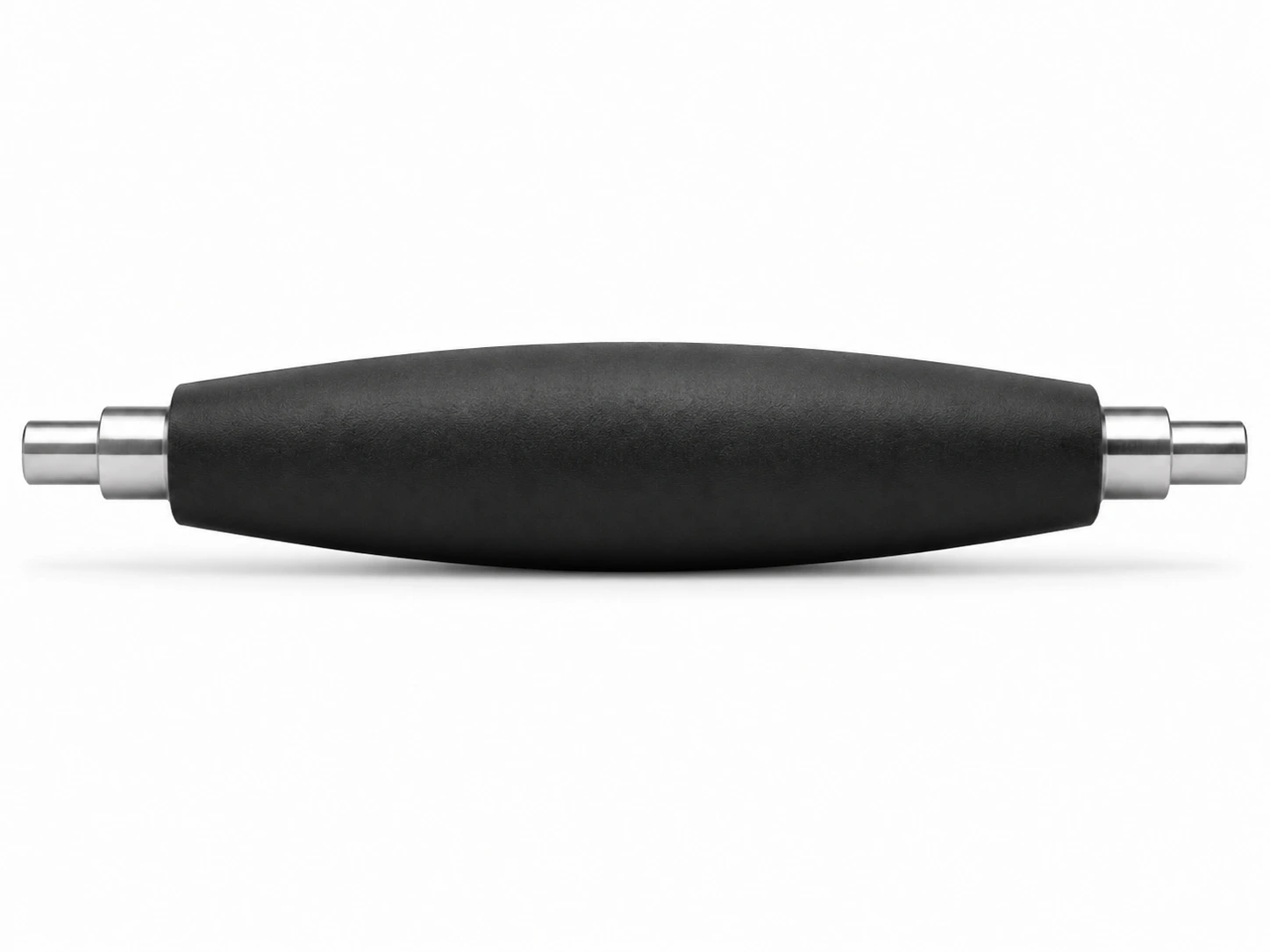
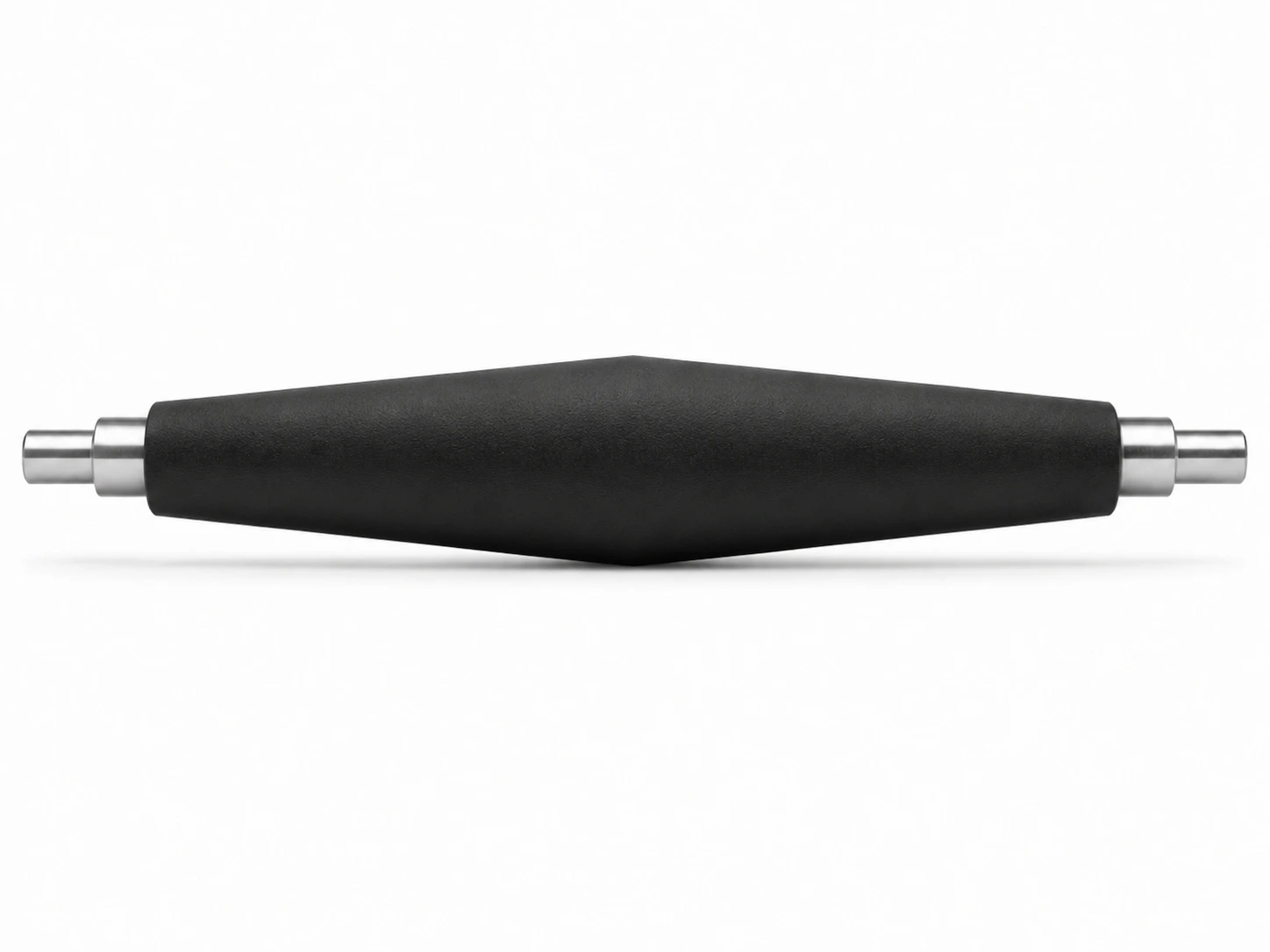
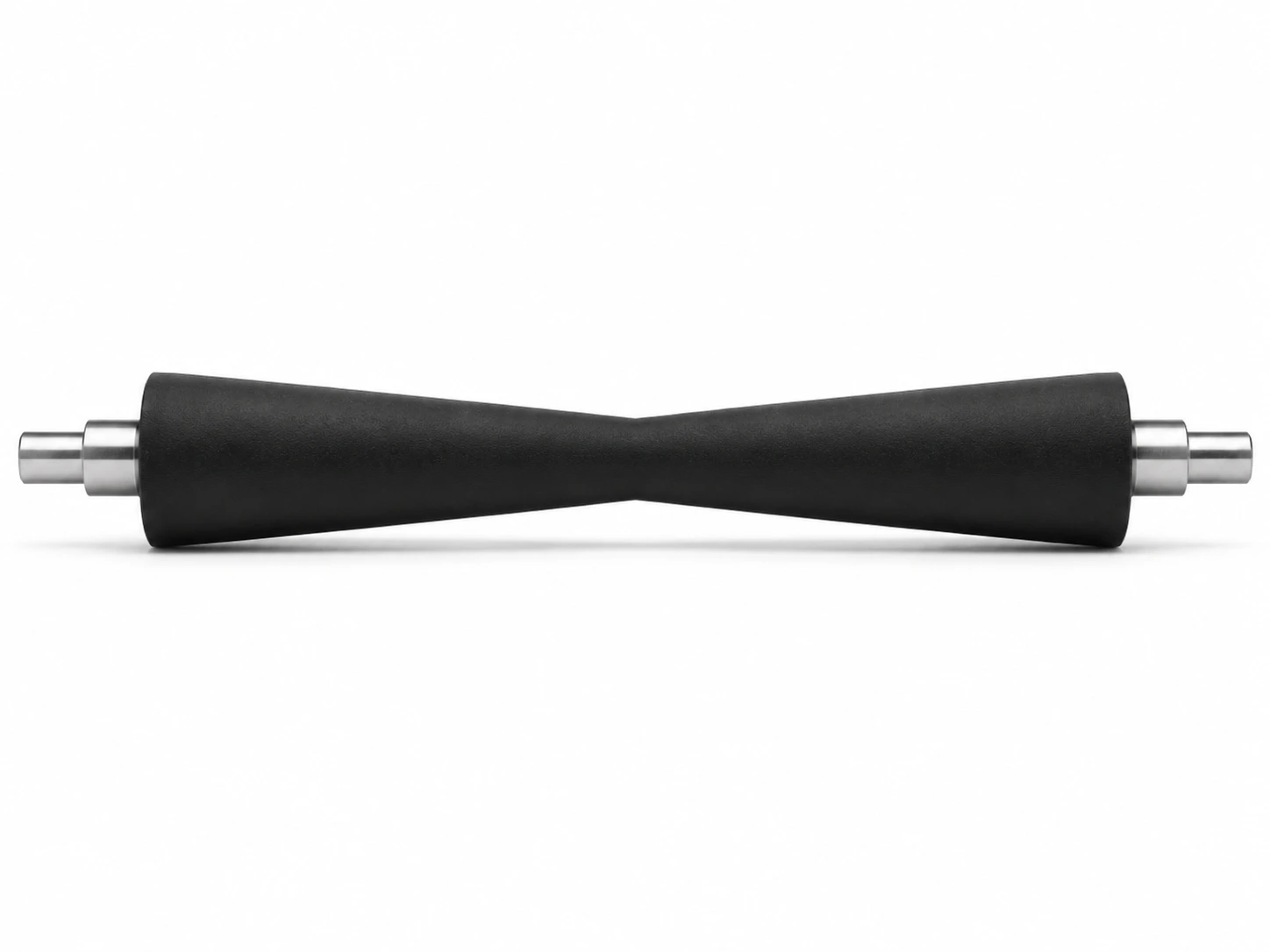
Rouleau recouvert à double conique (double tapered), bicône avec diamètre maximal au centre — Soremag, Laval (Québec)

Double taper (double tapered)

Largest diameter at the center, falling off toward both ends (twin cone).

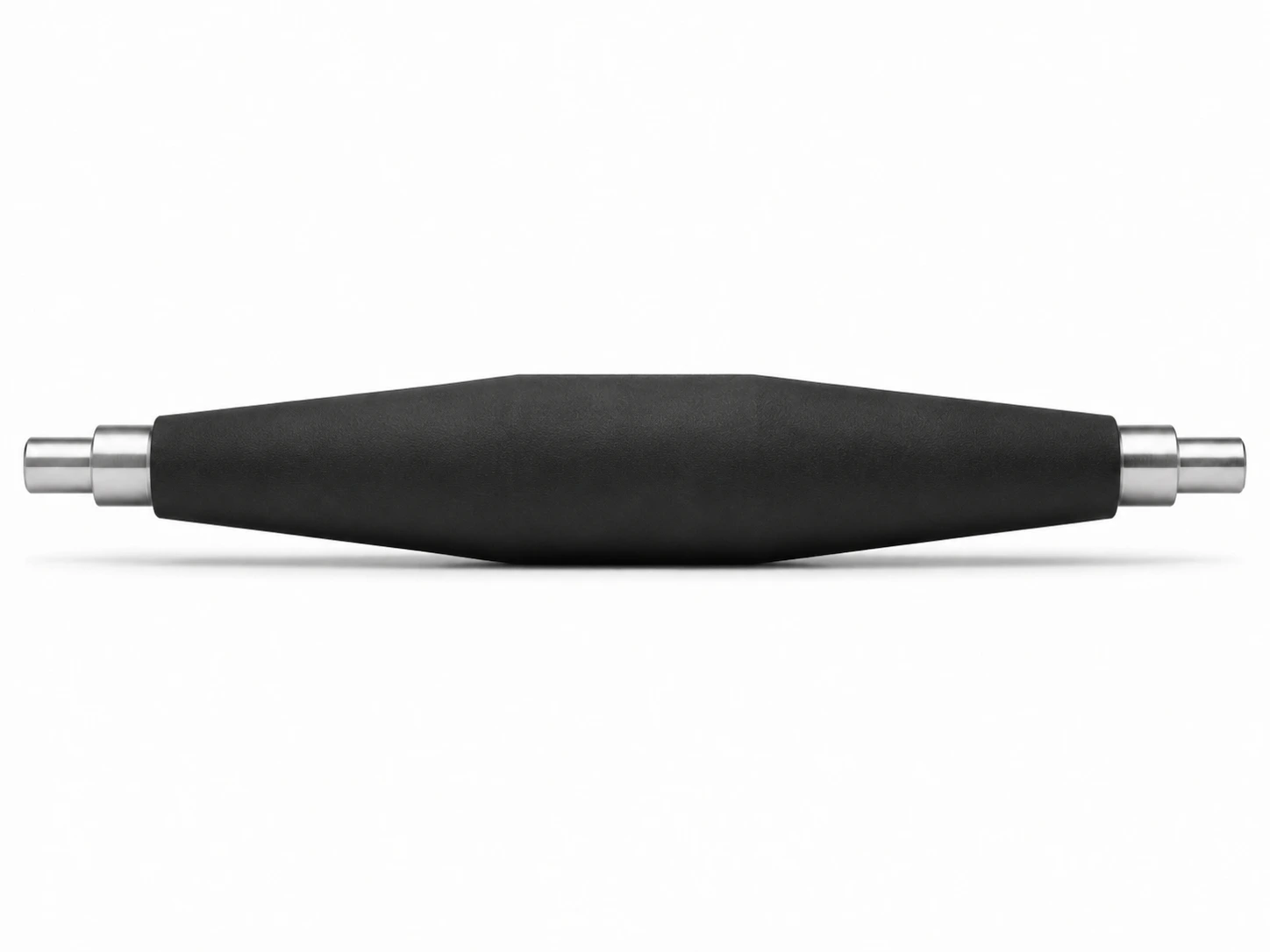
Rouleau recouvert à double conique à centre plat (double tapered with flat) — Soremag, Laval (Québec)

Double taper with flat center (double tapered w/ flat)

Cylindrical section at the center, even tapers toward both ends.

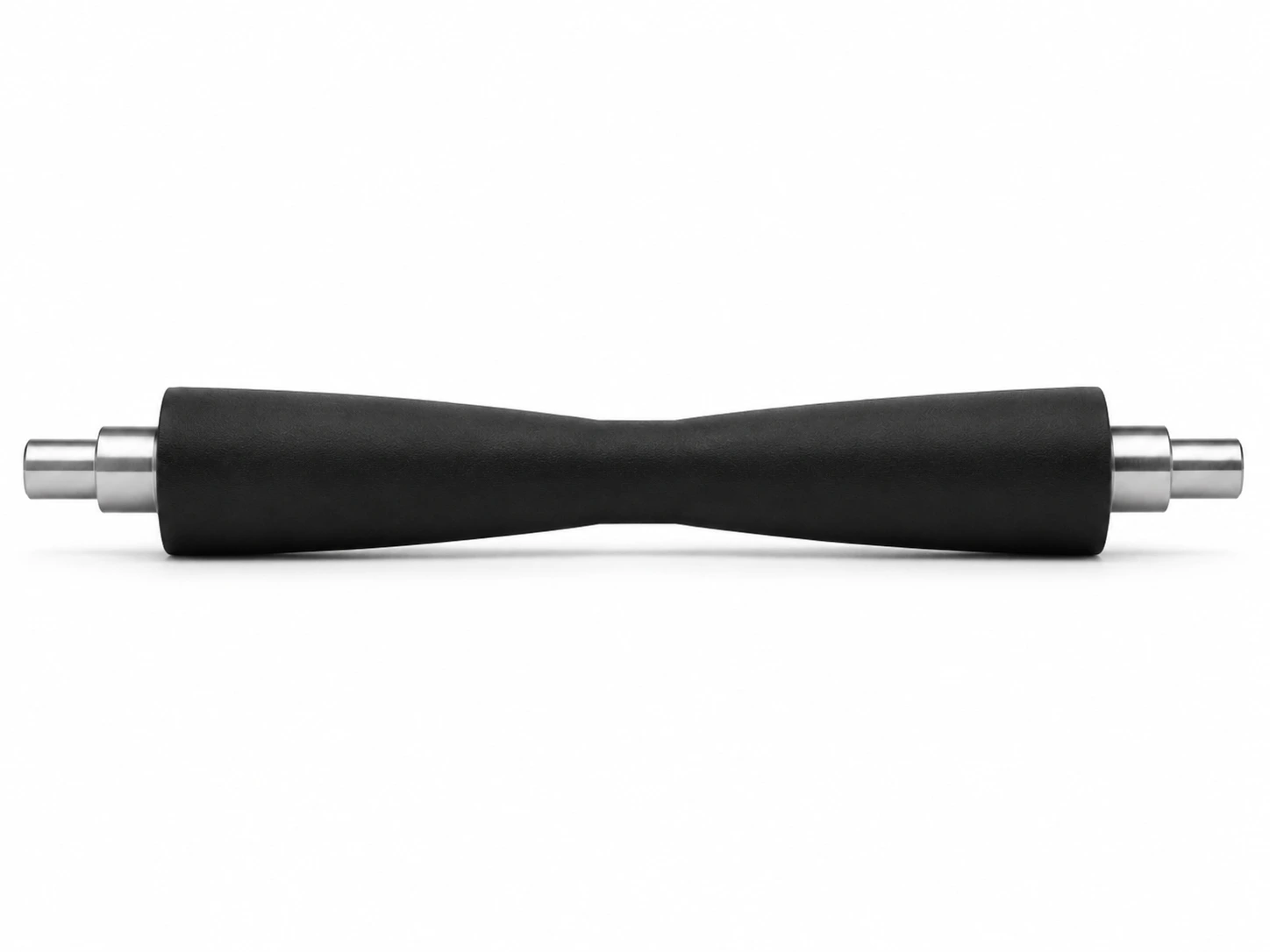
Rouleau recouvert à double conique intérieur (concave double taper), diamètre minimal au centre — Soremag, Laval (Québec)

Inverted double taper (concave double taper)

Smallest diameter at the center, rising toward both ends (straight flanks) — guiding / spreading of the web.

Rouleau recouvert à double conique intérieur à centre plat (concave double taper with flat) — Soremag, Laval (Québec)

Inverted double taper with flat center (concave double taper w/ flat)

Two inverted cones with a flat section at the center — smallest diameter, constant through the middle.

Two real cases where the profile settled everything:
on a padder nip roller in textile dyeing, a parabolic crown calculated for the working load corrected the pressure dropping off in the center of the fabric; on a plastic film line running several widths, a revised crown spread out the wear concentrated at the edge positions.

Engineering note

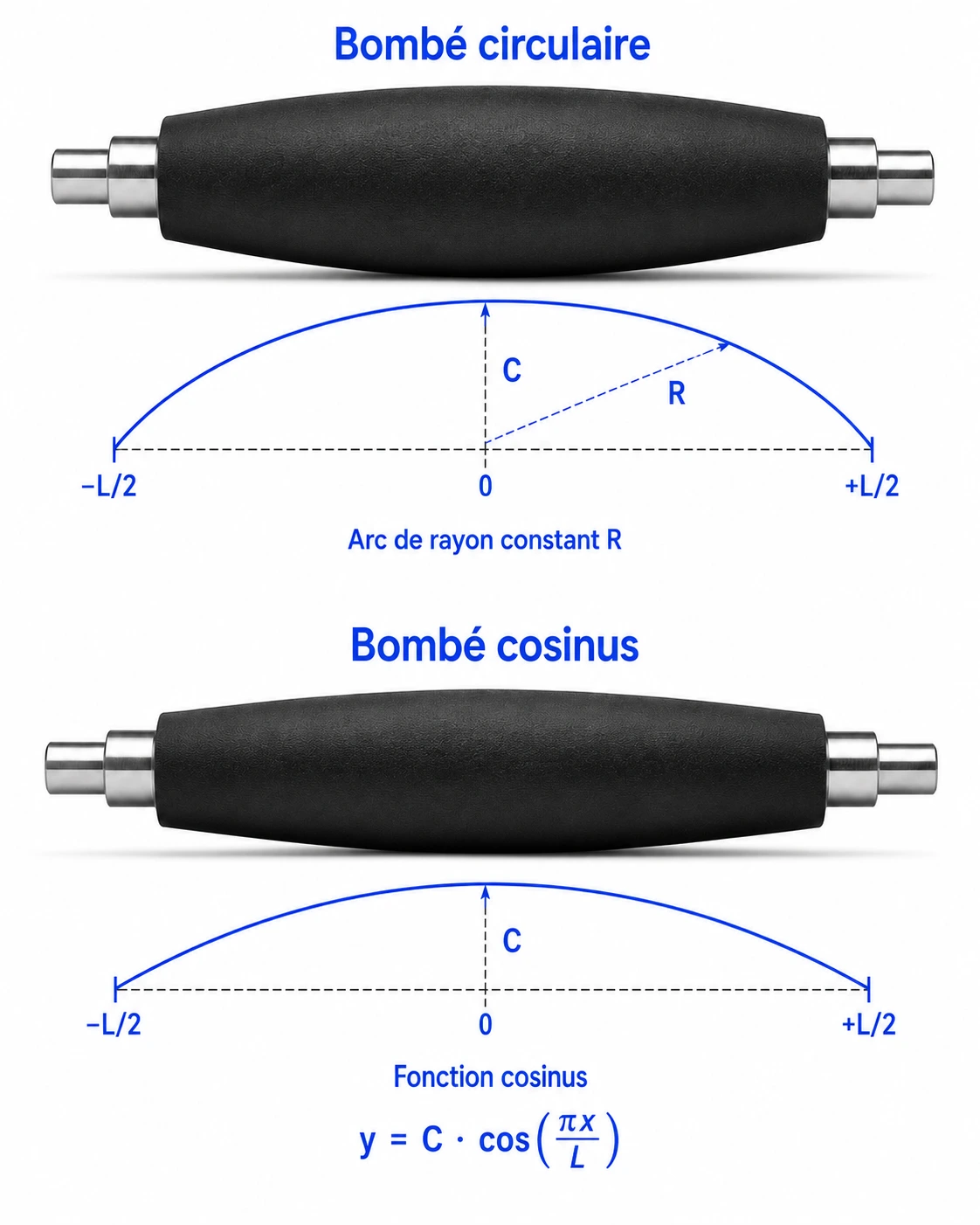
Circular crown: arc of constant radius R
y = R − √(R² − x²)
Geometry based on a radius (arc of constant radius)
Cosine crown: cosine function
y = C · cos(πx / L)
At x = 0, y = C (maximum); at x = ±L/2, y = 0

The math is not the same: the circular crown follows a constant radius, while the cosine crown follows a cosine function.

The circular crown follows an arc of constant radius: simple and proven, it compensates for deflection approximately.

The cosine crown follows a mathematically calculated profile: the crown is greatest at the center and returns to zero at the ends. It spreads the pressure more evenly across the whole face.

Our servo-driven CNC lathes and our conventional lathes fitted with CNC grinding heads reproduce either profile exactly, working from the deflection under load or from the nip impression.

C = bombé maximal au centre
L = longueur de la face
x = distance depuis le centre
R = rayon de l'arc circulaire
Bombé circulaire (arc de rayon constant R) et bombé cosinus (y = C·cos(πx/L)) sur rouleaux recouverts de caoutchouc
Notre atelier

Finishing know-how, backed by machines that can keep up

Finishing an elastomer roller takes precision, experience and control of temperature. The wrong speed, a badly dressed wheel or too much heat will burn the surface, leave waviness or ruin it.

An experienced team

Our grinding operators have close to a century of combined experience in roller finishing. Every part is worked according to its function, its speed, its load, its hardness and the process it runs in — not to a single recipe.

Final dimensions are checked after thermal stabilization, so the geometry holds up in service: a warm roller can look in spec on the grinder, then move slightly once it is back at room temperature.

42 in. × 240 in.
CNC grinding and grooving — diameter × length
68 in. × 175 in.
conventional grinding — diameter × length
Des équipements conçus pour la précision. Nos machines dédiées aux élastomères corrigent les conicités, génèrent des profils paraboliques complexes et rectifient avec précision les recouvrements en caoutchouc et en polyuréthane. Le contrôle thermique et le meulage cryogénique assurent une géométrie stable, même pour les matériaux les plus sensibles à la chaleur.
Une technologie de finition avancée, pour des rouleaux précis, stables et prêts à performer.

Why grind or reprofile a roller?

Do these symptoms sound familiar? Usually the geometry or the finish has drifted.

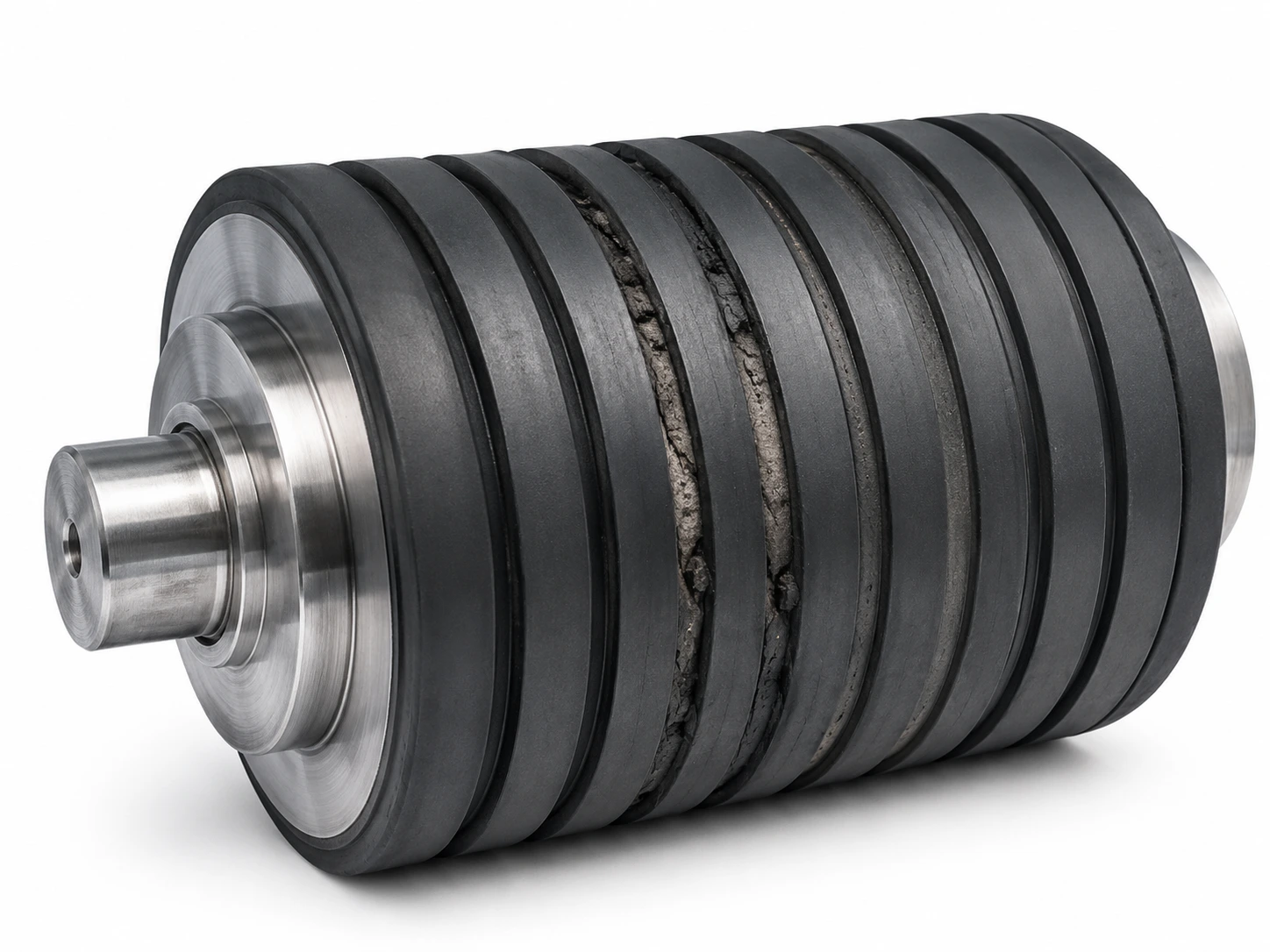
Usure inégale du recouvrement d'un rouleau (uneven cover wear) — SoremagUneven cover wear
Rouleau devenu ovale ou conique (out-of-round / tapered roller) — SoremagRoller gone out-of-round or tapered
Rouleau qui vibre à haute vitesse (high-speed vibration) — SoremagVibration at high speed
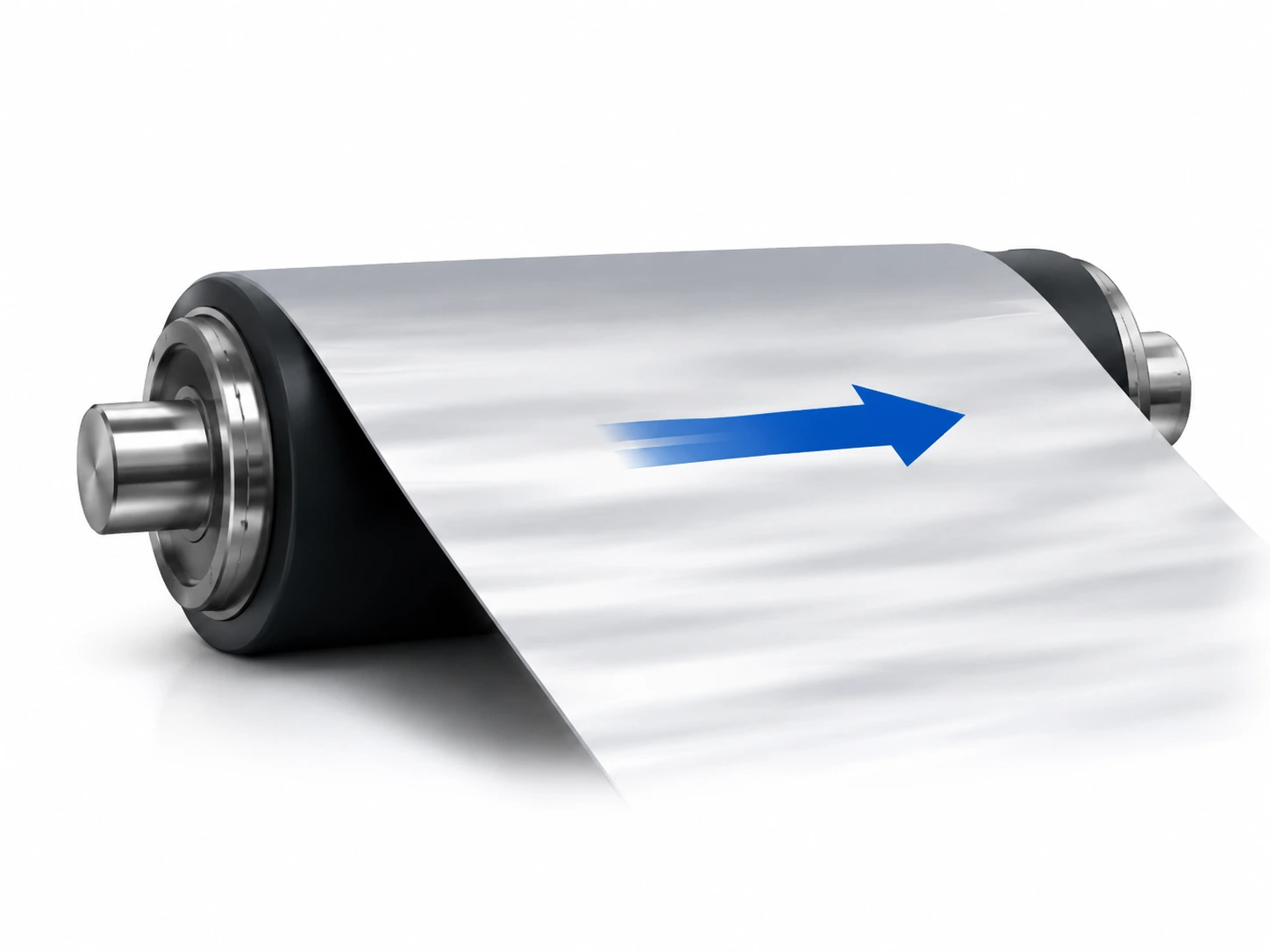
Le matériel glisse ou se déplace sur le rouleau (web slipping / drifting) — SoremagThe material slips or drifts
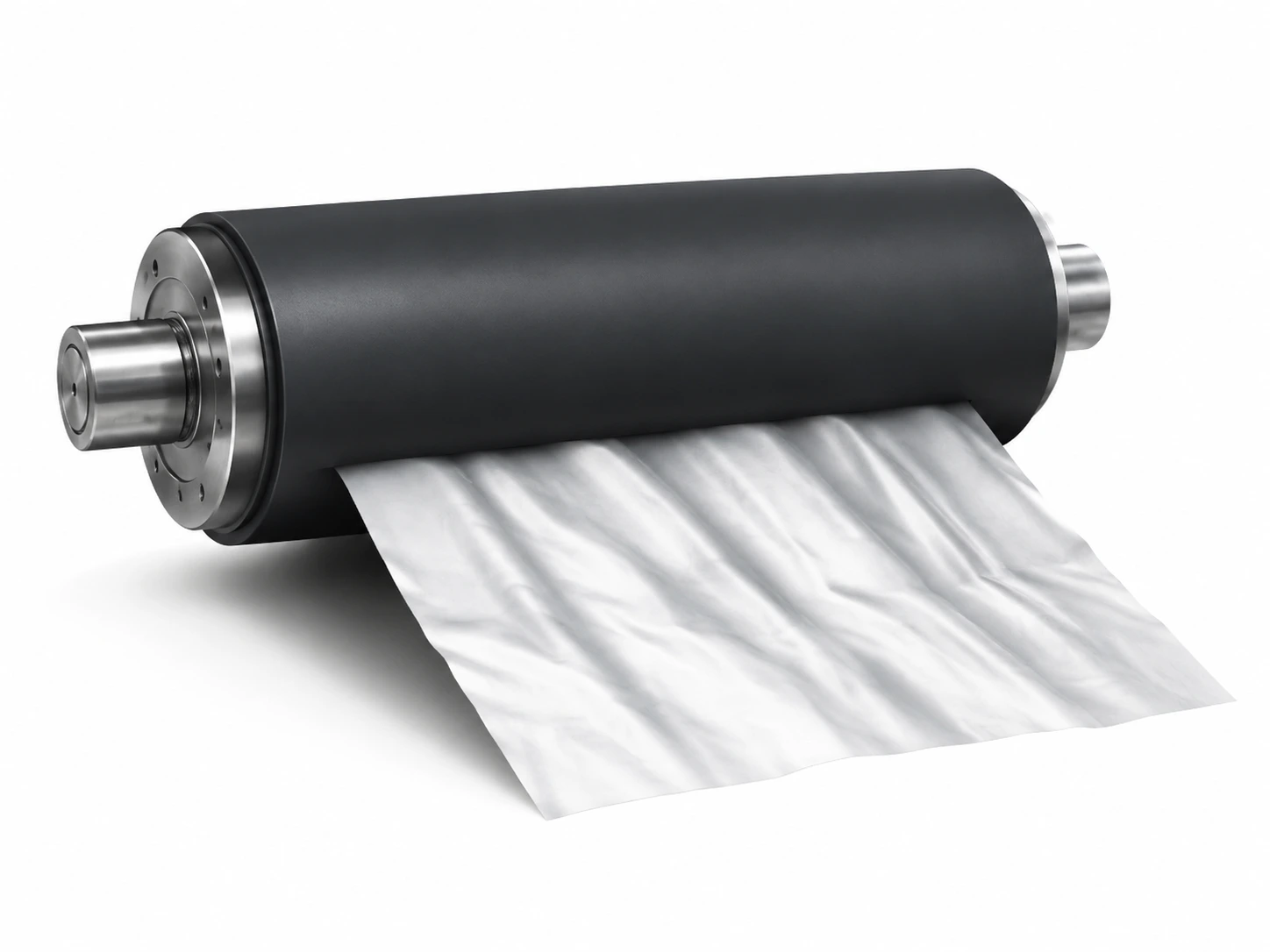
Plis dans le film, le papier, le textile ou le non-tissé (wrinkles / creases) — SoremagWrinkles in film, paper, textile or nonwoven
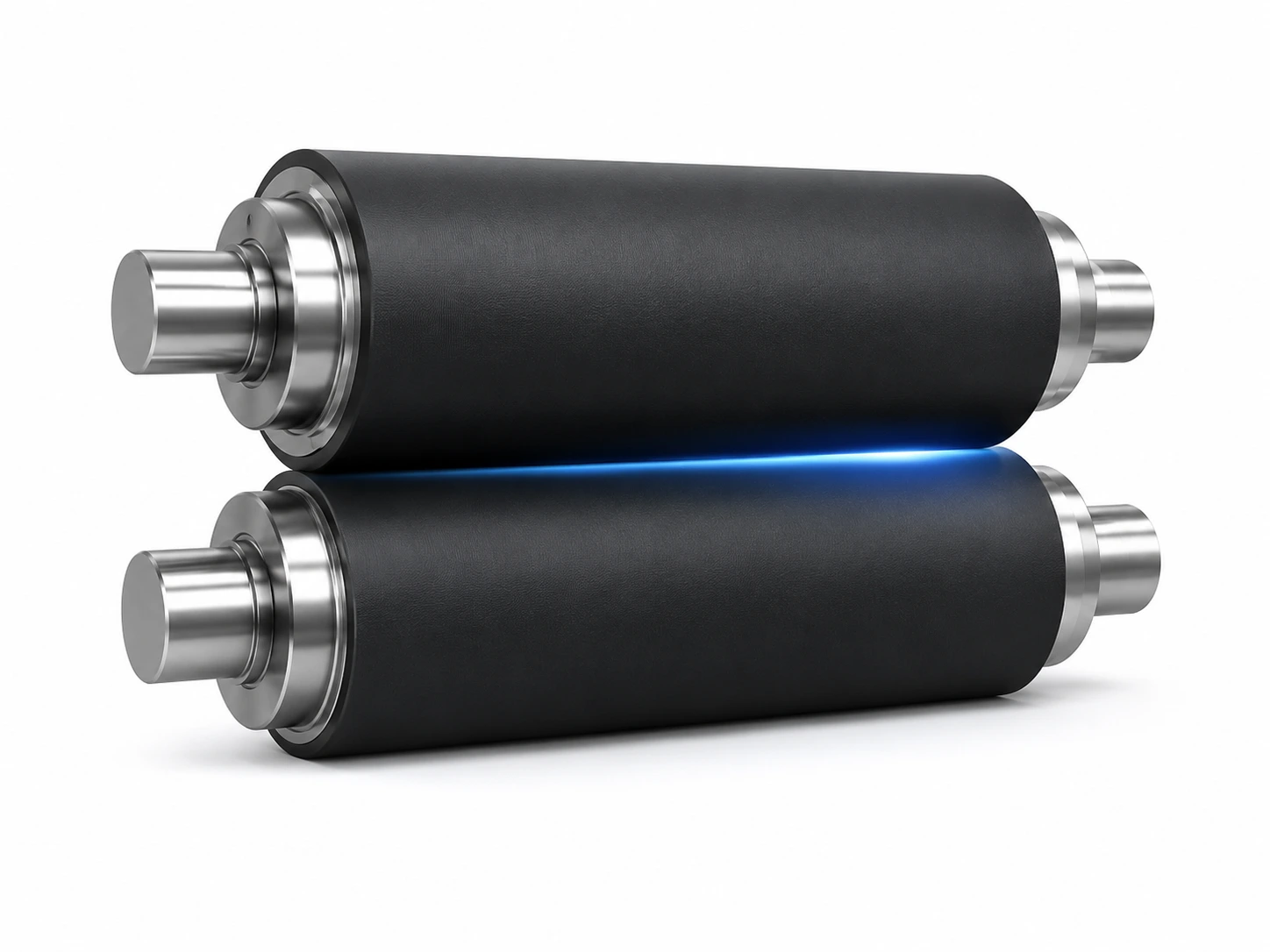
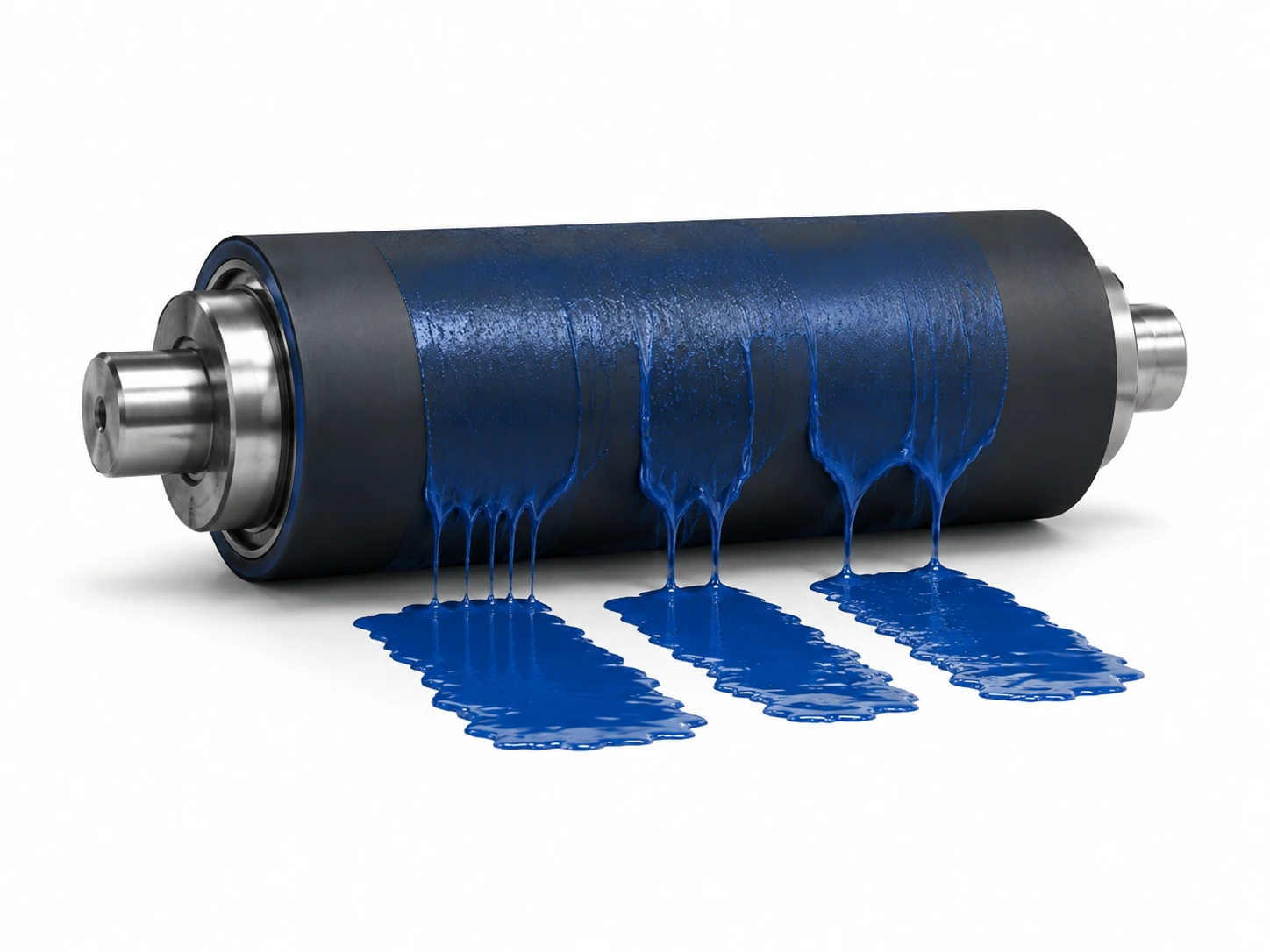
Mauvais contact ou pression inégale au nip (uneven nip pressure) — SoremagPoor contact or uneven pressure at the nip
Transfert inégal d'encre, de colle, de vernis ou d'eau (uneven coating transfer) — SoremagUneven transfer of ink, glue, varnish or water
Rainures bouchées, arrondies ou trop peu profondes (worn grooves) — SoremagGrooves plugged, rounded over or too shallow
Diamètre hors tolérance après usure (out-of-tolerance diameter) — SoremagDiameter out of tolerance after wear

Not sure what is causing it? → Roller & Wheel Diagnostics

Our grinding and profiling services

From bringing it back round to a custom profile — all in-house, with quality control.

ServiceÀ quoi ça sert
Meulage cylindriqueRemettre le rouleau rond, droit et à diamètre contrôlé.
Regrind / remise à neufEnlever usure, marques, glaçage, ovalisation ou défauts de surface.
Meulage de finitionObtenir le fini (Ra) demandé : standard, fin, poli ou rugueux d'adhérence.
Bombé (crown)Compenser la flexion sous charge et uniformiser la pression au nip.
Profil concave / coniqueCorriger le guidage et le suivi de bande, ou créer une géométrie précise (taper).
Profils spéciaux / OEMReproduire un profil d'origine (dessin, rouleau témoin) ou développer une géométrie sur mesure.
Contrôle qualitéDiamètre, TIR, taper, dureté, profil et fini — voir notre QC7 System.
Gros plan d'un rouleau recouvert de caoutchouc en cours de meulage sur la rectifieuse — surface rectifiée par Soremag
Aussi au menu

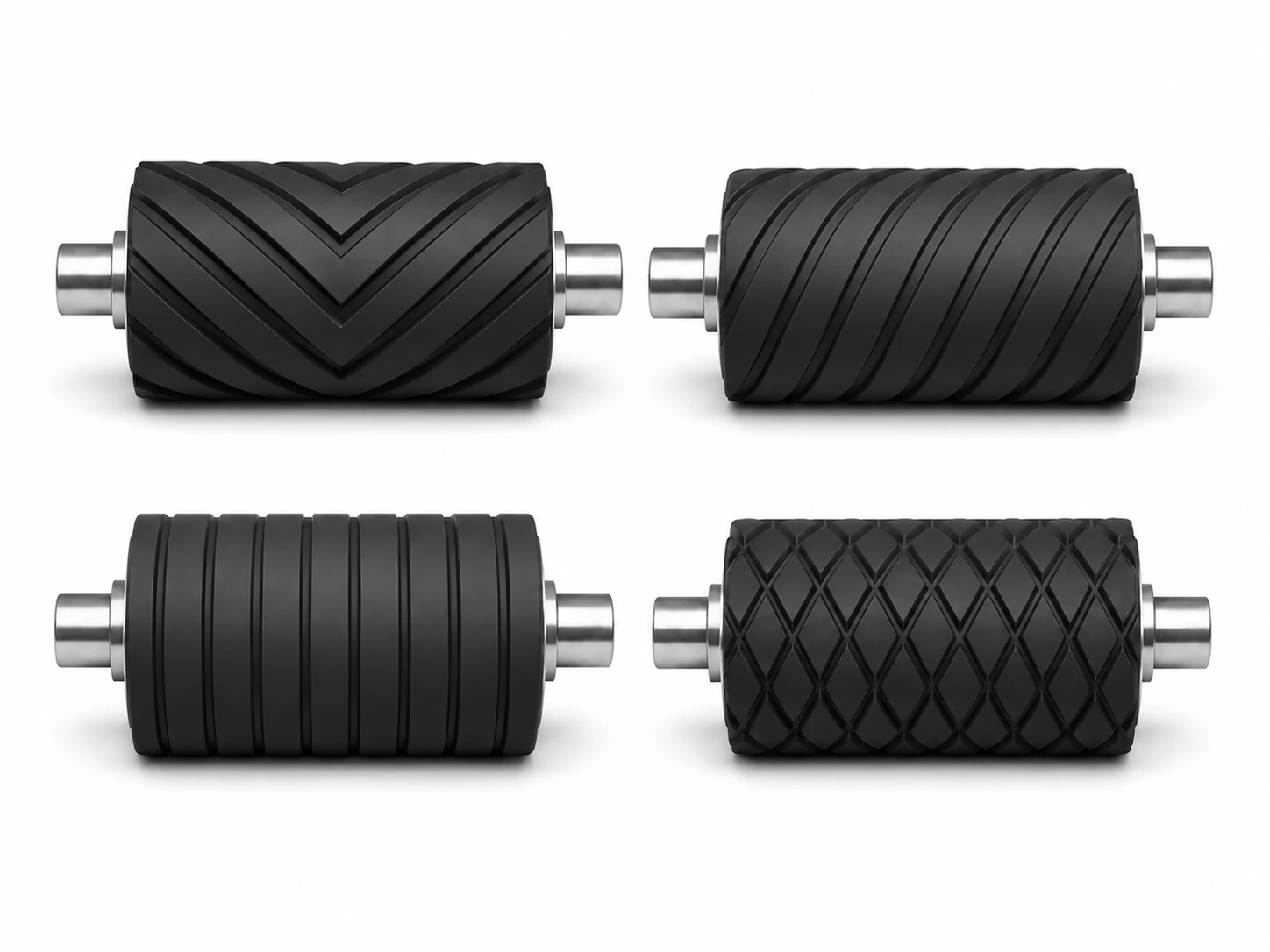
We groove too.

Diamond, spiral, herringbone, circumferential, spreader… The

right pattern for the function
: traction, water or air removal, wrinkle control. CNC machining up to 42 in. × 240 in.

See roller grooving →
Rouleaux recouverts à différents motifs de rainures — chevron, hélicoïdal, circonférentiel et diamant — rainurage CNC Soremag

Which profile or finish should you choose?

Start from the problem you see on your line — we adjust case by case from there.

Problème observéPiste de profil / fini
Mauvais transfert de coatingMeulage fin, Ra contrôlé, rouleau cylindrique ou bombé selon le nip.
Pression plus forte au centre ou aux boutsBombé calculé, concave, bouts dégagés ou profil sur mesure.
Vibration à haute vitesseMeulage cylindrique, contrôle du TIR et de la concentricité, équilibrage dynamique.
Produit fragile marqué par le rouleauFini plus fin, dureté adaptée, profil moins agressif.
Diamètre / rondeur hors toléranceRemeulage cylindrique à diamètre et faux-rond (TIR) contrôlés.

A problem with

wrinkles, water, air or traction
? It is usually a question of grooving — see Roller Grooving.

The rollers we grind and profile

Each type has its own preferred profile and finish. Here are the most common.

Nip / pinch roller (nip / pinch)

Needs an exact crown to hold a uniform pressure line across the whole face.

Drive roller (drive / pull)

Needs a grippy finish and the right diameter to drive without slipping.

Applicator & metering roller (coating / metering)

Requires a fine finish and tight TIR to lay down a constant film thickness.

Printing & ink roller

Needs a fine surface, free of micro-cracking, for even ink transfer.

Squeegee roller (squeeze / wringer)

Brought back to size and finish for wringing — washing, pickling, sheet metal.

Guide, tension & spreader roller (guide / spreader)

Profile: concave or tapered to guide the web and hold the tension.

Calender & laminating roller

Crown and finish controlled for uniform thickness and pressure across the width.

Covered conveyor roller

Diameter and grippy finish for traction and anti-slip, matched to the load.

Your roller is not on the list? Tell us about your line →

What we check — and the tolerances

What we measure before, during and after grinding. The values below are

typical industry ranges
, confirmed case by case.

ContrôleValeur indicativePourquoi
Diamètre final (OD)selon montageVitesse de surface et pression machine correctes.
Faux-rond / TIR≈ 0,003 po (0,076 mm) — plus serré possibleRéduit vibration, marques répétitives et variation de pression.
Conicité (taper)≈ 0,005 po (0,127 mm) — plus serré possibleÉvite un contact plus fort d'un côté que de l'autre.
Positions critiques (coating, extrusion)≈ 0,001 po (0,025 mm)Épaisseur de film et transfert constants.
Bombé (crown)tolérance ≈ 0,002 po (0,05 mm)Compense la flexion sous charge; pression uniforme au nip.
Dureté Shore A / D≈ 5 Shore A → 85 Shore DConfirme que le recouvrement est encore conforme.
Fini de surface (Ra / Rz)du poli au rugueuxInfluence traction, transfert, marquage et nettoyage.
Concentricité / cylindricitéselon dimensionAssure un contact régulier sur toute la face et entre portées.
Équilibrage dynamiquerouleaux longs / rapidesÉlimine vibrations et marquage à haute vitesse.

Final tolerances are confirmed according to the diameter, the length, the hardness of the cover, the mechanical condition of the core and the function of the roller.
A soft, long or worn cover cannot hold the tightest specifications; on elastomer, measurement is taken once the temperature has stabilized. For the detailed values, see our documents Geometrical and Dimensional Tolerances and Roller Surface Characteristics.

Materials we machine cleanly

Grinding rubber without burning it is a skill. We handle elastomer as well as polyurethane.

Natural rubberNeoprene (CR)Nitrile (NBR)Carboxylated nitrile (XNBR)Hydrogenated nitrile (HNBR)EPDMSilicone (VMQ)CSM (formerly sold as Hypalon®)Viton (FKM)SBRPolyurethane (PU)Hard rubber (ebonite)

Polyurethane, with its high abrasion resistance, takes deep, sharp grooves; rubber calls for controlled speed and wheel dressing to get a clean finish with no burning. Need to choose the material rather than the profile? See our pages rubber rollers and polyurethane rollers, or the material selection guide.

Pour aller plus loin

The technical detail of grinding and profiling

The real cases we see in the shop — open up whichever one concerns you.

Runout, out-of-round, taper: where does it come from? +

A roller that is no longer perfectly concentric creates vibration, intermittent contact and pressure variation. Runout often comes from uneven wear, long storage, a deformed cover, poor mounting, a damaged shaft, material build-up or an earlier repair done badly. We check the roller between centers or on its journals to verify the relationship between the shaft, the core and the outside diameter before correcting anything.

Glazing, marks and contamination: what grinding takes off +

Over time, some rubbers turn very smooth and shiny (a “glazed” surface) and lose their grip, even when the diameter is still good. Residues of glue, resin, ink, paint, wood or chemicals can also become embedded. As long as the damage stays on the surface, a regrind removes that layer and recreates a working texture — without recovering the roller.

When is a regrind no longer enough? +

A regrind is not always the right answer. A new cover becomes necessary with deep cracks, delamination, areas lifted off the core, missing chunks, hardness that has shifted a long way, chemical attack, swelling, not enough remaining thickness or corrosion under the cover. In that case we strip the old cover, inspect and prepare the metal body, then apply new rubber or polyurethane before the final grind. See Roller Covering.

Grinding a new roller: the sequence +

After covering, the diameter is deliberately left oversized. The typical sequence: inspection of the core and the shafts, preparation of the metal surface, application of the bonding agent, building or molding the cover, vulcanization or curing, stabilization, rough grinding of the diameter, precision grinding, profiling, surface finishing, grooving if required, dimensional inspection, final inspection and — where needed — dynamic balancing.

How much material can be taken off in a regrind? +

Before regrinding, we determine how much material can be removed without compromising the cover. We look at the current diameter and the minimum acceptable diameter, the cover thickness, the depth of the damage, the hardness, the bond to the core, the condition of the core, the profile wanted and the tolerances of the machine. Surface damage: a regrind is fast and economical. Deep damage: a new cover lasts longer.

Surface finishes available +

A very smooth surface is not always the better choice. Depending on the application we produce a very smooth finish (film, printing, laminating, delicate products), a fine ground finish (a good balance of appearance, grip and cleaning), a matte finish (less glazing, more traction), an open or rough finish (drive, wood, cardboard, anti-slip), a sanded, polished or textured finish. Where needed, the finish is defined by roughness values (Ra, Rz, RMS) — with the measurement method spelled out, since the reading on a soft elastomer varies with the instrument, the stylus pressure and the hardness.

Measuring and inspection instruments +

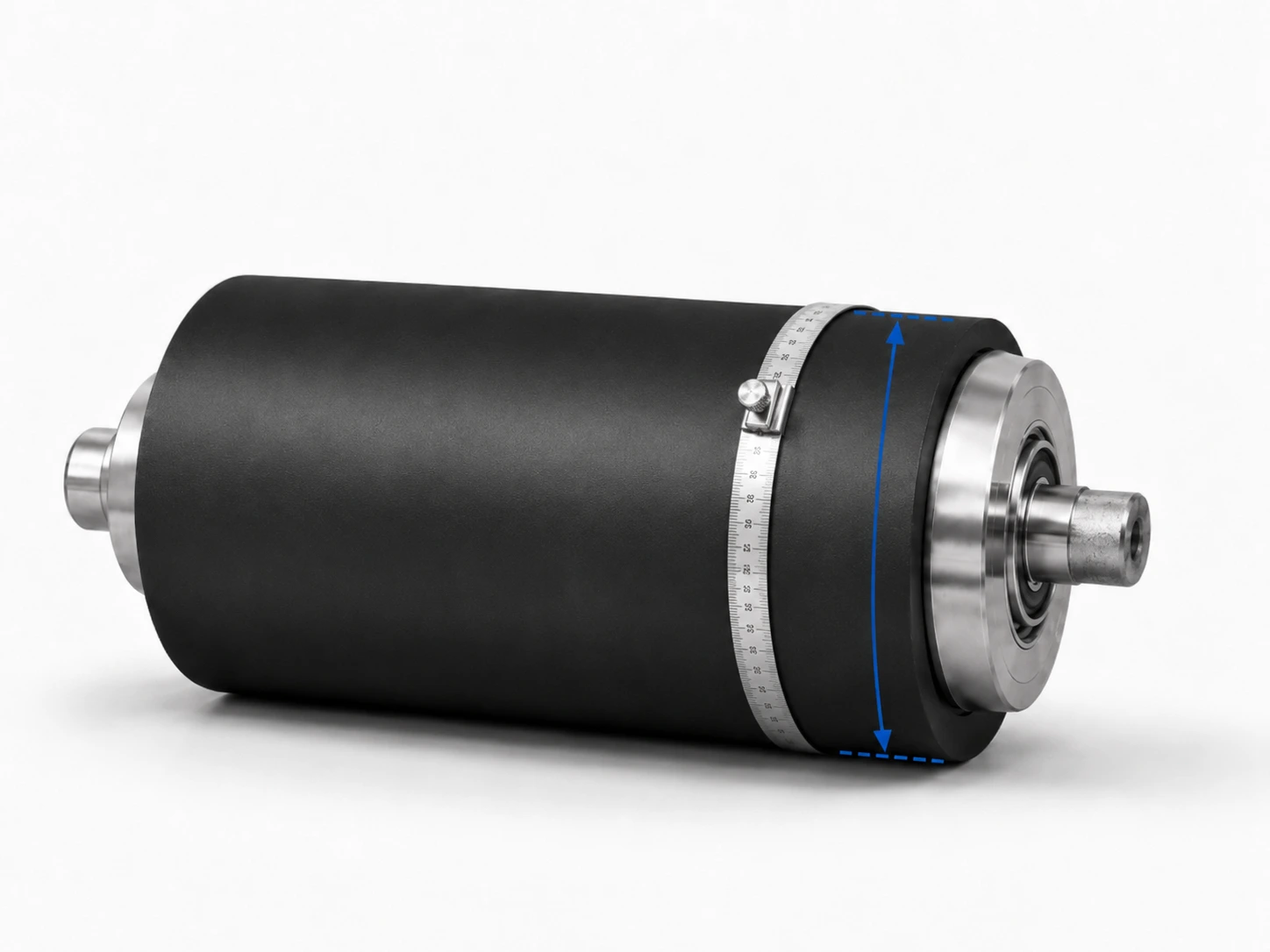
Quality depends as much on the measuring as on the machining: Pi Tape diameter tapes, micrometers, dial indicators and digital indicators, straightedges and profile gauges, a surface roughness tester, Shore A/D durometers, runout checks, alignment instruments and dynamic balancing. On a crowned, concave or special profile, the diameter is taken at several positions across the face and compared with the profile called for. Details in our documents Tolerances and Surface Characteristics.

Matched rollers and nip rollers: treat them as a pair +

When one roller works against another, the two form a set. A difference in diameter, hardness or profile changes the nip pressure, the surface speed, the traction, the thickness of the product, the temperature and the wear. It is often better to measure or regrind both rollers together to keep them compatible.

Useful information for a quote request +

To evaluate a project, these are particularly useful: current diameter and target final diameter, face length and overall length, weight, type of cover and hardness, profile required, surface finish, diameter and runout tolerances, rotating speed, whether there is grooving, a drawing and photos, and a description of the problem you are seeing. If the original profile is unknown, we can work from measurements of the roller, from a sample roller or from the operating conditions of the machine (reverse engineering).

Questions about grinding and profiling

When does a rubber or polyurethane roller need to be reground? +

When the diameter, the roundness, the surface finish or the profile no longer match what the machine needs: uneven wear, an out-of-round or tapered roller, vibration, slipping, wrinkles, poor nip contact or worn grooves. Grinding brings the surface back to size and to the right finish.

How many times can a roller be reground? +

As long as there is enough cover thickness left over the core and the bond is good, a roller can be reground several times. We measure the current diameter, the remaining thickness and the minimum acceptable diameter; below that threshold, we recover from scratch before regrinding.

What is the difference between grinding, grooving and crowning? +

Grinding brings the surface back to size and to the right finish. Grooving creates a functional pattern (traction, drainage, wrinkle control). Crowning changes the diameter along the face (crown or concave) to correct contact pressure and compensate for deflection under load.

Can you reproduce an OEM profile? +

Yes, from a drawing, an existing roller or a dimensional survey (reverse engineering). We reproduce the original profile, hardness and finish, or adapt them to what the equipment needs now.

Does the roller need to be balanced after grinding? +

On long, heavy or high-speed rollers, dynamic balancing is recommended to eliminate vibration and marking. On short, slow rollers, static balancing is often enough.

Which surface finish (Ra) should you choose? +

It depends on the function: a rougher finish increases traction; a fine or polished finish gives even transfer (ink, glue, varnish) and avoids marking a delicate product. The finish is chosen together with the hardness and the profile, to suit your application.

A roller to regrind, groove or reprofile?

Send us your dimensions, photos or a drawing. We assess whether the roller can be reground, grooved or reprofiled — or whether it has to be covered new first.

➔ Request a quote