
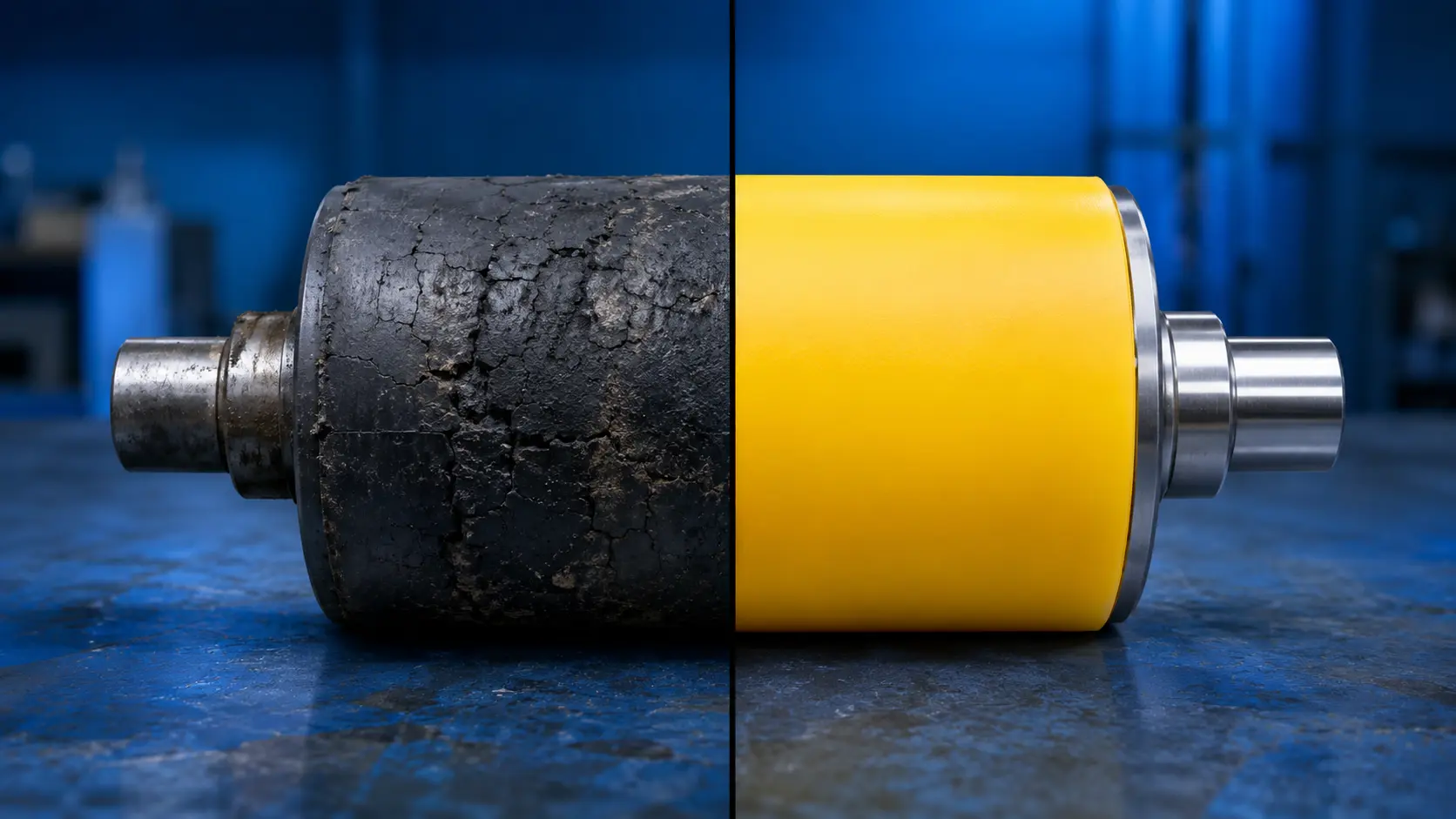
Wringer rollers that flat-spotted within a few weeks, insufficient wringing and downgraded coils. The reflex would have been to harden the cover so it would resist better. We did the opposite — and that is what fixed the problem.
The context
A rolling mill now operated by ArcelorMittal, on a processing line for steel sheet in coils (coils): up to 5 ft. wide, 1,000 ft. long, several tons per coil. The steel is cleaned there in a water-based solution with a high caustic content, then goes through a wringing section before the rest of the process.
This section holds up to 13 pairs of wringer rollers — one on top, one underneath — over several tens of meters. Each roller measures about 6 ft. wide by 15 in. in diameter and can weigh up to a ton. Their job is simple to state and hard to pull off: get the sheet out as dry as possible. When the solution is not completely removed, caustic streaks are left on the steel — the finished product loses value, and a poorly wrung coil can be rejected outright.
The problem
The rollers barely lasted a few weeks before they had to be resurfaced or refurbished. Worse: they were not wringing properly, which caused material losses on top of a high maintenance cost.
On inspection, the wear did not look like distributed abrasion. The cover showed flats (flat spots): localized flattened areas, while the rest of the circumference kept its diameter.
Our analysis
A flat spot never tells a story of wear: it tells a story ofstanding still. To mark the cover at one precise spot, the roller has to stay stopped while the product runs past.
That is exactly what was happening. These rollers are not mechanically driven: no motor, no chain. It is the steel sheet, pulled by the recoiler, that has to turn them by friction alone. But with a cover at 80 Shore A, the sheet slipped for several meters before it managed to drive the rollers. Through all that slipping, the steel rubbed on motionless rubber — and left a flat spot with every coil that went through.
So the problem was neither the quality of the rubber nor the way the roller was built: it was a problem of traction. This way of tracing a wear mark back to its cause is at the heart of our Roller and wheel diagnosis.
A softer cover flattens more under the nip pressure: the contact area with the sheet widens, and with it the friction available to drive the roller right from the start. The same conformity produces a second, subtler effect: instead of a nearly point contact that lets a film of solution slip past, the cover follows the sheet along a continuous wringing line — the solution is pushed out instead of being bridged over. A harder roller does neither one.
The solution
We proposed lowering the hardness from 80 to 60 Shore A — but not only that. A rubber that was simply softened would not have stood up to the caustic solution. So we reformulated the nitrile : a recipe adjusted to keep the chemical resistance to the alkaline environment while getting the mechanical behavior wanted in the nip. It is this double adjustment — hardness and formulation — that made the solution work. This material-and-hardness reasoning is the one behind our Material Selection Guide, applied to our rubber rollers.
At a glance
- Client
- Laminoir aujourd'hui exploité par ArcelorMittal — ligne d'essorage de feuille d'acier
- Année
- 2003 · référence client : service du laminoir
- Application
- Rouleaux essoreurs, jusqu'à 13 paires · acier traité en solution caustique
- Dimensions
- ≈ 6 pi de large × 15 po de diamètre · jusqu'à 1 tonne par rouleau
- Avant
- Nitrile vulcanisé, 80 Shore A — plats, essorage insuffisant
- Après
- Nitrile reformulé, 60 Shore A — entraînement quasi instantané
- Durée de vie
- De ≈ 3-4 semaines à ≈ 3-4 mois
Putting it to the test
The rollers were built at 60 Shore A with the new formulation, then production was restarted. The results were conclusive on both counts: the drive of the rollers became almost instant as soon as the sheet is pulled, and the wringing turned out to be clearly better than what the line had been getting before.
The benefits
The flat spots disappeared, since the rollers are driven as soon as the coil starts moving. Much more effective wringing reduced material losses — and the steel obtained was even upgraded, and therefore sold at a higher price. Finally, the frequency of maintenance work dropped sharply: beyond the direct savings, it made it possible to put the mechanics on other tasks instead of the recurring replacement of the same rollers.
What this case shows
The lesson is counter-intuitive: when a roller gets damaged fast, the reflex is to harden it so it will “resist better”. Here, hardening it would have made the problem worse. If an undriven roller develops flat spots, look at traction first, not at wear resistance. The same reasoning applies to any line with idler rollers driven by the product itself.
This case is also a reminder that hardness is not a quality grade but a design parameter: 60 Shore A is not “worse” than 80, it is simply the number that suited this function. Our article on Shore hardness explains what the durometer measures — and what it does not.
| Comportement dans le nip | Revêtement 80 Shore A | Revêtement 60 Shore A reformulé |
|---|---|---|
| Surface de contact | Étroite, peu de conformité | Élargie, le revêtement épouse la feuille |
| Entraînement par la feuille | Après plusieurs mètres de glissement | Quasi instantané |
| Mode de dégradation | Plats localisés à chaque bobine | Usure répartie, normale |
| Essorage | Film de solution qui échappe au contact | Ligne d'essorage continue |
A note on yesterday's equipment
This line had been designed at a time when steel sheet was thicker, recoilers were slower and the quality requirements on the finished product were lower. In that context, an 80 Shore A cover was a perfectly justified choice.
It is the conditions that changed, not the roller. That is often where the most profitable gains are hiding: a piece of yesterday's industrial equipment can be adapted to today's needs without being replaced — provided the original specifications are re-examined instead of being carried over out of habit.
Rollers that flat-spot, uneven wringing or a service life that is costing you too much?
Talk to our team