Covering & manufacturing · rubber and polyurethane · Quebec450 664-4000·1 800 361-5588·EN|FR
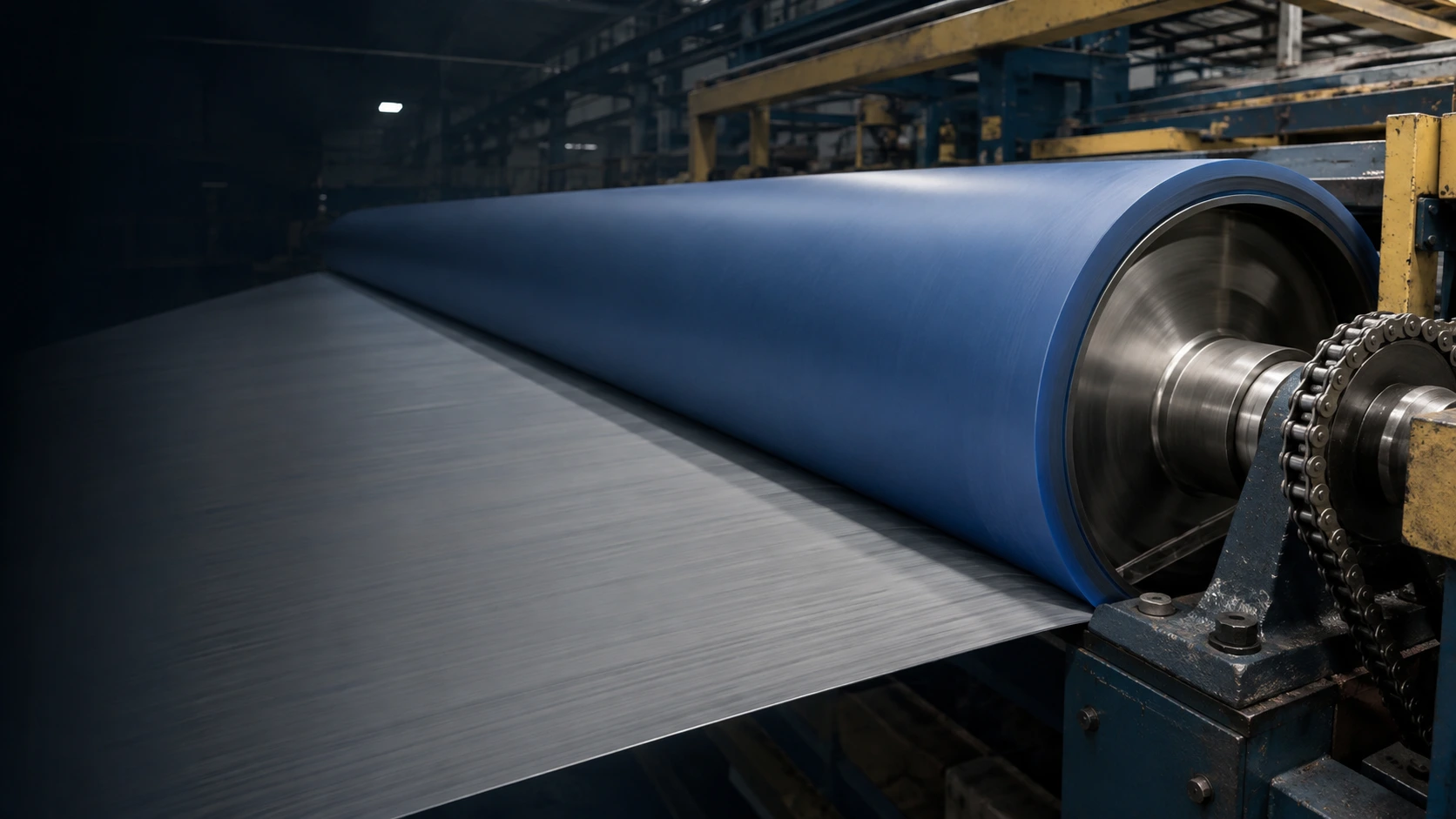
Rouleau d'entraînement recouvert de polyuréthane bleu entraînant une bande sur un large angle d'enroulement
Produits · Spécialité

Drive, pull and feed rollers in rubber and polyurethane

Drive rolls, pull rolls, feed rolls, draw rolls, haul-off: we cover, grind, groove, knurl and balance the rollers that move your product — for grip without slippage and without marking.

Covering rollers that have to drive

A drive roller has one job: transmit enough torque to move the product, without letting it slip and without marking it. Those two requirements pull in opposite directions, and that is exactly where the craft lies.

When a line loses its rate, wanders, breaks or stretches the product, the drive roller is the first suspect — and often rightly so. But the usual reflex, tightening down, is the most damaging one: it is pressure that marks. Soremag takes the problem back to the surface:

compound and durometer
,
finish
,
groove or knurl pattern
,
profile
and
balancing
— on your existing core.

Related expertise: roller covering, grooving, grinding and surface finish, nip and pressure rollers and reverse engineering.

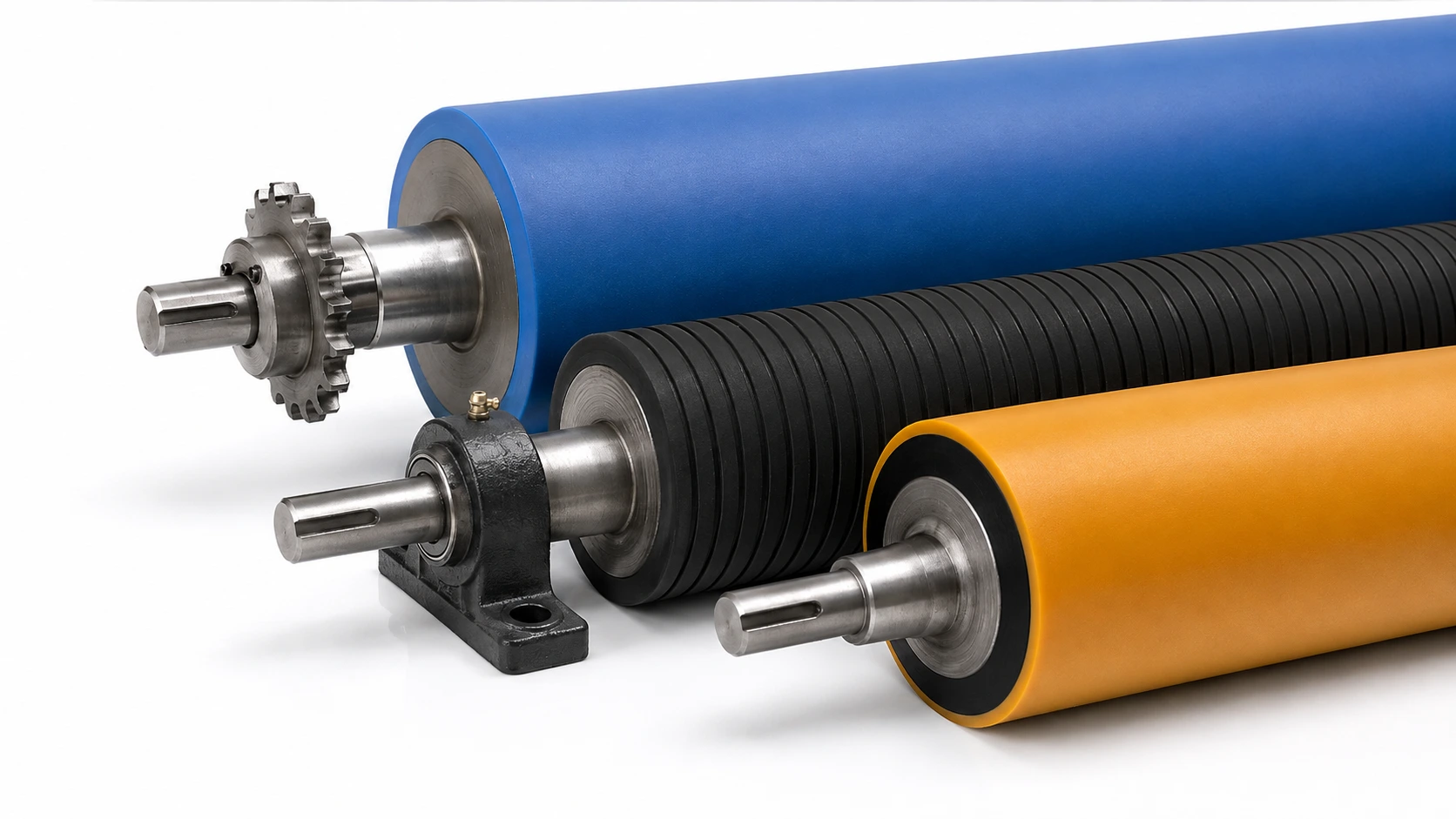
Trois rouleaux d'entraînement recouverts
Trois façons de construire de la prise sur un même mandrin : une surface lisse dont tout se joue dans le fini, un rainurage qui évacue l'air à grande vitesse, et une double dureté qui agrippe sans que le rouleau s'écrase. Au bout de chaque pièce, l'épaisseur du recouvrement se lit en coupe.

Where a roller's grip actually comes from

The traction a roller can transmit is not a property of its rubber. It is the product of three measurable quantities — the tension in the product, the angle over which it wraps the roller, and the friction at the contact. As soon as the torque demanded exceeds what those three deliver together, it slips. The whole tuning job comes down to knowing which of the three you can still increase.

Tension

What the product presses against the surface

The tighter the web, the harder it presses and the better it grips. But tension is rarely a free variable: it is set by the process and by what the product can take without stretching or breaking.

Angle d'enroulement

The variable almost everyone forgets

The larger the arc over which the product wraps the roller, the more length there is to transmit torque. Going from a tangent contact to a half wrap changes everything — and it costs the product nothing. It is the first lever to look at.

Frottement

The only one of the three we manufacture

This is our ground: compound, durometer, surface finish, texture, grooving, knurling. And it is the variable that degrades in service, because a surface glazes, fouls and hardens over the years.

Le piège classique

Faced with a roller that slips, the fastest fix is to

tighten it down
. It often works — until the product marks, the cover heats up, the bearings suffer and the surface glazes even faster. Now you have two problems instead of one.

Look at the wrap angle before the load. On many machines there is still room there, and it is the only lever that increases traction without asking anything more of the product.

The drive rollers we cover

One function — moving, pulling or holding back the product — under names that change with the machine and the industry.

Drive rollers — drive rolls

Driven, they set the line speed. Any difference between their surface speed and the product's is paid for in slippage, marks or stretch.

Pull rollers — pull rolls

They pull the web out of a section: oven, press, extruder. What you want here is a positive grip on a product that is often hot, dusty or freshly coated.

Feed rollers — feed rolls

They drive the workpiece into the machine: panel, sheet, board, profile. A steady feed pitch depends directly on their diameter and their grip.

Draw rollers — draw / haul-off rolls

Downstream of the extruder, they pull the film, tube or profile at constant speed. Any slippage shows up immediately in the product's dimensions.

Infeed and outfeed rollers — infeed / outfeed rolls

They carry the workpiece into and out of a work station without holding it back or pushing it faster than the tool.

Hold-down pressure rollers — hold-down rolls

They keep the workpiece pressed against the conveyor or the table during machining. Consistent pressure matters more than force.

Tension and braking rollers — bridle / S-rolls

Metal-line vocabulary: several rollers in an S pattern build up wrap angle and create the holdback needed to keep the strip under tension.

Capstan rollers — capstan rolls

Cable, wire, tube or profile wrapped several turns: traction builds with every pass. The cover has to hold up without wearing a groove.

Guide rolls and idler rolls — guide / idler rolls

Not driven, turned by the product itself. A special and nasty case: if they do not have enough grip to start turning, the product rubs against a roller that stands still.

Dual-durometer rollers

A hard base layer that carries the load, a soft surface layer that grips. The only way to get grip without the roller collapsing under load.

Grooved drive rollers

Diamond, herringbone or spiral depending on the job: they vent the air or water that works into the contact and restore grip at high speed.

Drive wheels and rollers — feed wheels

Same physics, different format: drive wheels, traction rollers, transfer wheels. See our page wheel covering.

Your position goes by another name? Send a photo or a drawing: it is the function and the service conditions that determine the cover. See also the other roller families.

Traction is won at the surface

On a drive roller, the finish and the surface pattern often count for more than the durometer. Here are the three families, and what each one costs you.

Smooth, ground or matte — ground / matte

Controlled roughness sets the grip without adding any relief. It is the choice when the product tolerates no imprint: thin films, printed sheets, varnished surfaces. The downside: it is the finish that glazes the fastest.

air évacué

Grooved — grooved

Spiral, herringbone, diamond or axial. The pattern opens a path for the air and water trapped in the contact — it is the answer to high-speed slippage. Reserve it for products that tolerate a discontinuous contact.

Knurled or textured — knurled

A cross-hatch machined into the surface, in fine, tight relief. Very positive grip on a rigid, slippery or dusty product, without having to crush the cover. But the pattern leaves an imprint: out of the question on a sensitive product.

The pattern is chosen with the product, the speed and the tolerance for marking. Patterns and their pitch are detailed on the page grooved rollers, and finishes on the page roller grinding.

What Soremag does to a drive roller

We start from your existing core: the part that wears is the working surface, not the structure.

InterventionCe que ça règle sur un rouleau d'entraînement
Recouvrement caoutchouc ou polyuréthane couléComposé et dureté choisis pour le frottement voulu, la vitesse de ligne et le produit en contact.
Recouvrement à double duretéSupport dur en sous-couche, adhérence en surface — quand une seule dureté ne peut pas faire les deux.
Rectification et fini de surfaceRugosité voulue, faux-rond, cylindricité : c'est ce qui redonne de la prise à un rouleau glacé.
Rainurage sur mesureMotif et pas adaptés à l'air ou au liquide à évacuer, reproduits ou repensés.
Moletage et texturationPrise franche sur produit rigide ou glissant, quand une empreinte fine est acceptable.
Profil et diamètre appariésSur une paire ou un train de rouleaux, des diamètres appariés évitent le glissement différentiel.
Équilibrage dynamiqueÉlimination du broutage et des marques cycliques sur les entraînements rapides.
Réparation du mandrin, des portées et des tourillonsUn rouleau qui vibre ou qui a du jeu ne transmet pas un couple régulier, peu importe sa surface.
Reverse engineeringReproduction de la matière, de la dureté et du motif à partir du rouleau usé — sans plan.
Formulations antistatiques ou conductricesSelon disponibilité, quand l'accumulation de charge nuit à l'entraînement ou à la sécurité.

Capabilities: from

10 Shore A to 85 Shore D
· parts from
2 mm to 20 ft. long
· machining up to
Ø 42 in. × 240 in.
,
Ø 68 in. × 175 in.
or
Ø 76 in. × 36 in.
· machining to within ±0.001 in. (±0.025 mm) depending on the compound. See quality control.

A real case where the whole question was traction

The perfect counterexample to the reflex “it wears fast, let's make it harder”.

Étude de cas · essorage de feuille d'acier

Rollers

with no drive
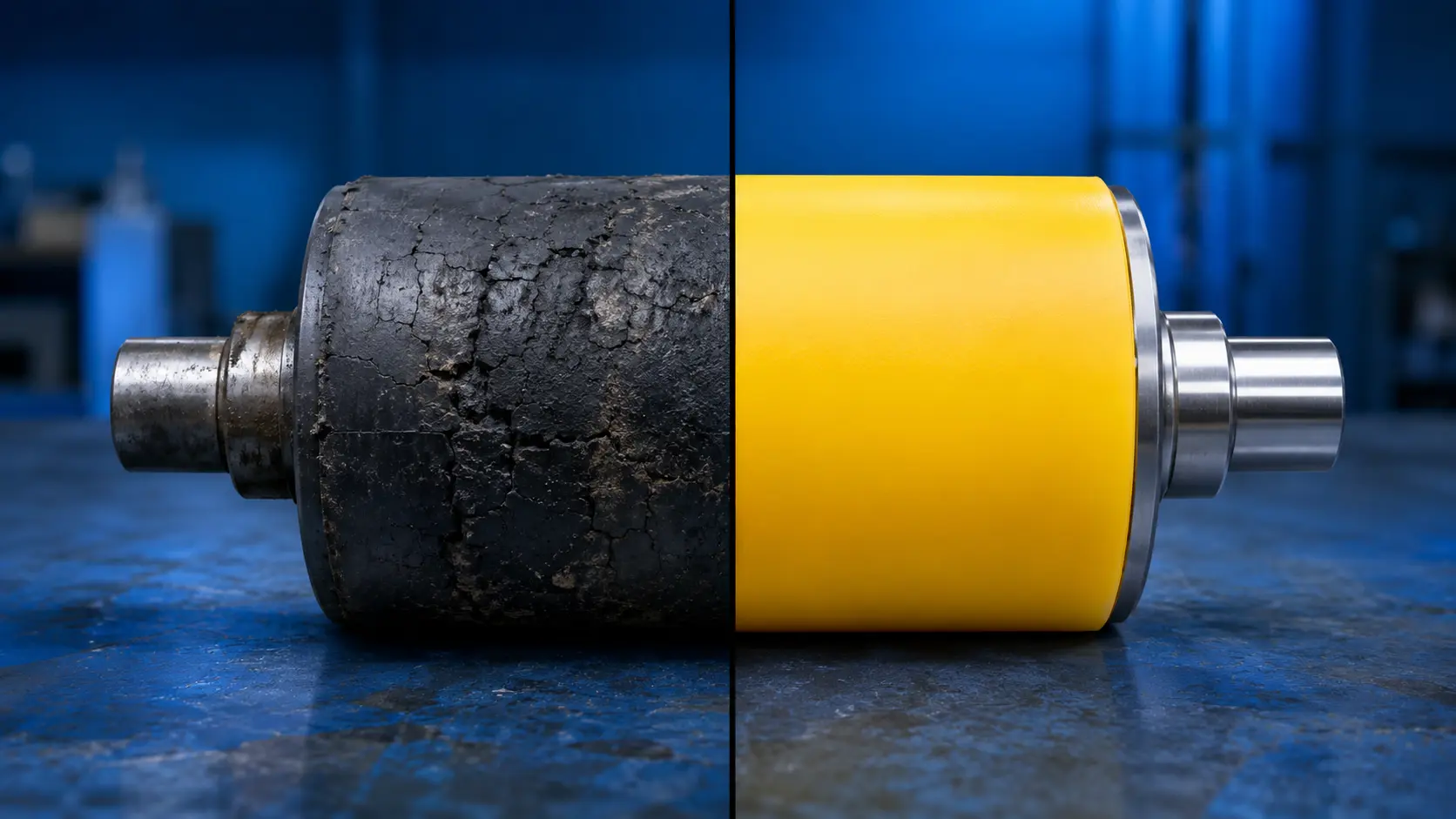
, meant to be turned by the steel sheet itself. At 80 Shore A, the sheet slid several meters before it managed to turn them — and left a flat spot on every coil. The wear looked like abrasion; it was really a drive failure.

Dropping to

60 Shore A
with a reformulated nitrile, the contact area widened, the available friction was enough to start the rollers turning right from rewind, and the flat spots disappeared. Service life went from about three to four weeks to three to four months.

Read the full case study →

The transferable lesson:

a flat spot never tells a story about wear, it tells a story about a roller that is not turning.
If a non-driven roller goes flat, look at traction first, not abrasion resistance. See also the diagnostic guide.

Which cover for driving

On a driven roller, we look first at the friction available against the product, then at temperature resistance and chemical compatibility.

Natural rubber (NR) — high grip, resilience, dry products SBR — all-around compromise, controlled cost Nitrile (NBR / XNBR) — oils, inks, adhesives Neoprene (CR) — balance of chemical resistance, weathering and grip EPDM — steam, hot water, alkaline washdowns Silicone — heat and release coming out of the oven Cast polyurethane — abrasion, cutting, high load

One caution specific to drive work: a high-grip compound is often less abrasion resistant, and the reverse holds too. The right choice is negotiated between the two. To compare, see the material selection guide, the page rubber rollers or the page polyurethane rollers.

The technical detail

The mechanisms specific to driving — the ones behind most of the lines that start slipping for no apparent reason.

L'angle d'enroulement : le levier gratuit

The traction available grows with the arc of contact between the product and the roller, and it grows fast. A roller barely tangent to the web has only a fraction of the grip the same roller would give over a half wrap, at the same tension and the same friction.

It is the principle behind

S-roll trains
on metal lines and
capstans
on cable lines: you raise neither the tension nor the load, you accumulate wrap angle.

In practice: before ordering a grippier cover, check whether an idler roller or a repositioning could increase the wrap. It is often the cheapest correction and the least risky for the product.

Le film d'air à grande vitesse

At high speed, the product does not really touch the roller: it floats on a layer of air dragged along by the rotation. That layer acts as a lubricant and drops the friction — the roller is in good shape, the compound is right, and it still slips.

The thickness of this film increases with the

speed
and
roller radius
, and decreases as the
tension
rises. That is why a slippage problem often shows up after a speed increase, with nothing having been changed on the roller.

The answer is grooving : giving the air a way out of the contact zone. A spiral or herringbone pattern vents toward the edges; an axial pattern cuts the film across the full width.

Le glaçage : le rouleau a l'air neuf et ne travaille plus

Over the months, the surface of a cover smooths out and polishes under contact and heat. It turns shiny, almost glassy — hence the name. The roughness that provided the friction is gone, but visually the roller looks perfect: no cracking, no noticeable loss of diameter.

It is one of the most common diagnoses when a line starts slipping gradually, with no triggering event. A dial indicator reading will not catch it; running your hand over the surface will.

The fix is precision grinding that restores the roughness you need. If the glazing comes back too fast, the compound is what has to be revisited — and sometimes the operating temperature.

Double dureté : agripper sans s'écraser

A soft cover grips well but collapses under load, which changes the effective diameter and therefore the drive speed. A hard cover keeps its geometry but has no grip.

The

dual hardness
approach resolves the contradiction by stacking two layers: a harder base layer that carries the load and stabilizes the geometry, and a softer surface layer that does the gripping.

We use it mainly on heavily loaded drives, large-diameter rollers and positions where a steady feed pitch is critical.

Diamètres appariés et glissement différentiel

When several rollers drive the same product, a difference in diameter between them creates a difference in surface speed. The product is then pulled by one and held back by the other: it slips on the slower one, stretches between the two, or both at once.

The effect is especially visible on

pre-stretch roller pairs
, where the diameter ratio is exactly what sets the stretch rate — see the page pre-stretch rollers.

Hence a simple rule: when we recover one roller in a train, we check the diameters of all the others. Recovering both rollers of a pair together is often cheaper than doing them separately six months apart.

Électricité statique

On plastic films and some nonwovens, running over an insulating roller generates an electrostatic charge. It attracts dust, makes the product stick where it should not, disturbs stacking and can become a safety issue where solvents are present.

There are

antistatic or conductive formulations
, subject to availability, to drain the charge through the core. It is a parameter to put on the table with your request, because it constrains the choice of compound.

Remise à neuf, étape par étape

1. Receiving and condition survey: durometer at several points, diameter, runout, roughness, condition of the existing pattern.

2. Stripping the old cover, inspection of the core, the bearing seats and the journals.

3. Mechanical repair if needed, surface preparation and bonding system.

4. Application of the new cover — vulcanization for rubber, hot cast for polyurethane.

5. Precision grinding to the target diameter, profile and finish.

6. Grooving or knurling depending on the function.

7. Dynamic balancing, final inspection and traceability. Full detail in our roll covering process.

Diagnosis → cause → correction

What we hear most often on the phone, and what it usually means.

SymptômeCause probableCorrection
Glissement apparu après une hausse de cadenceFilm d'air entraîné à la nouvelle vitesseRainurage adapté au sens d'évacuation; révision du fini.
Glissement progressif, sans événement déclencheurSurface glacée ou encrasséeRectification à la rugosité voulue; révision du composé si le glaçage revient vite.
Méplats sur un rouleau non motoriséTraction insuffisante pour le mettre en rotationBaisse de dureté avec composé reformulé, ou motif de surface plus agressif.
Produit marqué là où il est entraînéCharge trop élevée, recouvrement trop dur, motif trop agressifAugmenter l'angle d'enroulement plutôt que la charge; revoir le motif et la dureté.
Pas d'alimentation irrégulierDiamètre variable, recouvrement qui s'écrase, faux-rondRectification, double dureté, diamètres appariés sur le train.
Produit étiré ou déchiré entre deux rouleauxGlissement différentiel par écart de diamètreRéappariement des diamètres, réfection de la paire ensemble.
Rainures comblées ou arrondiesUsure du motif, encrassement, fluage du composéReprise du rainurage; motif ou pas révisé si le comblement récidive.
Broutage, vibration à haute vitesseBalourd, roulement, portée uséeRéparation des portées, roulements neufs, équilibrage dynamique.
Poussière collée, produit qui adhère au rouleauCharge électrostatique, composé trop collantFormulation antistatique selon disponibilité; révision du composé et du fini.

Every wear signature is covered in detail in the roller and wheel diagnostic guide.

Where these rollers are found

Anywhere something has to move at a controlled speed — which is to say just about everywhere.

Frequently asked questions — drive and pull rollers

Why does my drive roller slip? +

The traction available depends on three things: the tension in the product, the angle over which it wraps the roller, and the friction at the contact. As soon as the torque demanded exceeds what those three deliver, it slips. The most common concrete causes: a surface that has

glazed
by use, a
wrap angle
that is too small, an
air film
at high speed, a cover that has gone too hard, or fouling.

Does a softer cover always give more grip? +

Often, but never for free. A softer cover deflects more, the contact area widens and the available friction goes up. In exchange it runs hotter at high speed, wears faster against an abrasive product, and can mark a sensitive one. On a non-driven roller, lowering the durometer is sometimes exactly the right answer — we documented it on a steel line.

Does grooving really increase traction? +

It increases it mainly when the loss of grip comes from an

air film
. At high speed, a layer of air builds up between the product and the roller and acts as a lubricant; its thickness grows with speed and with roller radius. Grooves give that air a way out. Against a glazed surface or too little wrap angle, though, grooving alone will fix nothing.

What is a dual-durometer roller? +

A cover in two layers: a harder base layer that carries the load and stabilizes the geometry, and a softer surface layer that provides the grip. It is the only way to grip without the roller collapsing under load — a trade-off a single durometer cannot make.

How do you increase traction without marking the product? +

By looking somewhere other than pressure. Tightening down is the most common reflex and often the most damaging, because it is the load that marks. Start with the

wrap angle
, which increases traction without asking anything more of the product; then the finish and the surface pattern; and only then the durometer and the load.

What is glazing, and how do you fix it? +

It is the gradual smoothing of the surface in service: it turns shiny, almost polished, and loses its grip. The roller looks new but no longer works. The fix is precision grinding that restores the roughness, and a change of compound if the glazing comes back too fast.

Should both rollers of a pair be recovered together? +

It is preferable as soon as both of them drive the product. A difference in diameter between them creates a difference in surface speed: the product slips on the slower one or stretches between the two. Recovering the pair in one go often costs less than two separate jobs six months apart, and avoids a stretch of time when the train is mismatched.

Can you reproduce a drive roller without a drawing? +

Yes. We measure the dimensions, identify the compound family and its durometer in the lab, and reproduce the existing pattern. We often take the chance to correct what the wear has revealed: a pattern that kept filling in, a durometer that no longer suits the current line speed. That is the work of reverse engineering.

A roller that slips, that marks or that loses its rate?

Send us the roller dimensions, the current material and durometer, the line speed, the product in contact and the angle over which it wraps the roller — with a photo of the surface if you have one. We come back to you with the compound, the durometer, the finish and the pattern that suit your position.

➔ Request a quote