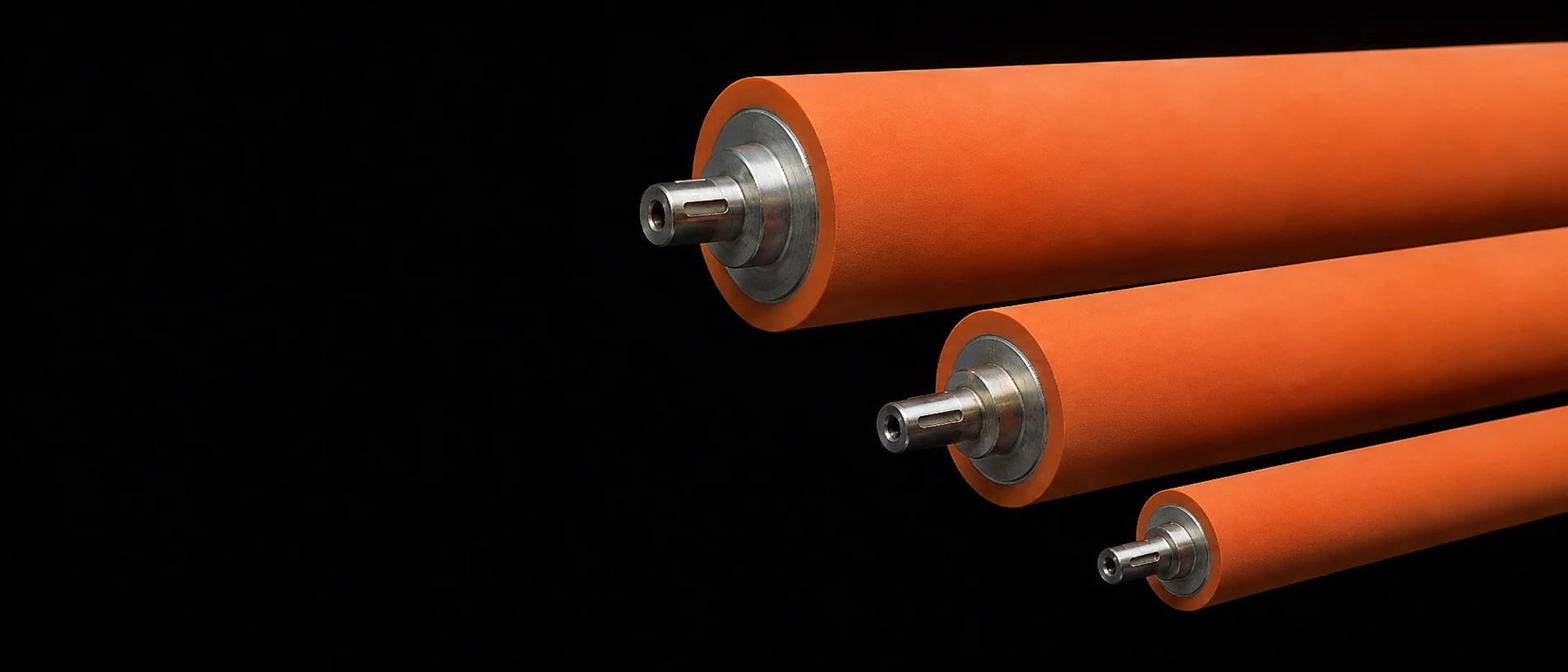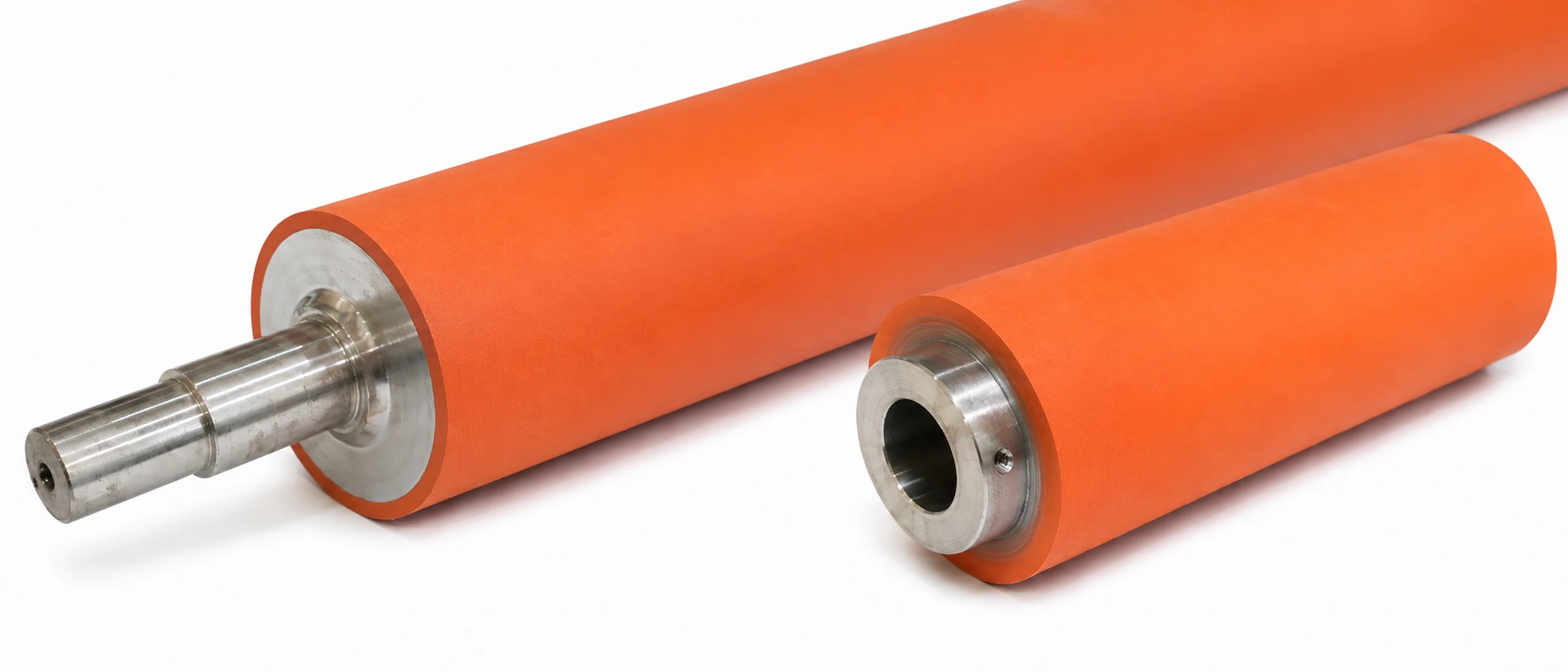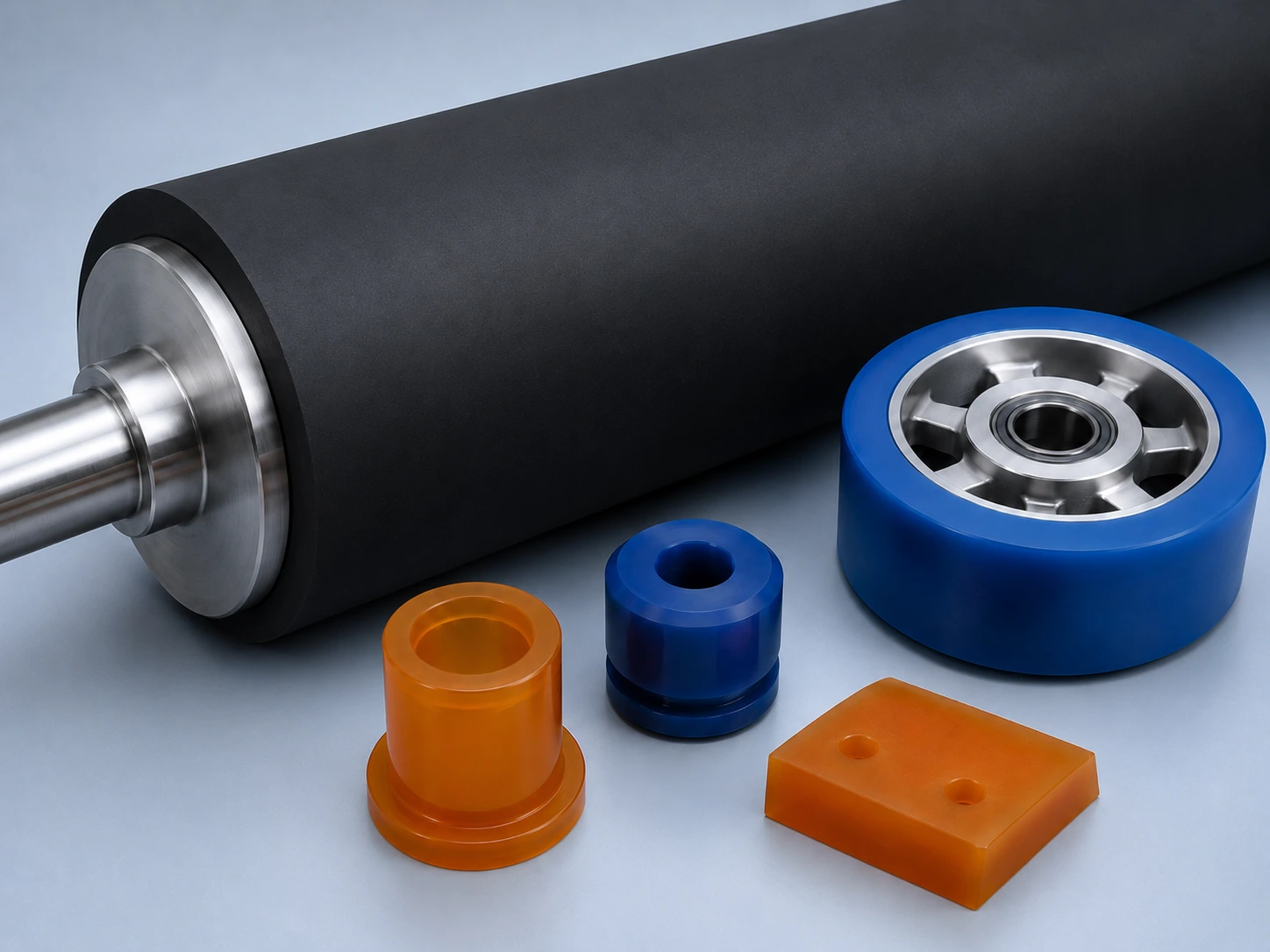
Heat sealing, hot lamination, corona treatment, food contact: silicone works where the other elastomers harden, stick or contaminate. We formulate it, we cast it and we grind it — and we know its limits too.
Silicone —
It's a specialist, not a generalist — and this page owns both halves of that sentence. We'll tell you where silicone is unbeatable, and where rubber or an polyurethane are the better choice.
Related expertise: roller covering, grinding and surface finish, material selection and nip and laminating rollers.
Three properties, one origin: the chemistry of the silicon-oxygen backbone.
Depending on the grade, silicone holds its properties over a very wide temperature range: many VMQ compounds run from about −50 °C to +200 °C for common grades, and specialized formulations go up to +260 °C. Past the useful range of many organic rubbers, it keeps its flexibility — thermal cycle after thermal cycle.
Its very low surface energy means hot adhesives, heat-sealed films and wet coatings release cleanly. That's the property that makes it irreplaceable for hot release — and that makes it hard to bond to a core.
Formulations that can meet the applicable FDA requirements — in particular 21 CFR 177.2600 — are available, depending on the grade and the operating conditions: inert, no migrating plasticizers, easy to clean. An elastomer widely used in demanding food applications.
The half the sales sheets leave out. Silicone pays for its three strengths with real mechanical weakness — knowing that up front avoids expensive disappointments.
| Critère | Silicone | Nitrile | EPDM | Polyuréthane |
|---|---|---|---|---|
| Température élevée | Excellent | Limité | Bon (eau chaude, vapeur) | Limité |
| Relâchement / antiadhérence | Excellent | Faible | Faible | Faible à moyen |
| Abrasion | Faible | Bonne | Moyenne | Excellente |
| Coupure / déchirure | Faible | Bonne | Moyenne | Excellente |
| Charge mécanique | Limitée | Bonne | Bonne | Excellente |
| Propriétés diélectriques | Excellentes | Faibles | Bonnes | Variables selon formulation |
| Grades alimentaires | Oui, courants | Nitrile blanc FDA selon le cas | Oui, selon grade | Selon formulation |
Qualitative comparison, for guidance only: every cell is validated by grade and by application. The detail on each family is in the material selection guide and on the pages for rubber rollers and polyurethane rollers.
If your position calls for none of these —
The positions where its three territories — heat, release, purity — are the very definition of the job.

Welding a film under heat and pressure without the seal sticking to the roller. Silicone's signature position: bag making, flexible packaging, lidding.
Bonding layers together under heat while releasing the molten adhesive cleanly. Heat resistance and non-stick working together.
The insulating backing roll of the corona station. Excellent dielectric properties and good aging resistance — but the cover is still exposed to electrical stress, localized heat and accidental arcing : its integrity has to be monitored.
Conveying, transfer and processing in direct contact with the food, with FDA-compliant grades and a surface that cleans without soaking anything up.
Picking up, guiding or transferring product that's still hot without sticking to it or marking it. Note: silicone is chosen here for its heat resistance and its release, not to cool — it's a relative thermal insulator, which sets it apart from a true metal chill roll.
Picking up product that's still hot — a varnished panel, a painted part, a coated textile — without marking the finish or sticking to it.
When the applied product has to transfer completely to the substrate instead of staying on the roller. See also applicator rollers.
Repeated heat and pressure on the fabric, with no unwanted glazing and no transfer. Grades are selected to the calender temperature.
Interchangeable sleeves to change function without tying up the machine — common on corona and sealing stations.
Heated films that shrink on contact: the roller has to take the heat and release the film every cycle.
Does your position combine heat and tack some other way? Describe it to us — the function decides, not the name. See also other roller families.
We start from your core — and with silicone, the bonding system is half the job.
| Intervention | Ce que ça règle sur un rouleau silicone |
|---|---|
| Choix du grade | Plusieurs grades disponibles : dureté, tenue thermique, conformité alimentaire FDA et propriétés diélectriques s'ajustent au poste. |
| Adhérisation spécifique au silicone | La faible énergie de surface qui rend le silicone antiadhérent le rend aussi difficile à coller : préparation et primaires dédiés, sans quoi le recouvrement se décolle sous cycles thermiques. |
| Recouvrement et vulcanisation | Application du grade retenu sur votre mandrin existant, du souple au ferme — typiquement de l'ordre de 30 à 80 Shore A. |
| Rectification de précision | Diamètre, cylindricité, faux-rond et fini adaptés — un rouleau de scellage marque la soudure s'il n'est pas rond. |
| Essai de compatibilité | Validation sur échantillon face à vos produits et vos nettoyants — le silicone a ses fluides ennemis, notamment les huiles silicone. |
| Réparation du mandrin, des portées et des tourillons | Les postes chauds fatiguent la mécanique autant que le recouvrement. |
| Caractérisation et rétro-ingénierie | Quand le rouleau d'origine n'est plus documenté : relevé de la dureté, des dimensions, de la construction et du mode d'usure, analyse des conditions réelles du poste, puis sélection d'un grade de remplacement approprié — avec essais de compatibilité lorsque l'application l'exige. |
| Contrôle et traçabilité | Dureté relevée sur la face, dimensions, faux-rond, fini — consignés pour la pièce, avec la documentation du grade alimentaire lorsqu'il y a lieu. |
Capabilities: machining up to
What sets silicone apart on the inside — and what that changes in service.
| Propriété | Valeur typique |
|---|---|
| Plage de température utile | −115 °C à +260 °C et plus (−175 °F à 500+ °F) |
| Dureté, Shore A | 20 à 90 |
| Résistance à la traction | jusqu'à 1600 psi (≈ 11 MPa) |
| Allongement à la rupture | jusqu'à 1000 % |
| Résistance à la déchirure | jusqu'à 300 ppi |
| Déformation rémanente à la compression | aussi basse que 8 % |
| Densité (gravité spécifique) | 1,0 à 2,1 |
| Résistivité volumique | 10¹⁵ à 10¹⁷ Ohm·cm |
| Rigidité diélectrique | 600 à 650 volt/mil |
| Constante diélectrique (60 cps) | 3,0 à 3,5 |
General values for the silicone family (VMQ), all formulations taken together — to be validated grade by grade for your application. The
Organic rubbers are built on carbon-carbon chains; silicone, on chains of
The same backbone stays flexible in deep cold — that's why the service range extends in both directions: on the order of −50 °C to +200 °C for common grades, and up to +260 °C for specialized formulations (see the property table below).
The trade-off: that chain tears more easily under mechanical stress. The chemistry that gives the heat resistance is the same one that limits cut resistance.
For a material to adhere to a surface, it has to be able to spread on it — to wet it. Silicone has
In service, that shows up as a heat seal that doesn't stick to the roller, a lamination that releases excess adhesive, hot product that picks up cleanly.
The flip side is real:
The backing roll of a corona station has to be insulating and has to live in the environment the discharge creates. Silicone excels there: excellent dielectric properties and good aging resistance.
But to be straight about it: the cover is still exposed to
So a corona roller gets watched — surface condition, durometer — and gets recovered when it loses its integrity. We can set the interval with you based on your running hours.
“Silicone” covers a family of formulations, not a single material. The grades differ in
A heat sealing roller working irregular surfaces calls for a soft, conforming grade; a laminating nip, a firmer grade that holds the pressure; a food position, a documented FDA grade.
That's why we ask about the position before proposing a grade — and why we keep several grades rather than one do-everything silicone.
A paradox shops know well: silicone swells in particular in contact with
Some solvents and hydrocarbons attack it too. As with every family, the only reliable answer is a
The approach is the same as on our applicator rollers : validate both liquids, the process one and the washdown one.
1. Condition survey: durometer at several points, dimensions, runout, surface condition — and a check for swelling or corona erosion.
2. Identification of the existing grade and validation of the selected grade, backed by an immersion test if the chemistry is in play.
3. Stripping of the old cover, inspection of the core, the bearing journals and the journals.
4. Surface preparation and
5. Application of the selected grade and vulcanization.
6. Grinding to the target diameter and finish.
7. Final inspection and traceability, FDA documentation included where applicable. Full detail in our roll covering process.
The symptoms specific to silicone rollers, and what they usually mean.
| Symptôme | Cause probable | Correction |
|---|---|---|
| La soudure ou l'adhésif commence à coller au rouleau | Surface encrassée, glacée ou érodée — le relâchement se dégrade | Rectification pour retrouver la surface; révision du nettoyage. |
| Entailles et arrachements en rive | Faiblesse à la coupure du silicone face aux arêtes du produit | Soulagement des rives; vérifier si un autre élastomère convient au poste. |
| Recouvrement gonflé, mou par plaques | Huile silicone ou solvant incompatible migré dans la matière | Essai d'immersion, changement de grade ou révision des agents en contact. |
| Surface irrégulière sur un rouleau corona | Érosion lente par la décharge et l'ozone | Rectification ou regarnissage périodique — c'est l'usure normale du poste. |
| Recouvrement décollé du mandrin | Adhérisation inadaptée au silicone, aggravée par les cycles thermiques | Retrait complet, remise en état du mandrin, adhérisation spécifique refaite. |
| Marques ou brillance sur le produit scellé | Faux-rond, dureté inadaptée ou température excessive pour le grade | Rectification; révision du grade et du couple température-pression. |
| Usure rapide généralisée | Poste abrasif ou charge élevée — le silicone n'est pas la bonne matière ici | Réévaluation du matériau : nitrile, EPDM ou polyuréthane selon le poste. |
Every wear signature is covered in detail in the roller and wheel diagnostic guide.
Anywhere heat, release or purity defines the position.
Because its surface has
Depending on the grade: many VMQ compounds run from about
Yes, with the right grades: formulations that can meet the applicable FDA requirements — in particular
Because mechanically it's one of the weakest elastomers: cut, tear and abrasion well below nitrile and nowhere near polyurethane, high nip loads to avoid, and a higher cost. Silicone is a
The insulating backing roll of the station: excellent dielectric properties and good aging resistance. With one honest caveat — the cover is still exposed to
Typically on the order of
Yes — and that's where the expertise counts: the same low surface energy that makes silicone non-stick also makes it
They're two opposite specialists.
It depends on the nature of the heat.
Tell us the actual temperature at the position, what touches the roller — product, adhesive, cleaners —, the pressure applied and the food requirement if there is one. We'll propose the right silicone grade… or another material if your position doesn't need one. Both answers are fine by us.
➔ Request a quote