
In a mine or a quarry, wear never comes from a single cause. Equipment has to stand up at the same time to impact, sliding abrasive material, vibration, moisture, temperature swings and long operating hours.
Crushed ore, sand, gravel and sharp-edged rock attack chutes, conveyors, hoppers, piping and processing equipment nonstop. One localized failure can quickly turn into material spillage, a mechanical breakdown or a complete production line shutdown.
A cast polyurethane is a strong option here, not because it automatically replaces steel or rubber, but because it combines several properties that are hard to get in a single material: elasticity, abrasion resistance, tear strength, impact absorption and a formulation that can be tuned to the application. Polyurethane system manufacturers offer it for screens, trommels, hydrocyclones, scrapers, flotation cells, liners and other components exposed to heavy mining wear.
Why does mining equipment wear out so fast?
In a mining plant, several wear mechanisms can be at work in the same spot.
Sliding abrasion
Conveyed material rubs against a surface as it drops down a chute, passes through a hopper or slides across a transfer plate. Hard particles act as an abrasive and remove material a little at a time.
Particle erosion
In a pipe, a cyclone or a discharge zone, particles strike the surface over and over. Impact angle, velocity, particle size and ore concentration all drive the wear rate directly.
Impact
Large rocks dropping into an impact box, a hopper or a truck body generate very high point loads. A surface that is too rigid can deform, crack or pass the shock straight through to the structure.
Cuts and tears
Sharp edges can gouge an elastomer. A small cut becomes a real problem when the material has poor resistance to tear propagation.
Fatigue and vibration
Rollers, wheels, screens, scrapers and suspension parts go through millions of deformation cycles. Even when each load looks moderate, the accumulation can lead to fatigue, delamination or permanent deformation.
So the right material has to be selected on the
How does polyurethane extend equipment service life?
1. It deforms to absorb part of the impact
Unlike a rigid metal surface, polyurethane can compress or deflect for a moment when a rock hits it.
That deflection spreads the load over a larger area and lowers the stress concentration. When the material and the geometry are chosen correctly, the part then returns to its original shape.
That protects not only the exposed surface, but also the steel plate, the frame, the bolts and the welds behind it.
2. It offers excellent abrasion resistance
Some cast polyurethane formulations show very low material loss in standard abrasion tests. In a mining application, that can translate into slower wear in the areas where ore slides across the surface or keeps striking it.
The real-world result still depends on several factors:
- particle shape and hardness;
- their velocity and impact angle;
- the pressure applied to the part;
- temperature;
- the presence of water, oil or chemicals;
- the polyurethane formulation and durometer;
- the thickness of the part and its backing.
3. It resists cut and tear propagation
A good polyurethane formulation has to do more than resist the first gouge. It also has to keep that gouge from running.
That property matters for scrapers, conveyor skirtboard, impact plates, screens and any part exposed to sharp-edged rock.
A part that is too hard can hold up well against sliding but become more prone to chipping or cutting. A more resilient formulation takes impact better but can deform too much under a constant load. Selection therefore has to balance durometer, resilience, modulus and tear strength.
4. It eliminates direct metal-to-metal contact
Polyurethane can be cast directly onto a hub, a shaft, a plate or another metal structure.
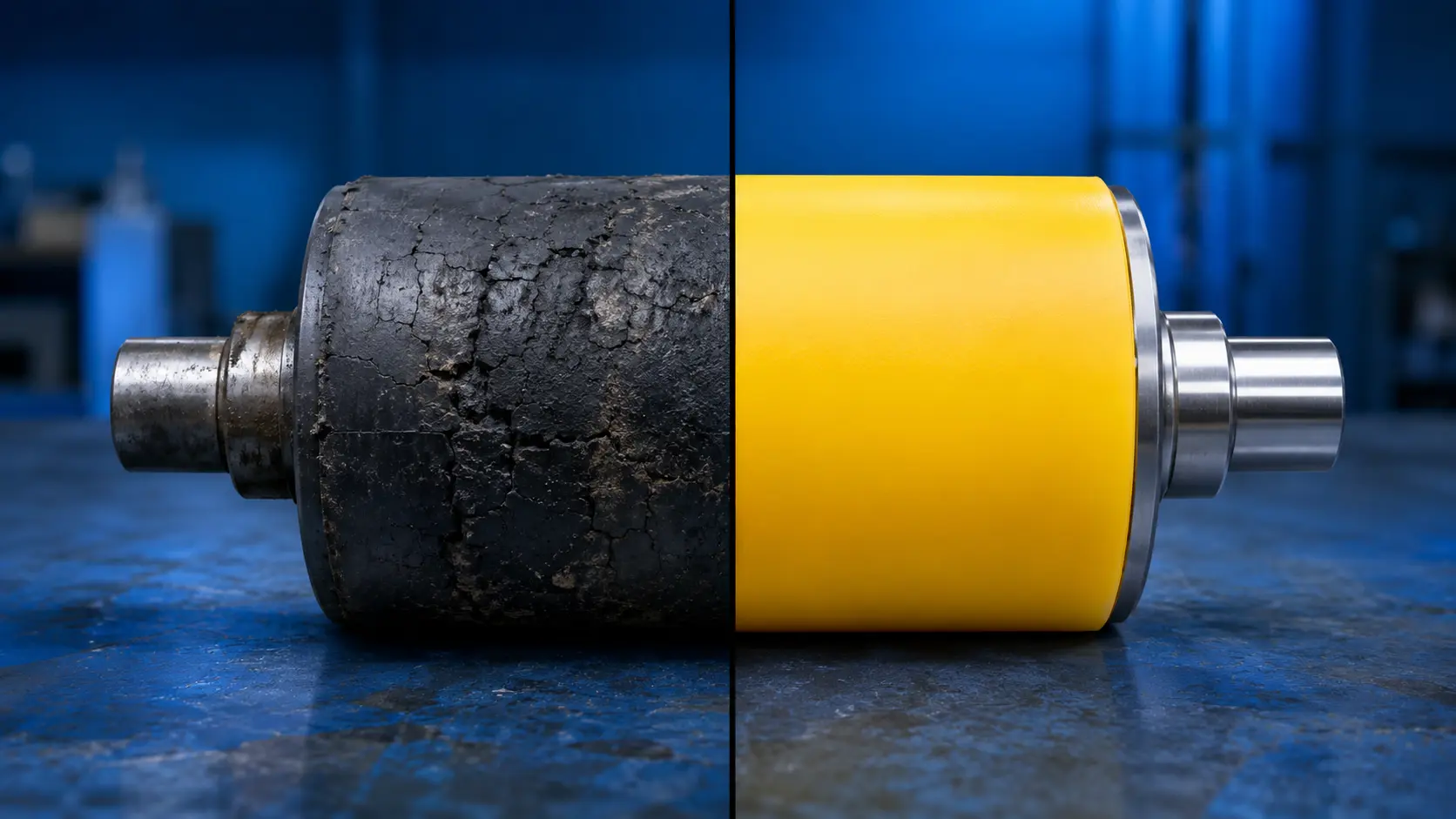
The steel core carries the stiffness and the mounting, while the polyurethane layer becomes the wear surface. This hybrid construction is especially useful for wheels, rollers, cam followers, steel-backed plates and bolted parts.
By keeping two metal components from touching, polyurethane can also cut down on hammering, vibration and noise.
5. It protects the main structure
On a lot of equipment, polyurethane is used as a sacrificial, replaceable component.
Replacing a wear plate, a wear strip or a wear module is usually simpler than rebuilding a hopper, a chute or an entire truck body. A modular design also lets you replace only the most worn area instead of pulling the whole liner.
This approach can cut down on:
- downtime;
- weld repairs;
- replacement of large structures;
- work carried out directly at the mine site;
- the risk of spillage or contamination caused by a hole worn through.
6. Its formulation can be matched to the environment
The word “polyurethane” covers a family of materials, not a single formulation.
Chemistry, durometer and additives can be adjusted to favor specific properties: abrasion, resilience, cut resistance, dynamic behavior, low-temperature flexibility, water resistance or compatibility with certain hydrocarbons.
Systems based on
The formulation still has to be validated against the exact service conditions. A material that performs well in a dry application can break down early in a hot, constantly wet environment.
7. It lets us build a part that follows the equipment exactly
Cast polyurethane can take shapes that are hard to get from a simple cut sheet.
We can produce:
- curved shapes;
- variable thicknesses;
- parts with metal inserts;
- plates with molded-in holes or anchors;
- replaceable sections;
- parts reproduced from an existing component;
- liners fitted to a specific impact zone.
A molded part that fits the structure properly reduces gaps, exposed seams and the spots where ore could work its way under the liner.
Polyurethane applications in mines and quarries
Wear plates
The polyurethane wear plates protect flat or slightly curved surfaces exposed to rubbing, erosion and moderate impact.
They can be made entirely of polyurethane or cast onto a steel backing so they can be bolted or welded to the structure.
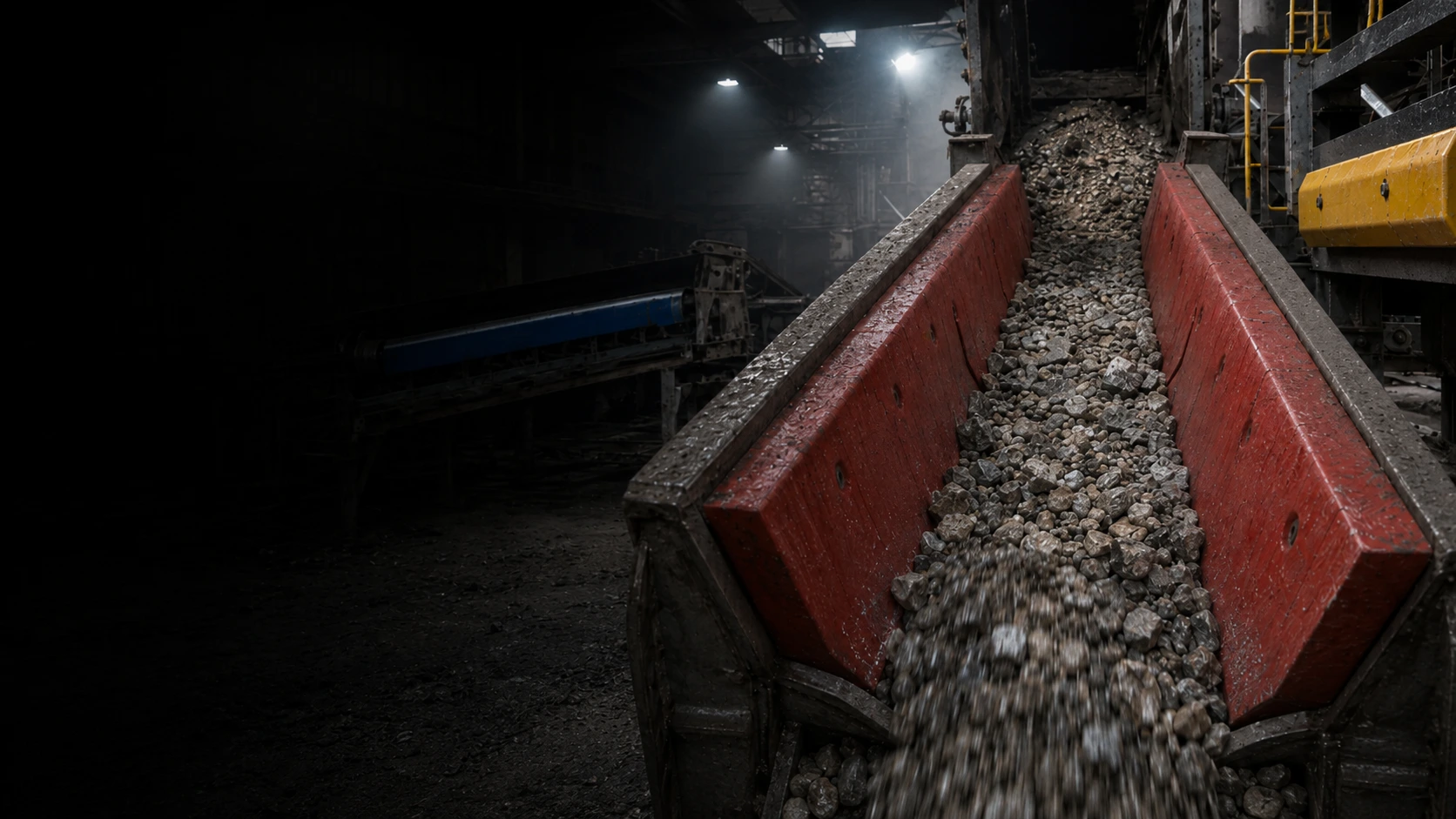
Chute and transfer point liners
Wear in a chute is not uniform. The inlet can take heavy impact, while the lower section sees mostly sliding.
So different thicknesses, durometers or constructions can be used zone by zone — see our chute and hopper liners. A proper design can also improve flow and limit material buildup.
Hoppers, dump bodies and impact boxes
A thick layer of polyurethane can absorb part of the energy released by falling rock.
In very severe areas, polyurethane can be combined with a reinforced steel structure or with ceramic elements.
Conveyor belt scrapers
Polyurethane is commonly used to make conveyor belt cleaner blades.
A blade has to be stiff enough to remove carryback, yet flexible enough to follow the movement of the belt without damaging it. It also has to resist abrasion and hold its profile in service.
Conveyor skirtboard and sealing systems
Polyurethane skirtboard can limit ore spillage and dust generation at transfer points.
A softer formulation and a well-designed geometry keep contact with the belt while limiting pressure and unnecessary wear.
Screens, screen panels and trommel parts
Polyurethane is used to make screen panels, trommel modules and flexible systems.
Its resilience helps the apertures clear themselves, while its abrasion resistance protects the surfaces exposed to ore. Screens, trommels and screening systems are in fact among the most common mining applications for cast polyurethane.
Hydrocyclones and slurry-contact components
Hydrocyclones, nozzles, piping and pump parts can face intense erosion from particle-laden slurry.
Polyurethane liners or components can protect the internal surfaces, especially when a water- and hydrolysis-resistant formulation is selected.
Piping, elbows and fittings
Changes of direction often concentrate heavy wear in pneumatic or hydraulic conveying lines.
Polyurethane can serve as an internal liner, a sleeve or a replaceable section in elbows and critical areas — see our wear nozzles and tips.
Wheels, rollers and cam followers
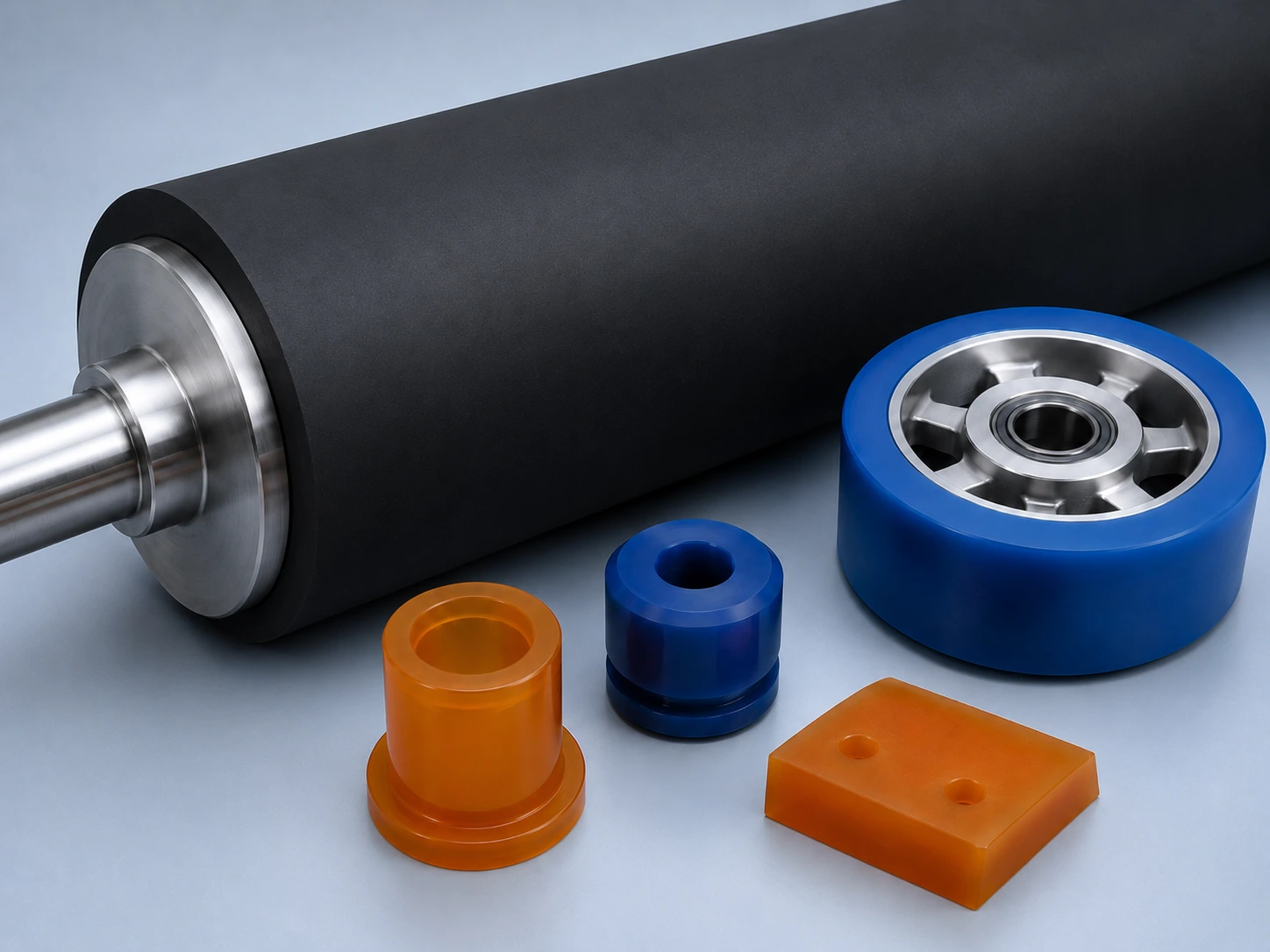
Polyurethane can be cast onto steel hubs or shafts to make wheels, drive and guide rollers and cam followers.
The metal core carries the load, while the polyurethane surface provides grip, cushioning and wear resistance. This construction can also cut noise and protect the mating surfaces.
Shims, stops and impact pads
The polyurethane bumpers are used to limit travel, absorb a shock or protect a structure from repeated contact.
They can be built with a plate, a threaded stud, an insert or an integrated metal mounting system.
Cable protectors and roadway crossings
At a mine site, power cables, hoses and lines often cross the traffic lanes. A cast polyurethane cable protector lets traffic pass over them without crushing them.
This kind of part calls for a particularly tough formulation: the load is not a pedestrian or a cart, but a haul truck or an off-highway vehicle whose every axle concentrates very high loads on a small footprint. The polyurethane needs enough modulus not to crush, while keeping enough resilience to absorb repeated passes without cracking or taking a permanent set.
Depending on the project, a cable protector can be built with channels sized to your cables, a removable lid, anti-slip surfaces, approach ramps and interlocking sections that cover the exact width of the crossing. Because it is a cast part, the number of channels, the wall thickness and the geometry can be matched to the actual load instead of being dictated by a stock size.
Protective curtains and flexible shields
Flexible sheets or sections can serve as splash curtains, dividers or shields in certain processing areas.
The flexibility of the material lets it absorb impact without the permanent deformation you get with thin sheet metal.
Off-road tire sidewall protection
Custom polyurethane protector segments can be made and mounted on the outside, around the sidewalls of mining vehicle tires, to reduce the risk of cuts or punctures from rock.
We do not replace the tire: we extend its life. A segmented build also makes it easier to replace one damaged section without changing the whole protector.
Flotation components and submerged parts
Some hydrolysis-resistant formulations can be used for wheels, rotors, stators, flotation cells and other components that run continuously in water and mineral slurry.
Polyurethane with ceramic: hybrid protection
Where sliding abrasion is extremely severe, ceramic tiles, cylinders or elements can be embedded in a polyurethane matrix — see our ceramic + polyurethane wear plates.
The ceramic provides a very hard surface against wear, while the polyurethane:
- absorbs part of the impact;
- holds the ceramic elements in place;
- reduces stress concentrations;
- allows a flexible or semi-rigid panel to be built;
- makes it easy to integrate a steel backing.
This combination is especially useful when the surface has to handle abrasive sliding and impact at the same time.
It is not needed in every application, though. A plain polyurethane plate can be more economical and more suitable when impact, flexibility or ease of replacement is the priority.
Polyurethane is not automatically the best answer
For all its advantages, polyurethane has limits.
Excessive temperature can soften the material or accelerate its aging. The wrong formulation can be sensitive to hydrolysis, to certain chemicals or to hydrocarbons. A part under rapid dynamic deformation can also generate heat build-up inside the material.
In some crushing, grinding or highly concentrated impact areas, an abrasion-resistant steel, a specialty rubber, a ceramic or a hybrid construction may still be the better fit. Some rubber compounds are in fact still preferred in specific applications such as certain hoppers, certain mills and certain crushers.
So the choice has to account for the whole service condition:
- ore type;
- particle size;
- drop height;
- material velocity;
- dry or wet abrasion;
- minimum and maximum temperature;
- presence of water, oil or chemicals;
- impact frequency and duration;
- mounting method;
- downtime available for maintenance;
- total cost of replacement.
Design the protection around the wear problem
Shore hardness alone is not enough to select a mining polyurethane.
Two materials at the same durometer can behave very differently in resilience, tear strength, compression, heat build-up and moisture resistance.
So before a part gets made, it is important to identify:
- exactly where the wear starts;
- the main mechanism: impact, sliding, cutting or erosion;
- the direction the material travels;
- particle size and velocity;
- the environmental conditions;
- the current service life of the part;
- how the part has to be removed and replaced.
Effective protection is not just a matter of adding more material. It is a matter of putting the right formulation, the right thickness and the right mounting system in the right place.
Cut downtime instead of just replacing parts
The main advantage of a well-designed wear part is not measured by the price of the part alone.
Longer service life can cut unplanned downtime, emergency calls, field repairs and lost production. A modular design can also let you replace a small section during a planned shutdown, instead of waiting until a whole structure is worn through.
We build cast polyurethane parts matched to real service conditions: wear plates, scrapers, wheels, rollers, cam followers, bumpers, sleeves, parts bonded to metal, tire sidewall protectors, cable protectors for traffic lanes and custom components. Depending on the project, a part can be reproduced from an existing sample, modified to fix a wear zone or fully redesigned to simplify installation and replacement.
The goal is not just to supply a polyurethane part. It is to design a wear surface that protects the equipment, reduces service calls and stays predictable in the hard conditions of a mining operation.
Frequently asked questions
Quelle dureté de polyuréthane choisir pour une pièce d'usure minière ? +
Polyuréthane ou caoutchouc pour un équipement minier ? +
Pouvez-vous reproduire une pièce d'usure minière existante sans plan ? +
A chute wearing through, a scraper that will not hold up, a wear part you need to last longer?
Tell us about your wear problem