Covering & manufacturing · rubber and polyurethane · Quebec450 664-4000·1 800 361-5588·EN|FR
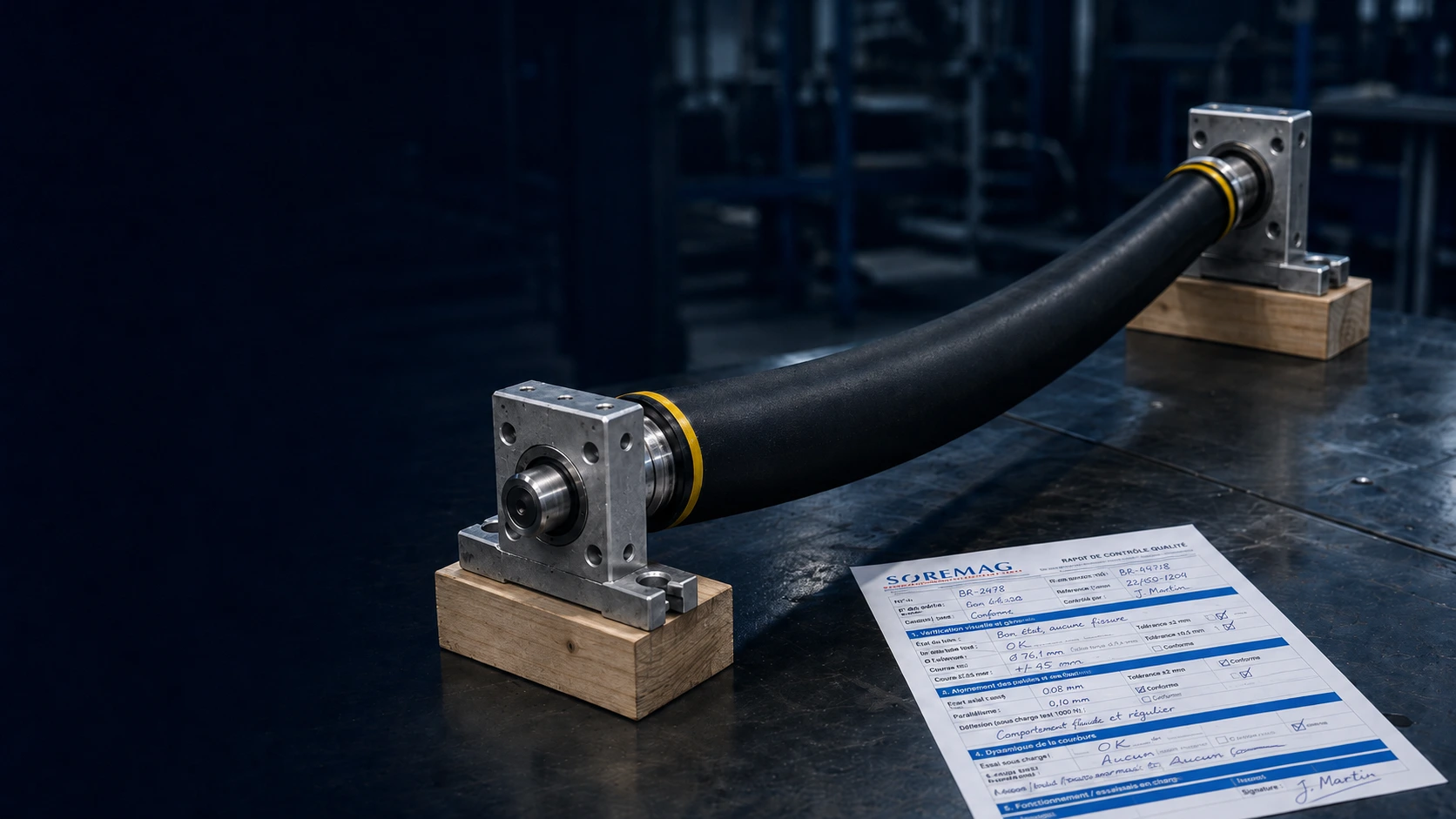
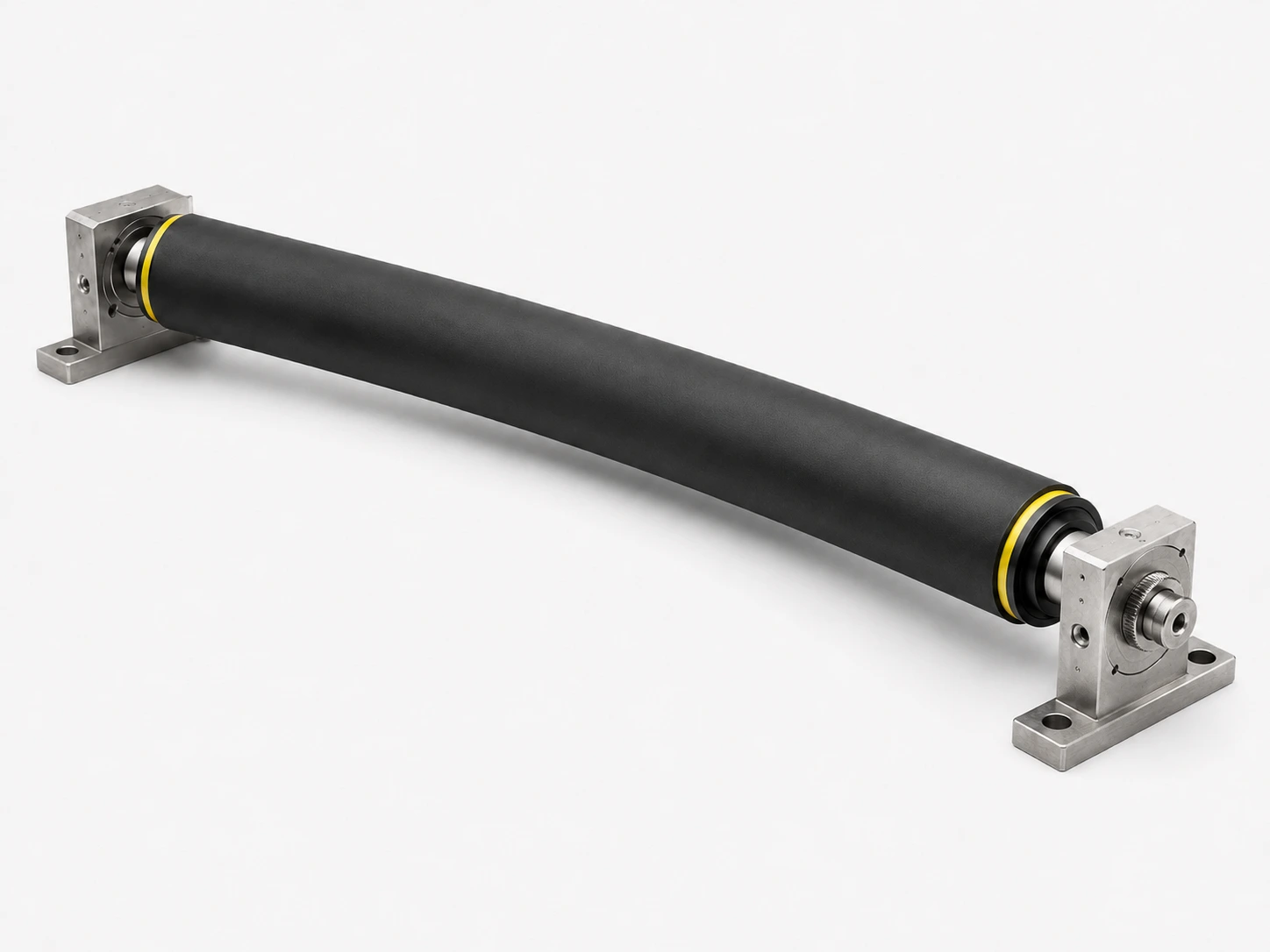
Rouleau déplisseur courbe recouvert d'une gaine élastomère (bow roll / spreader / expander) qui étale une bande à plat
Produits · Spécialité

Curved spreader rollers in rubber and polyurethane

Also called bowed roll, bow roll, spreader or expander: we cover, grind, groove, balance and refurbish your spreader rollers — for a flat web, with no wrinkles.

Covering and refurbishment of spreader rollers

A curved spreader roller (bowed roll / bow roll / expander) is a cylinder with a slightly bowed axis, covered with an elastomer sleeve, that stretches the web across its width to remove wrinkles and waves before winding or before a critical operation.

Soremag does not build the new curved-shaft mechanism: we take care of the

roll covering
and
refurbishment
of your existing roller — elastomer sleeve, precision grinding, grooving, dynamic balancing and bearings. We can also advise you on the right elastomer for the application.

Our complementary expertise: roll covering, grinding, grooving and dynamic balancing.

How a spreader roller removes wrinkles

The axis of the roller is bowed. The web, under tension on the sleeve, tends to enter perpendicular to the axis (the normal entry rule) and is forced to widen toward the edges: a positive cross-web tension is created that cancels the compression responsible for the wrinkles. The rubber sleeve, stretched on the convex side, actively takes part in the spreading.

What Soremag does on your spreader rollers

We start from your existing roller and bring it back to size and back into service — on the curved geometry.

ServiceÀ quoi ça sert
Regarnissage (recouvrement) du manchonNouvelle gaine élastomère continue, adhérence et étalement rétablis.
Rectification (meulage)Diamètre, cylindricité, faux-rond et fini remis aux cotes sur la géométrie courbe.
Rainurage (chevron / anti-air)Évacue l'air à haute vitesse pour garder la traction (anti-aquaplaning).
Équilibrage dynamiqueChaque segment équilibré pour éliminer les vibrations à haute vitesse.
Roulements & segmentsRemplacement des roulements scellés, joints et segments grippés.
Réparation & inspectionDiagnostic, remise en état, contrôle avant retour en production.
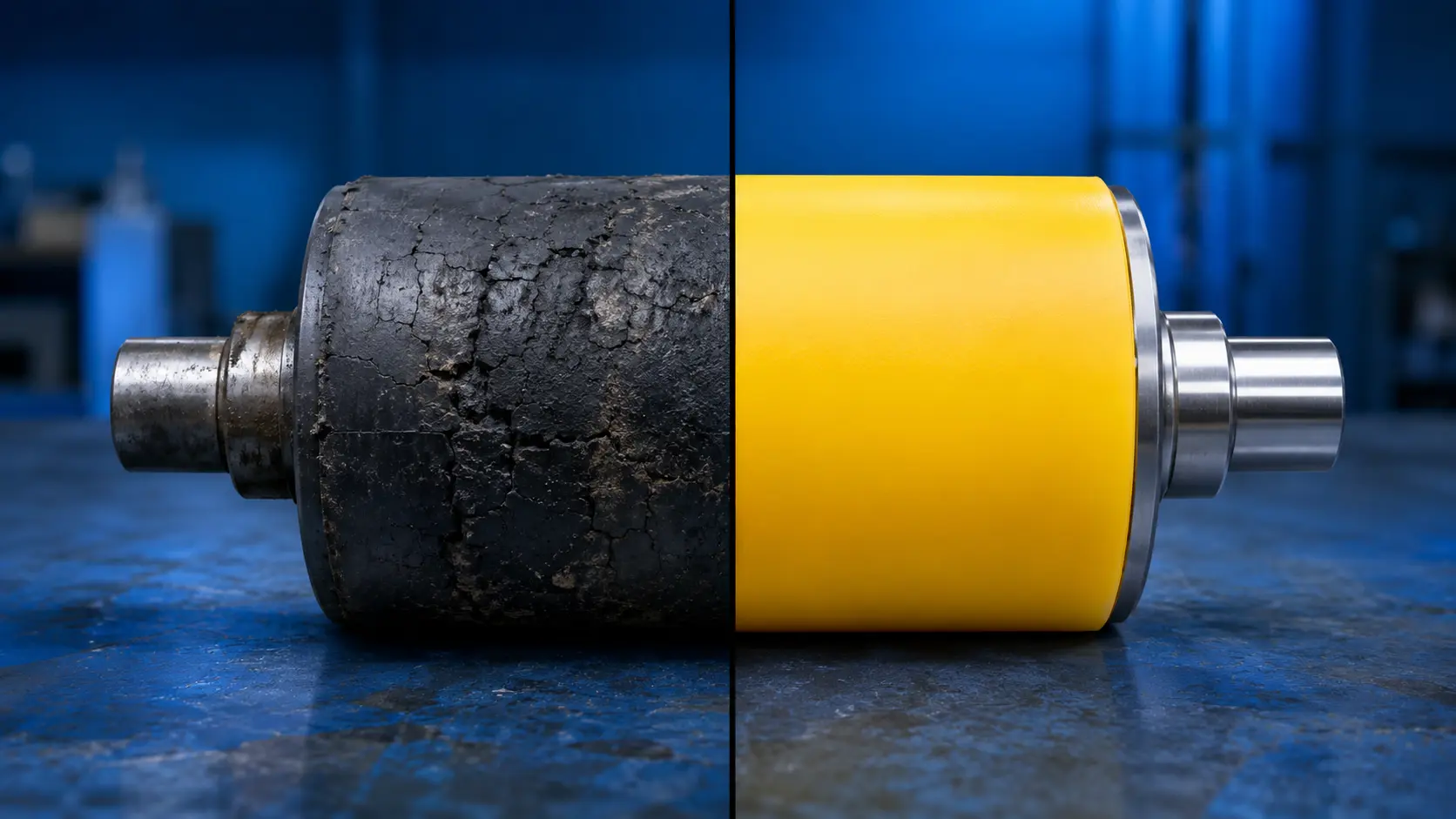
Manchon élastomère regarni sur un rouleau déplisseur courbe en atelier / re-covered curved spreader roll sleeve

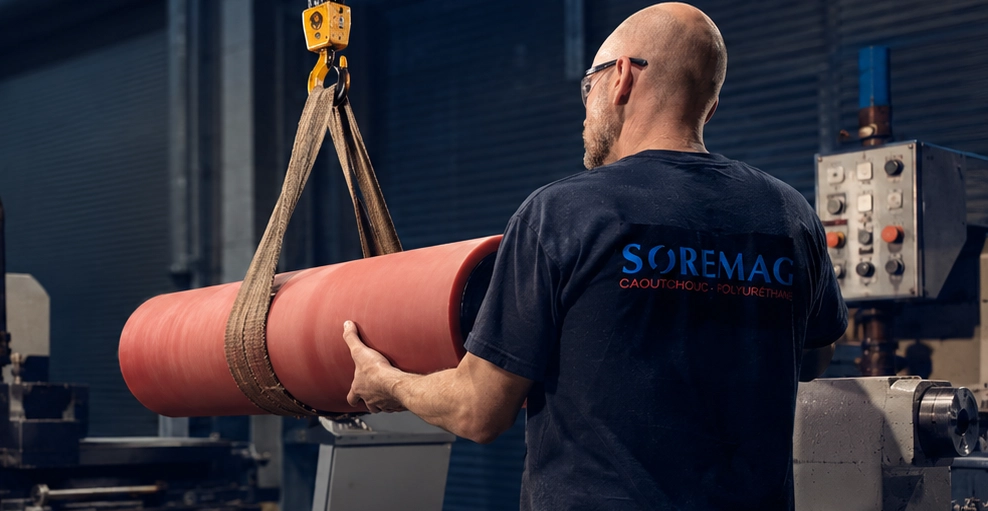
Recovering the elastomer sleeve on a curved spreader roller.

Which material for the sleeve

We choose the elastomer according to the heat, the chemistry and the abrasion of your application.

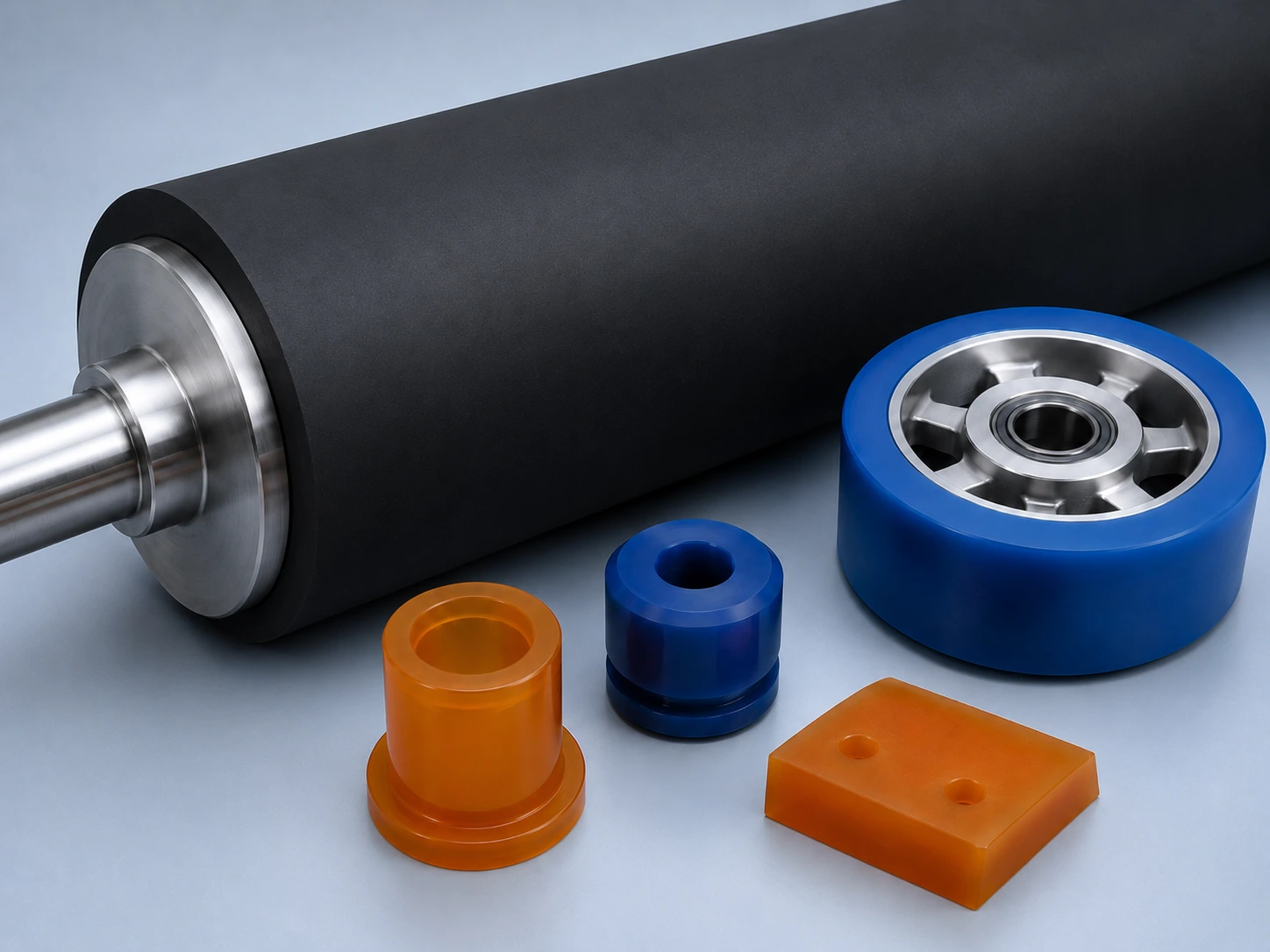
Natural rubber (NR) — resilience, dry paper Nitrile (NBR / XNBR) — oils, inks, printing EPDM — steam, hot water, acids, paper wet end CSM, formerly sold as Hypalon® — plastic films, aggressive chemistry Silicone — heat, release, dryers Polyurethane — abrasion, heavy loads (wood, metal)

To choose, see the material selection guide.

The technical detail

What makes a spreader roller work well — and what we recondition.

Traction et anti-aquaplaning

At high speed, a layer of air works its way into the contact between the web and the sleeve. Without traction, the web slips on the roller and the wrinkles come back: the spreading no longer happens.

A

herringbone grooving
forces this air out and restores the traction. The contact pressure follows the relation
P = T / R
(web tension divided by the radius), hence the importance of the geometry and the surface.

Réglages d'installation (à respecter)

Wrap angle
: 15 to 30° of web/roller contact.

Entry/exit distance ratio
: about 3:1 (long entry, short exit).

Apex orientation
(the top of the bow): neutral = symmetrical spreading; turned toward the web = re-tensions a baggy center; turned the other way = straightens loose edges (with care).

Flèche fixe ou variable

Fixed bow (perma-bow)
: a fixed bow, set for a single application; rugged construction.

Variable bow (vari-bow)
: bow adjustable from 0 to about 3% of the face, to cover several materials and widths.

Remise à neuf, étape par étape

1. Disassembly and removal of the old sleeve.

2. Replacement of the bearings and the seals.

3. Dynamic balancing segment by segment.

4. Recovering the sleeve (extruded or calendered elastomer + vulcanization).

5. Precision grinding and grooving on the lathe.

6. Testing (vibration, thermal) before return to production.

Diagnosis → cause → correction

The most common symptoms on a spreader roller and how we correct them.

SymptômeCause probableCorrection
Plis persistantsPerte de traction / angle d'embarrage trop grand / apex mal orientéNettoyer et rainurer la gaine, ramener l'angle < 30°, orienter l'apex ⟂ à la bissectrice.
Chevauchement au bobinageDistance de sortie trop longueRapprocher le rouleau de l'enrouleur (ratio d'environ 3:1).
Bords déchirésArc trop prononcé / surtension latéraleRéduire l'arc, ramener l'apex en position neutre.
Broutage, bruit cycliqueRoulement grippé / balourdArrêt, réfection : roulements neufs + équilibrage dynamique.

For which industries

Anywhere a web has to stay flat, with no wrinkles, before winding or before a critical operation.

Frequently asked questions — spreader rollers

What is a bowed roll / bow roll? +

A spreader roller with a slightly bowed (curved) axis, covered with an elastomer sleeve. The web, under tension on the curved sleeve, is forced to widen toward the edges: this creates a cross-web tension that spreads the material and removes the wrinkles before winding.

Does Soremag build new spreader rollers? +

We specialize in

roll covering
and
refurbishment
: recovering, precision grinding, grooving, balancing and bearings. We start from your existing roller rather than building the new curved-shaft mechanism.

Which grooving keeps traction at high speed? +

Grooving in a

herringbone pattern
that forces out the air that works its way in between the web and the sleeve (anti-hydroplaning), to maintain the traction needed for spreading.

Which sleeve material should you choose? +

It depends on the heat, the chemistry and the abrasion: NR, NBR/XNBR, EPDM, CSM, silicone or polyurethane. See the material selection guide or describe your application to us.

Can you balance the roller and replace the bearings? +

Yes: dynamic balancing segment by segment to eliminate vibration at high speed, plus replacement of the bearings, the seals and new segments.

What wrap angle and what distances? +

A wrap angle of 15 to 30° and an entry/exit distance ratio of about 3:1 (long entry, short exit).

A spreader roller to cover or refurbish?

Send us the make, the model and the dimensions of your curved spreader roller — we take care of the covering, the precision grinding, the grooving, the balancing and the bearings. Service in Quebec, with shipping available.

➔ Request a quote