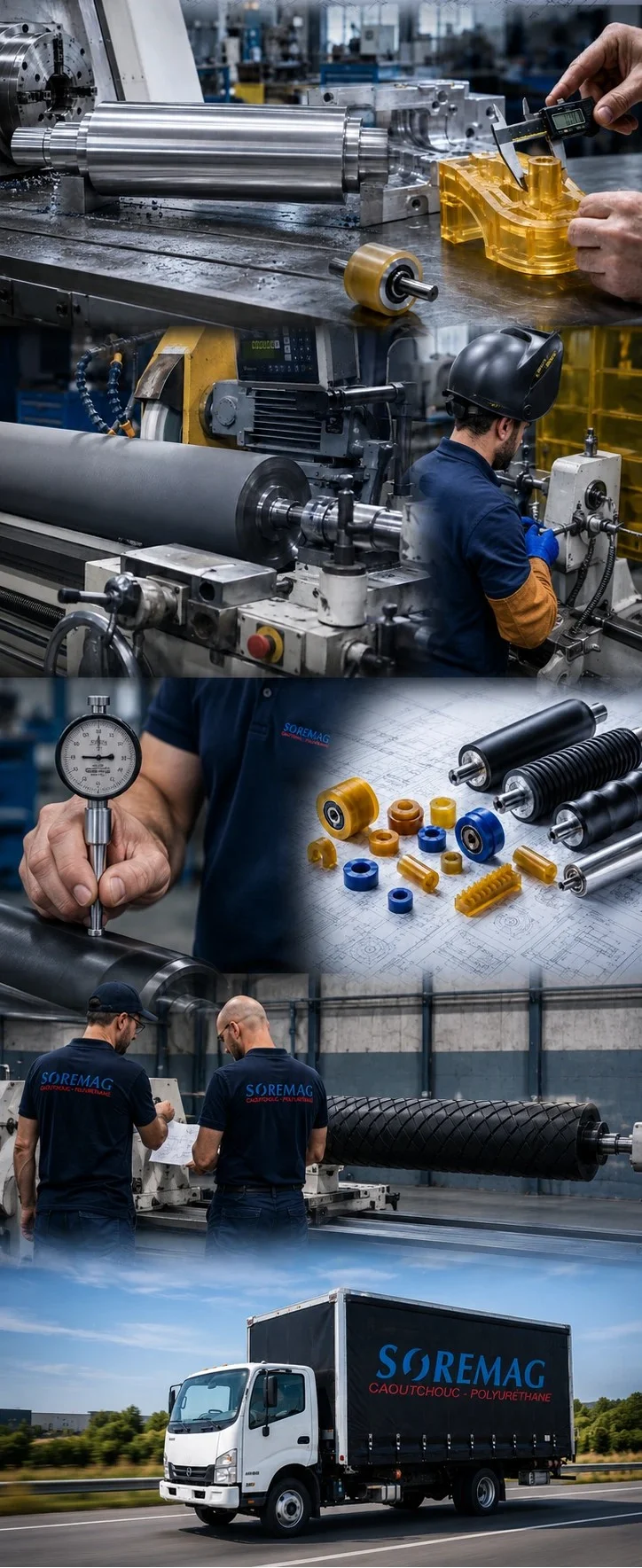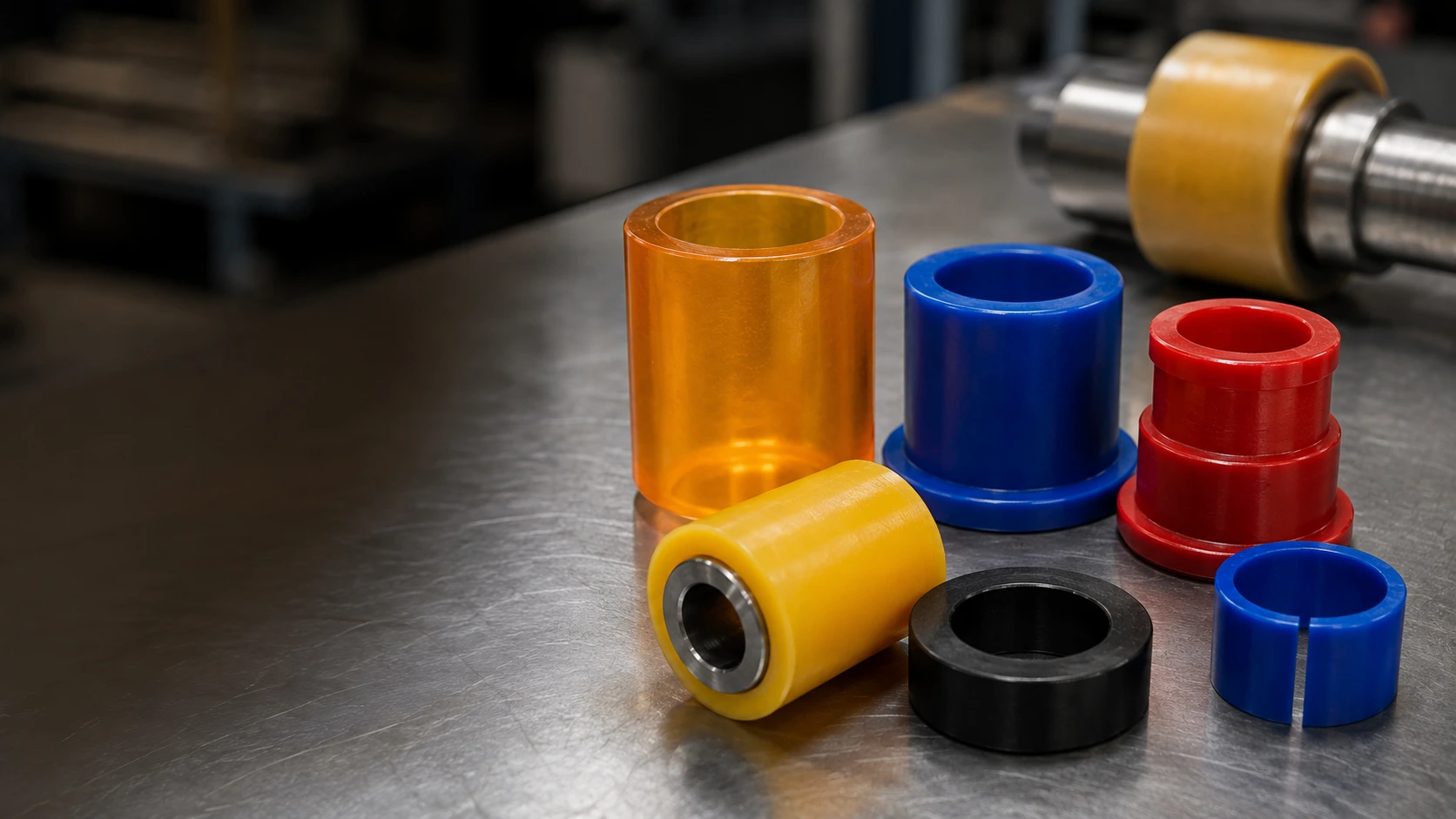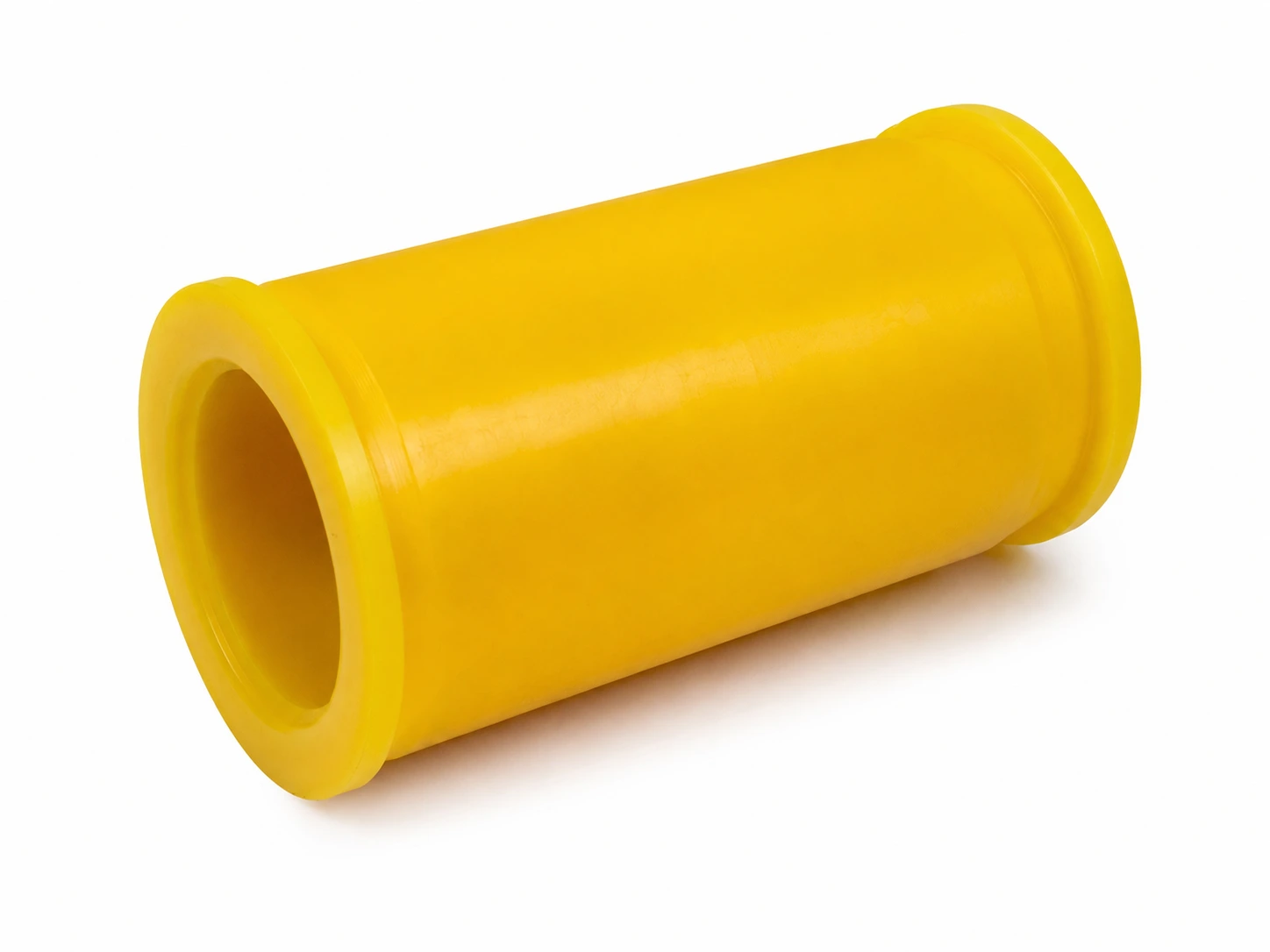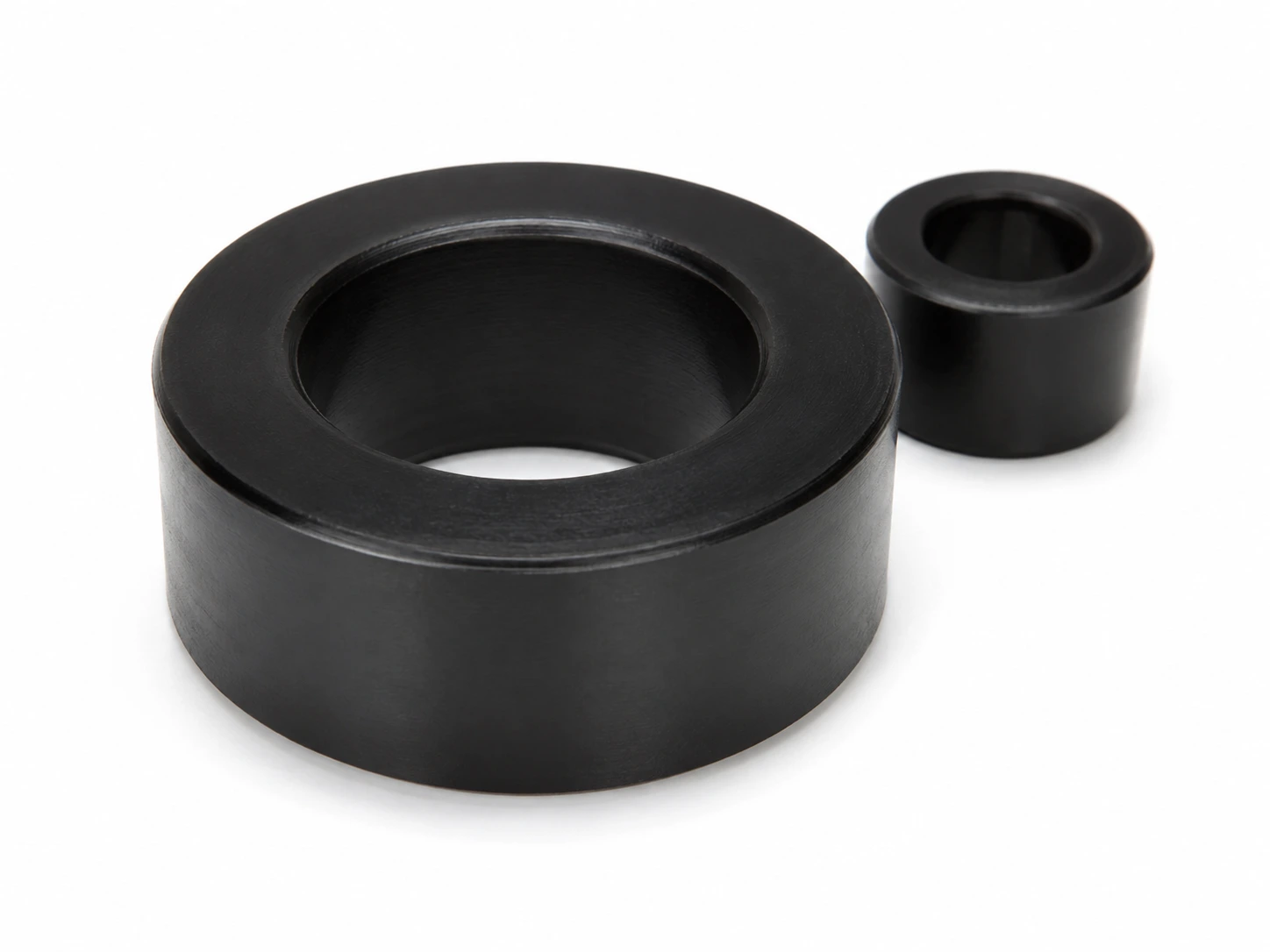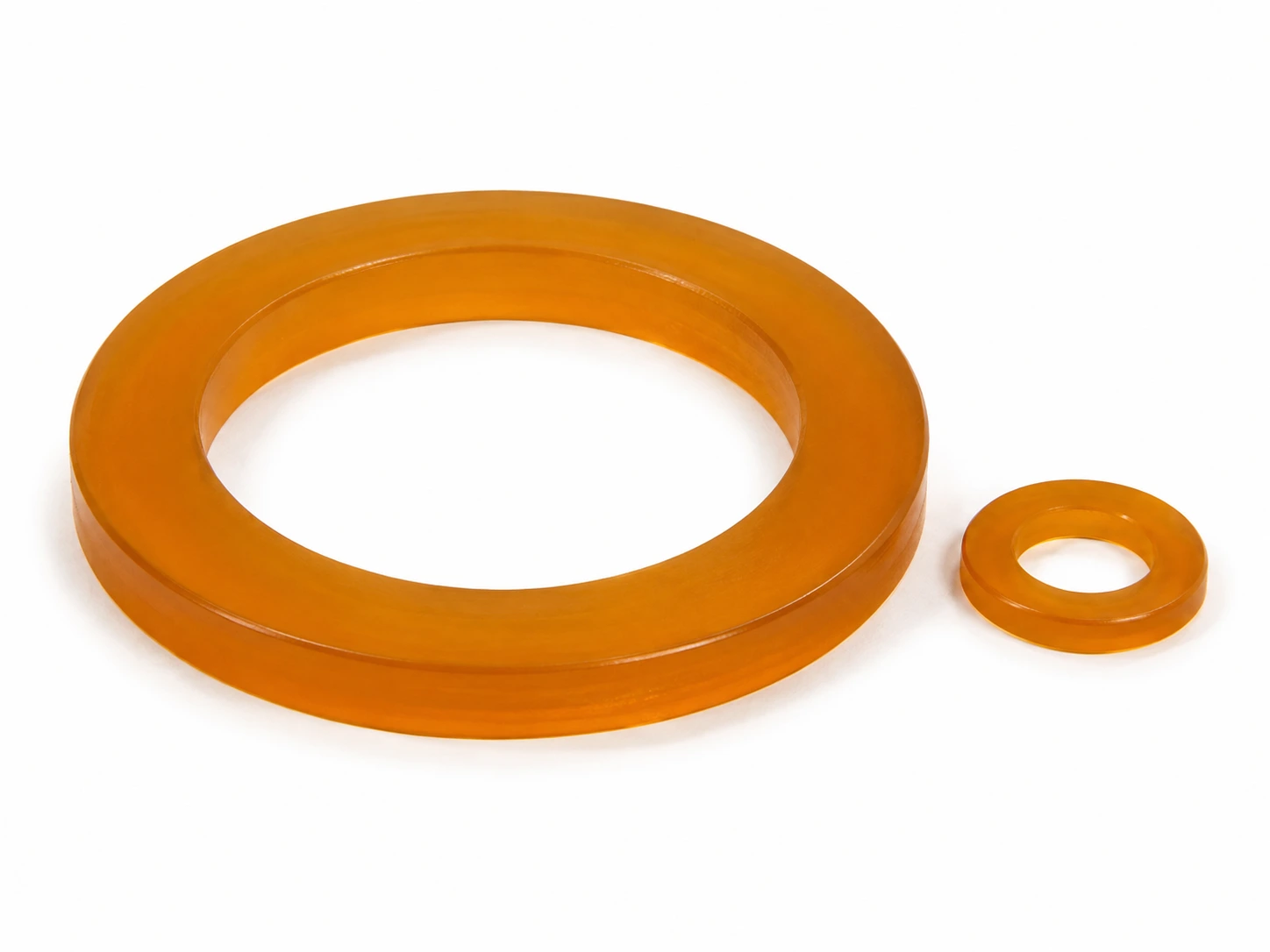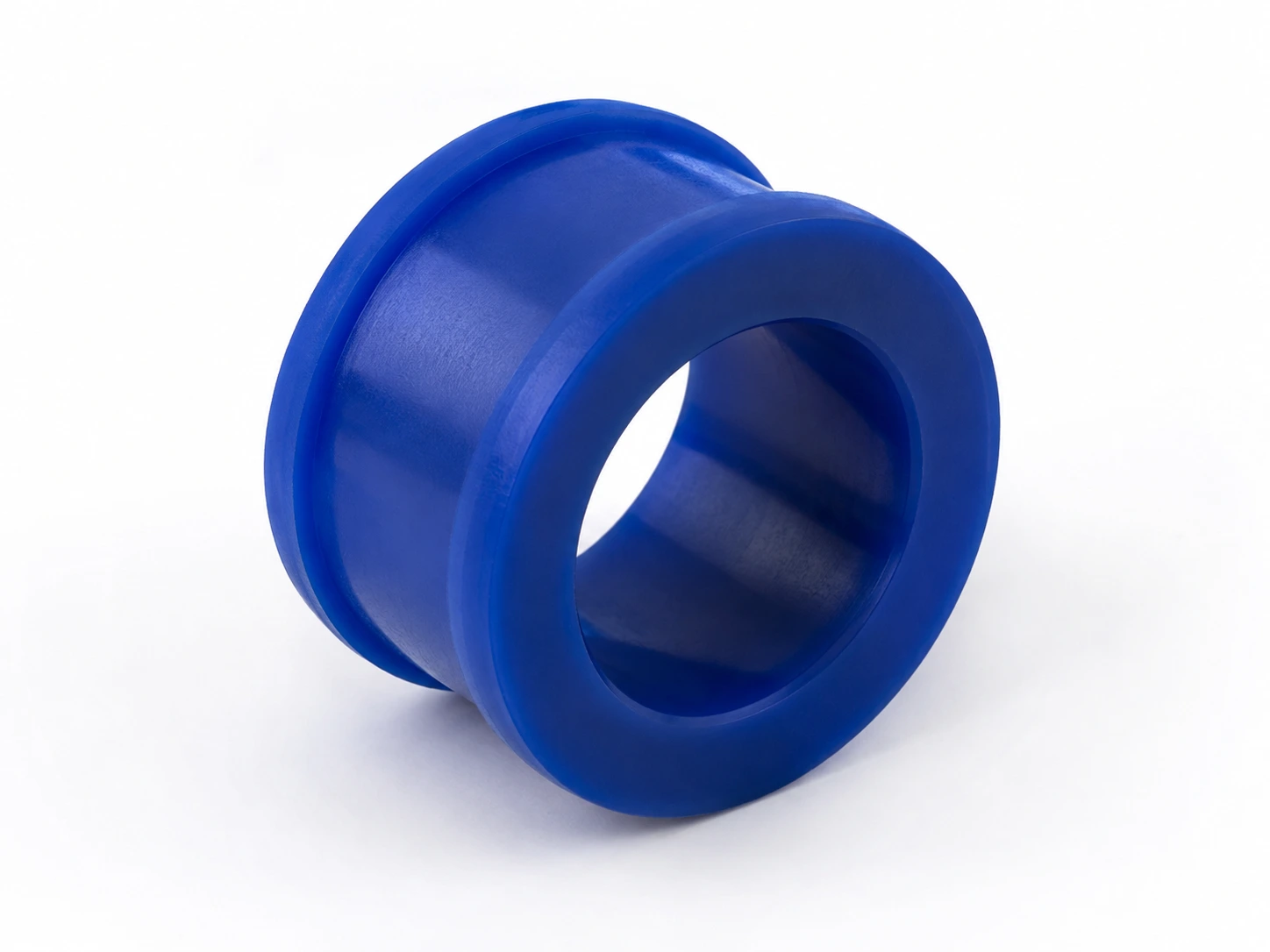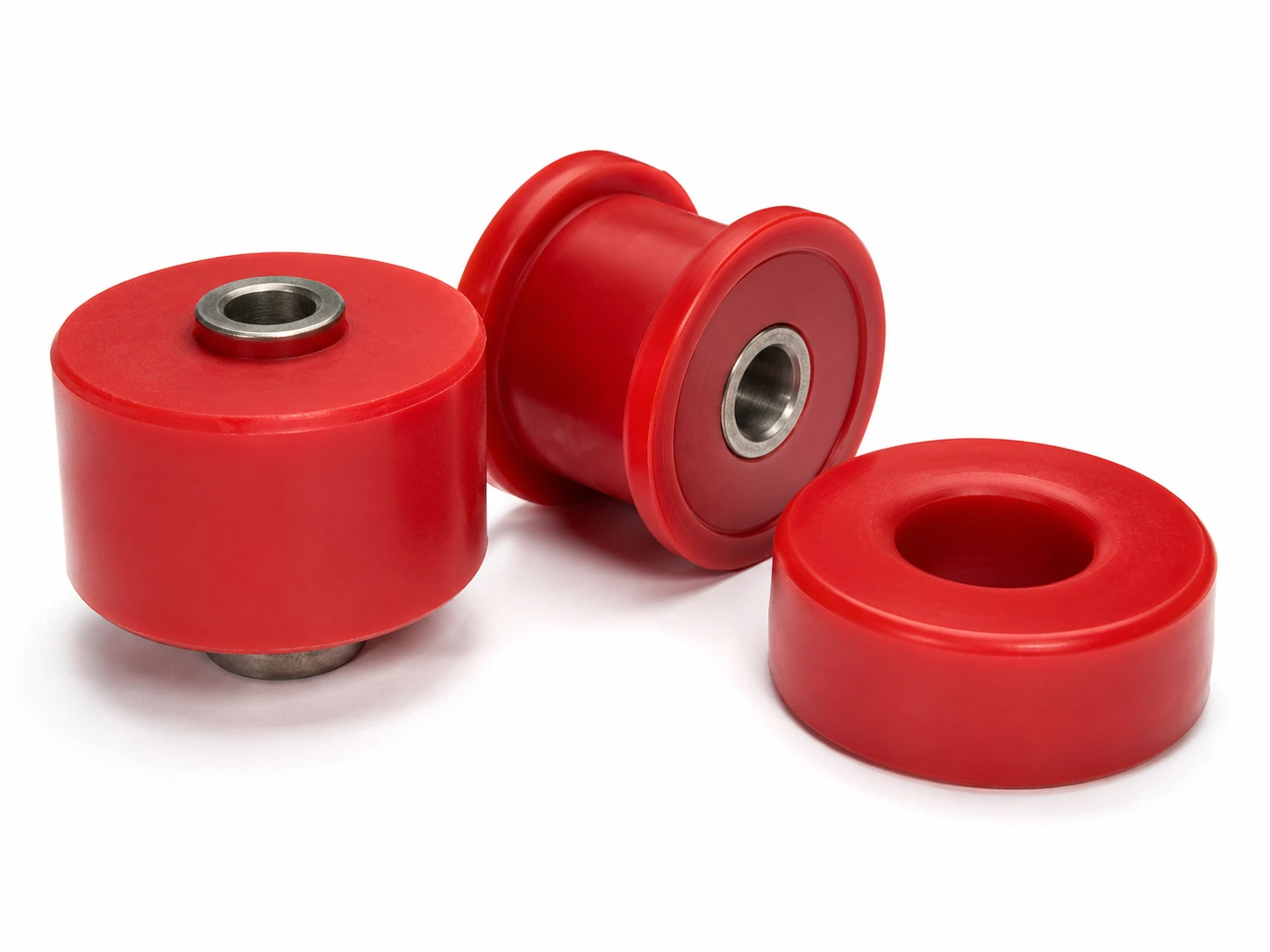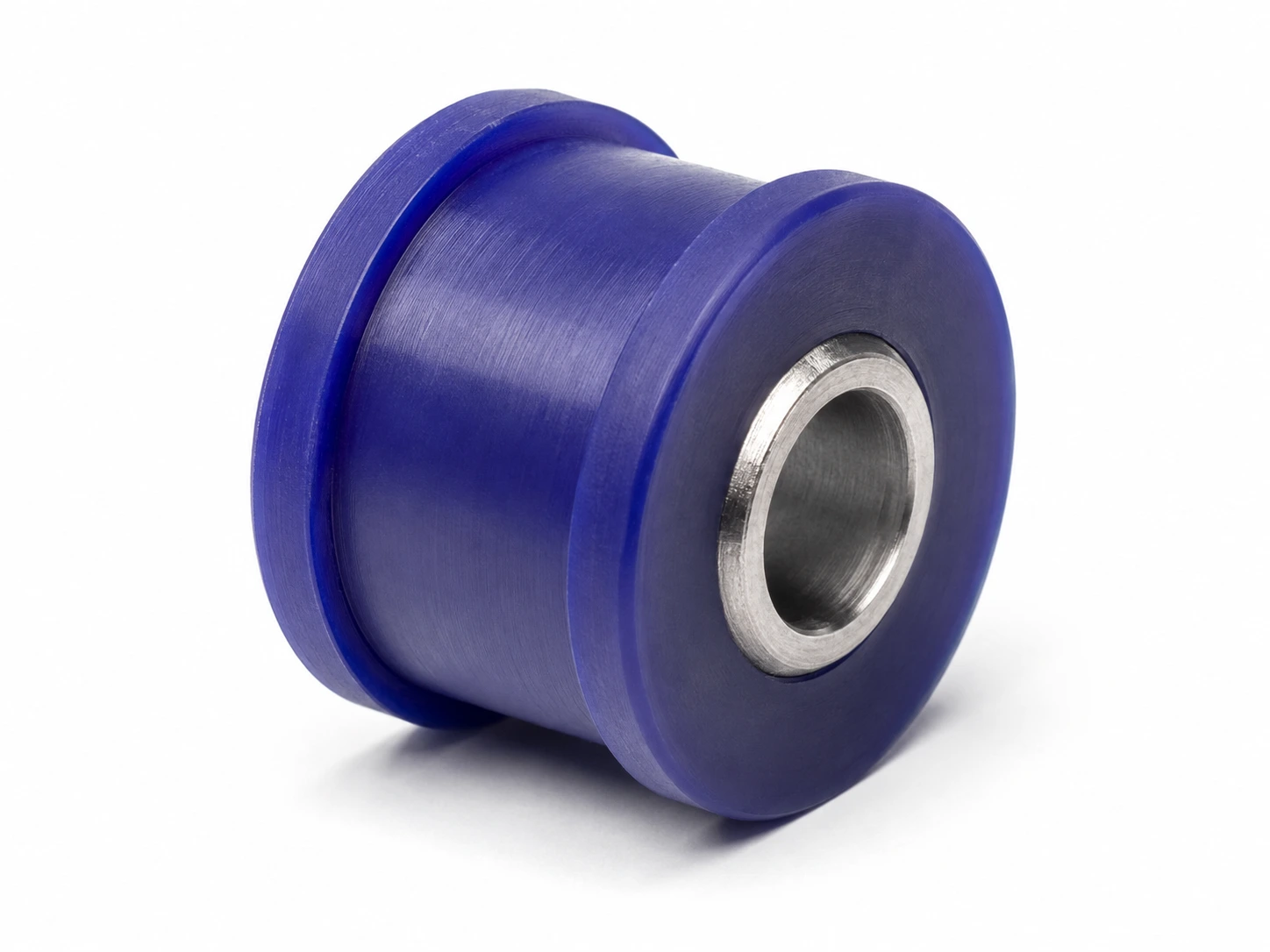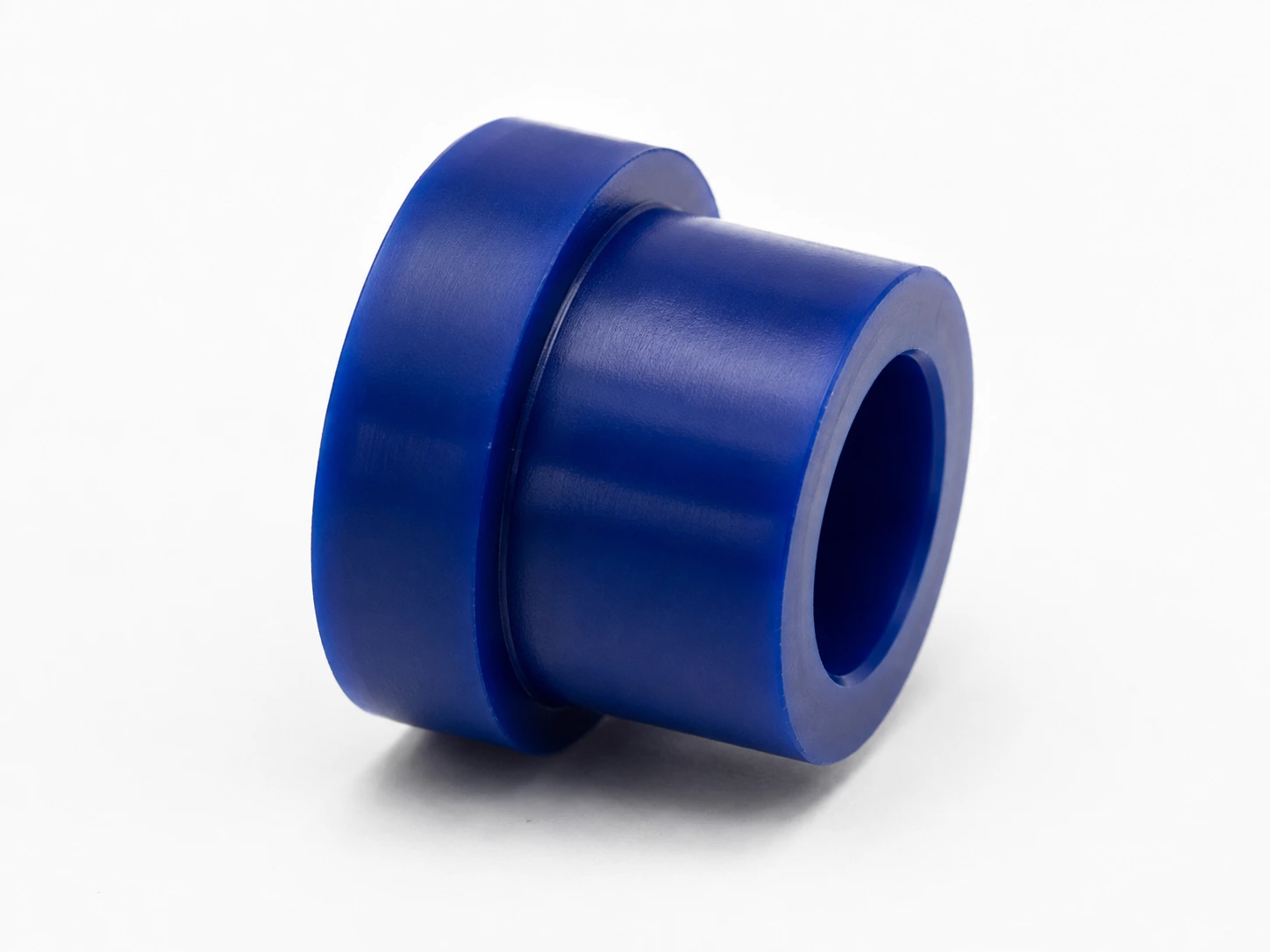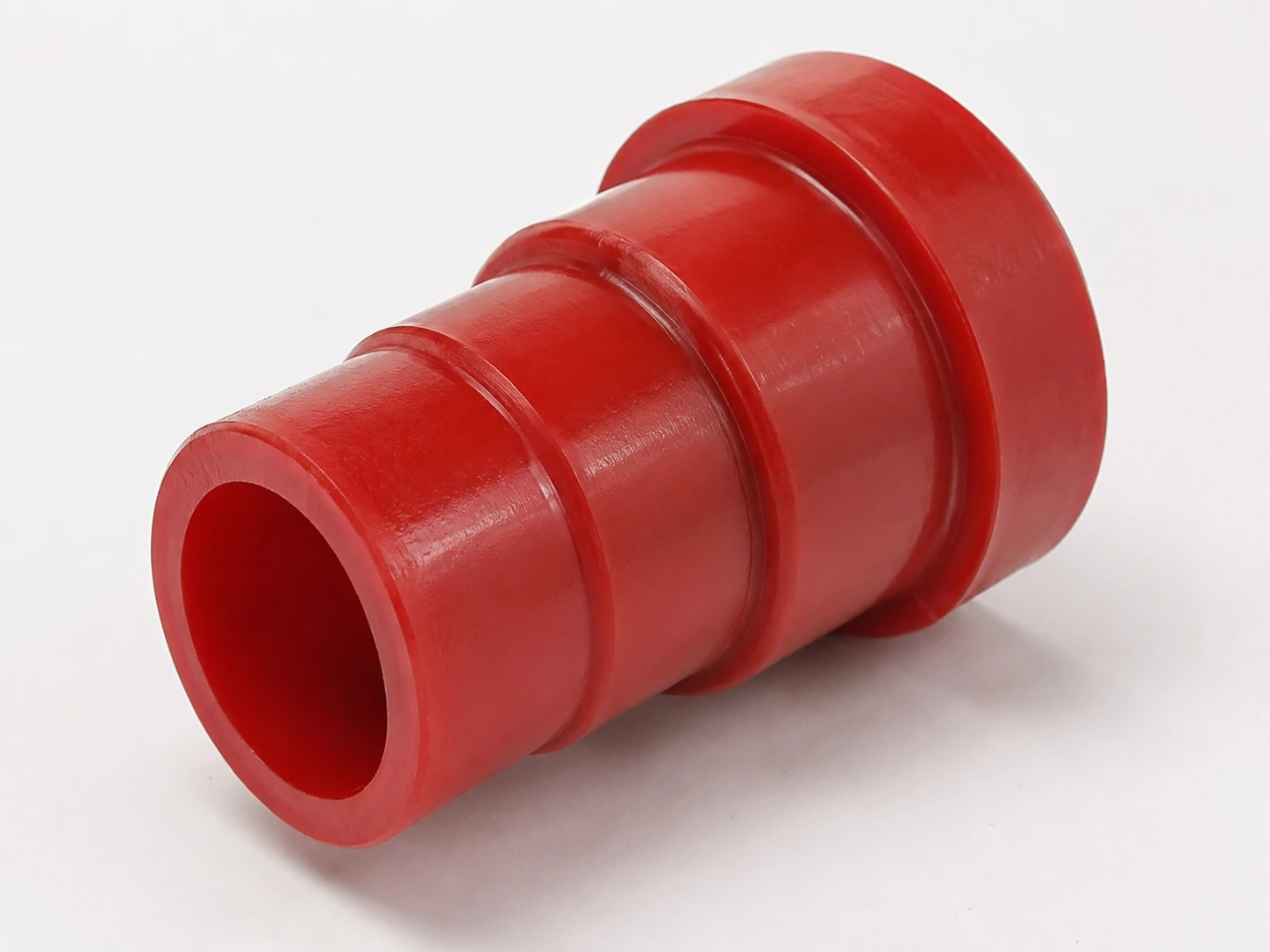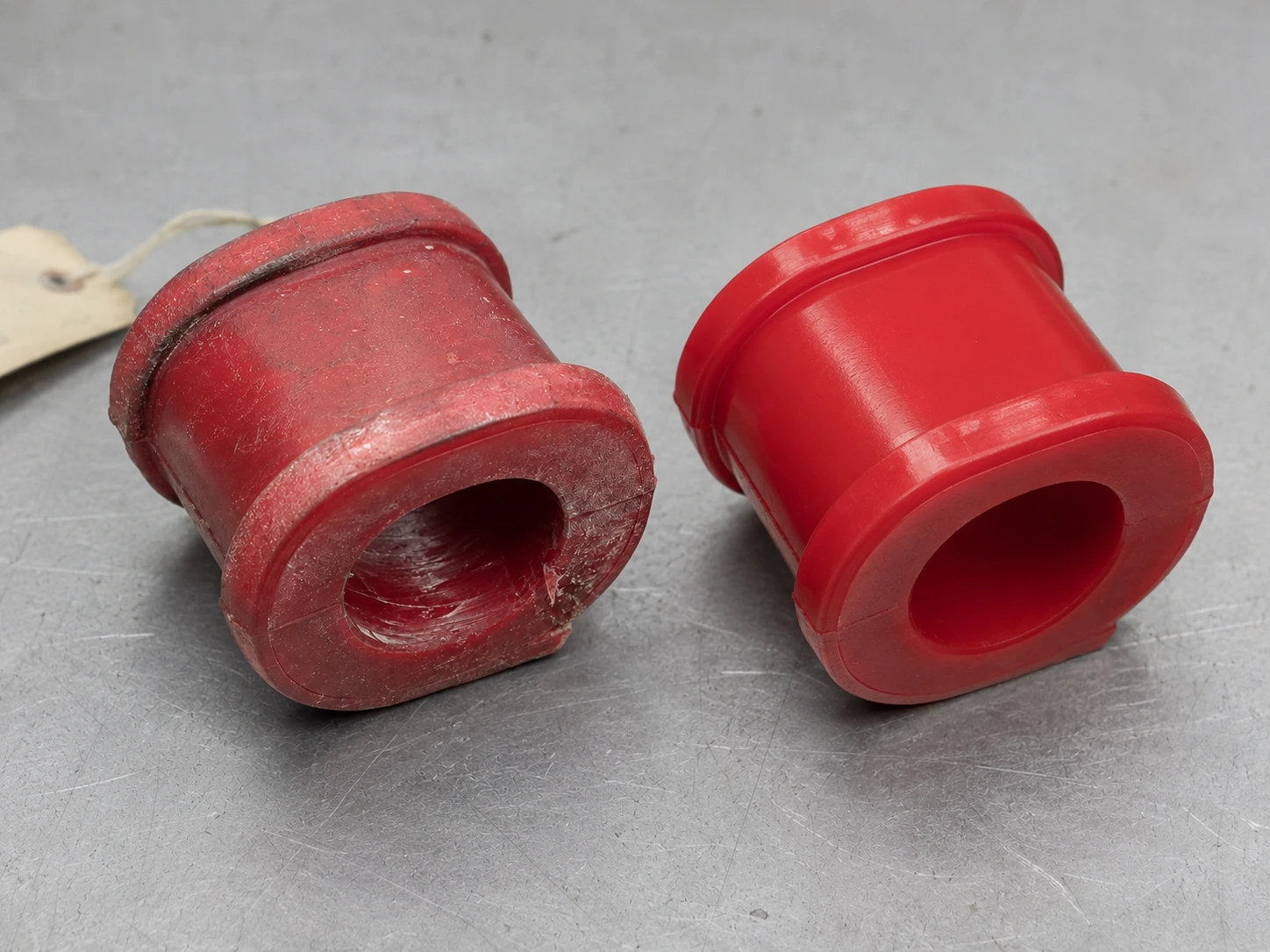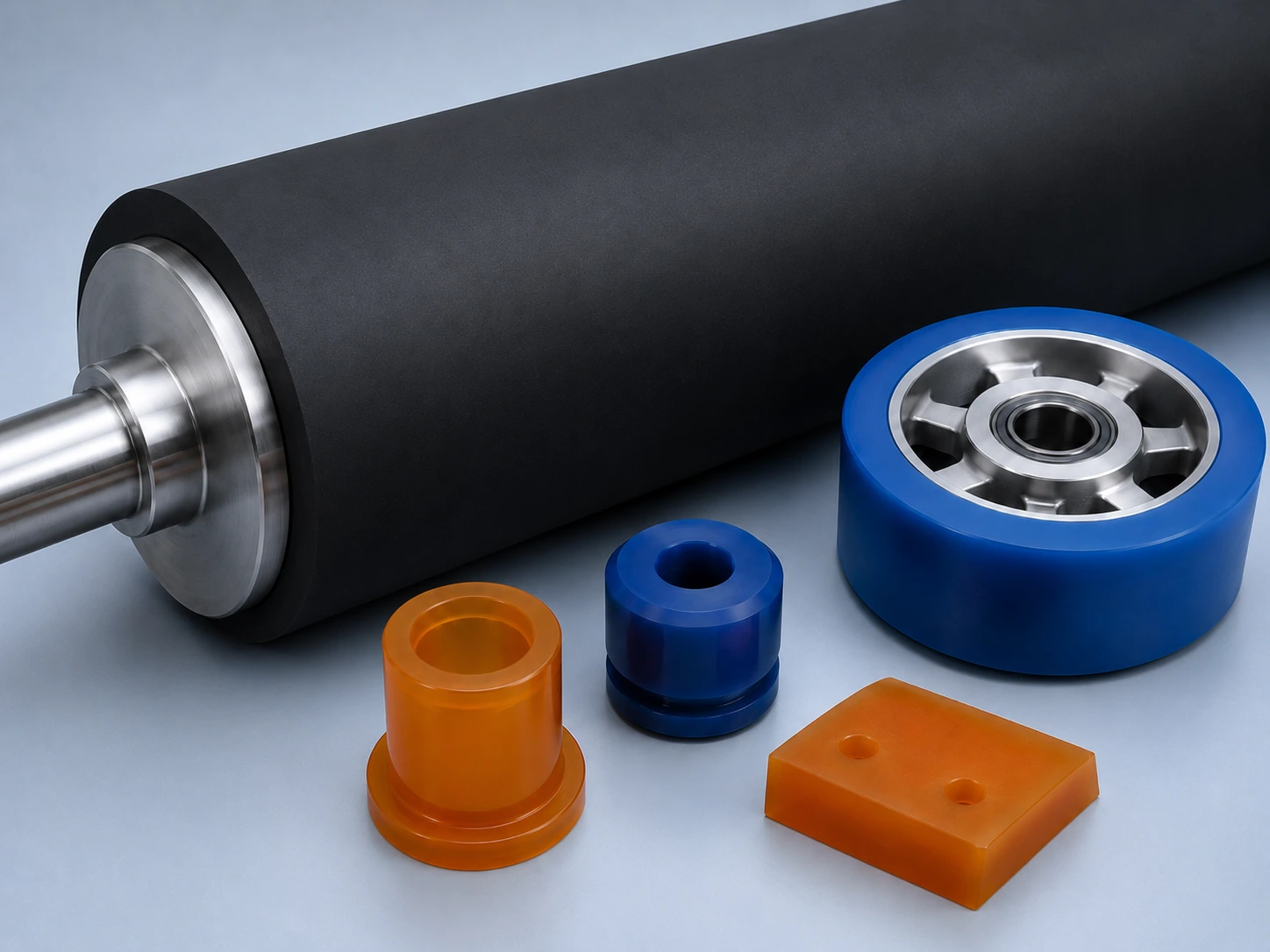
Parts designed to guide, protect, cushion and isolate two metal parts — replacing bronze, rubber or plastic. Custom-made, with the hardness and the formulation matched to your application, depending on the project.
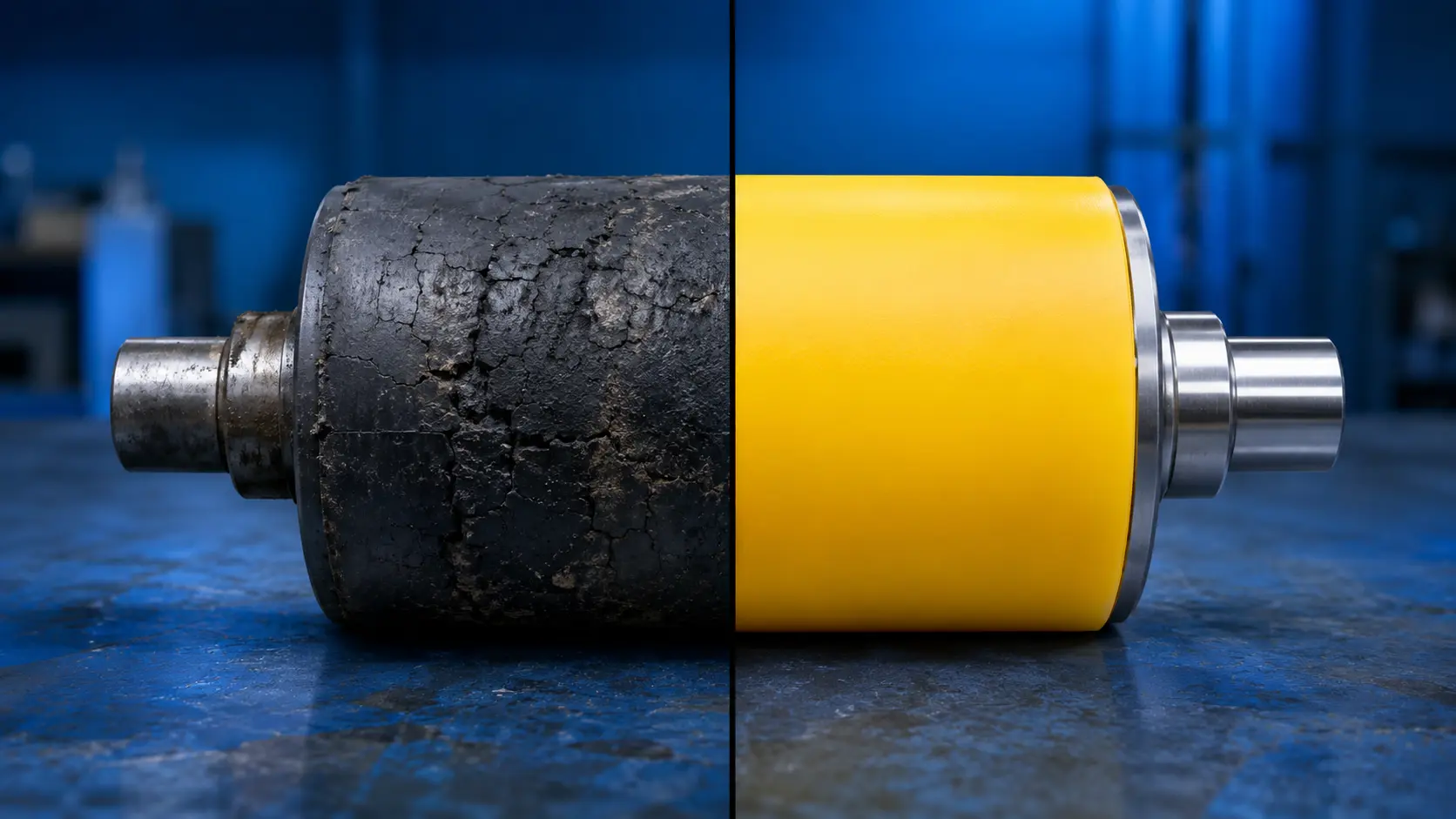
Bronze seizes without lubrication, rubber crushes down and takes on permanent clearance, plastic cracks under impact. Cast polyurethane holds its shape under load, absorbs impact and does not corrode — with little or no greasing. Bushings, bearings, ferrules and sleeves sit between a shaft and its housing to guide the motion, carry the load and eliminate metal-to-metal contact; the right choice always depends on the load, the motion and the environment the part works in.
An overview of the bushings, bearings and sleeves we cast in polyurethane. The list is not exhaustive: tell us about your part and what it does.


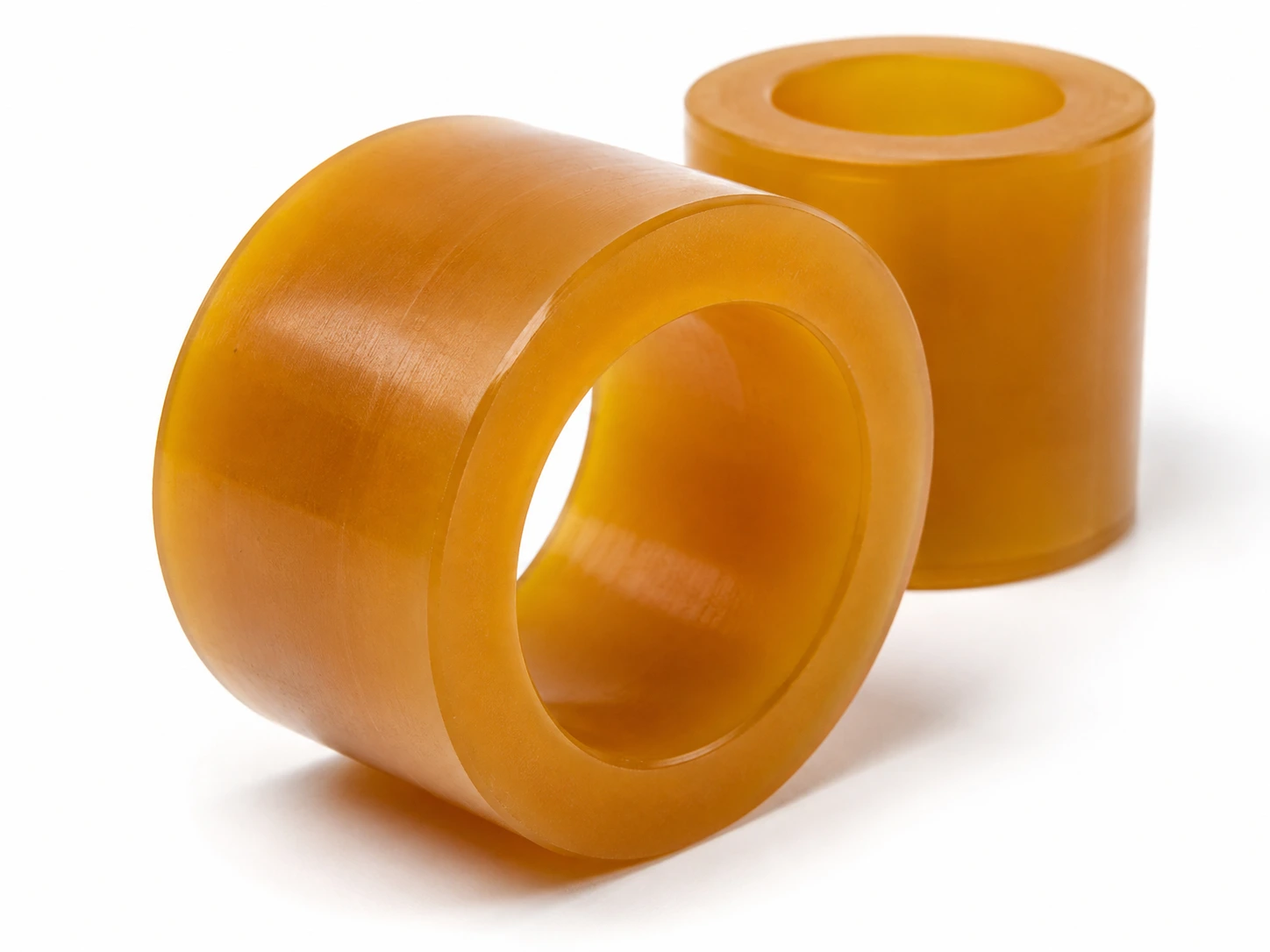
Guide or support sleeves slipped onto a shaft or into a housing. Polyurethane cushions and resists wear without seizing or corroding.
Interface between two moving parts, replacing bronze or rubber. Runs quietly and stands up well to moisture, depending on the application.
Centering, protection or support ferrules, cast to the size of the shaft and the housing. Handy to take up clearance or protect a bore.
Protection, drive or coupling sleeves, from soft to rigid. A tough polyurethane working surface around the component to be protected.
Spacing parts that hold a set distance between two components, while absorbing shock and isolating metal-to-metal contact.
Molded rings and washers for support, shimming or cushioning. Cast to the shape you need, with no expensive metal tooling, depending on the project.
Guides and guide bushings that position a shaft, a rod or a moving part. Polyurethane slides and cushions while limiting marking.
Bushings, pads and mounts that decouple two parts to cut vibration and noise. Hardness chosen to suit the load and the frequency, depending on the project.
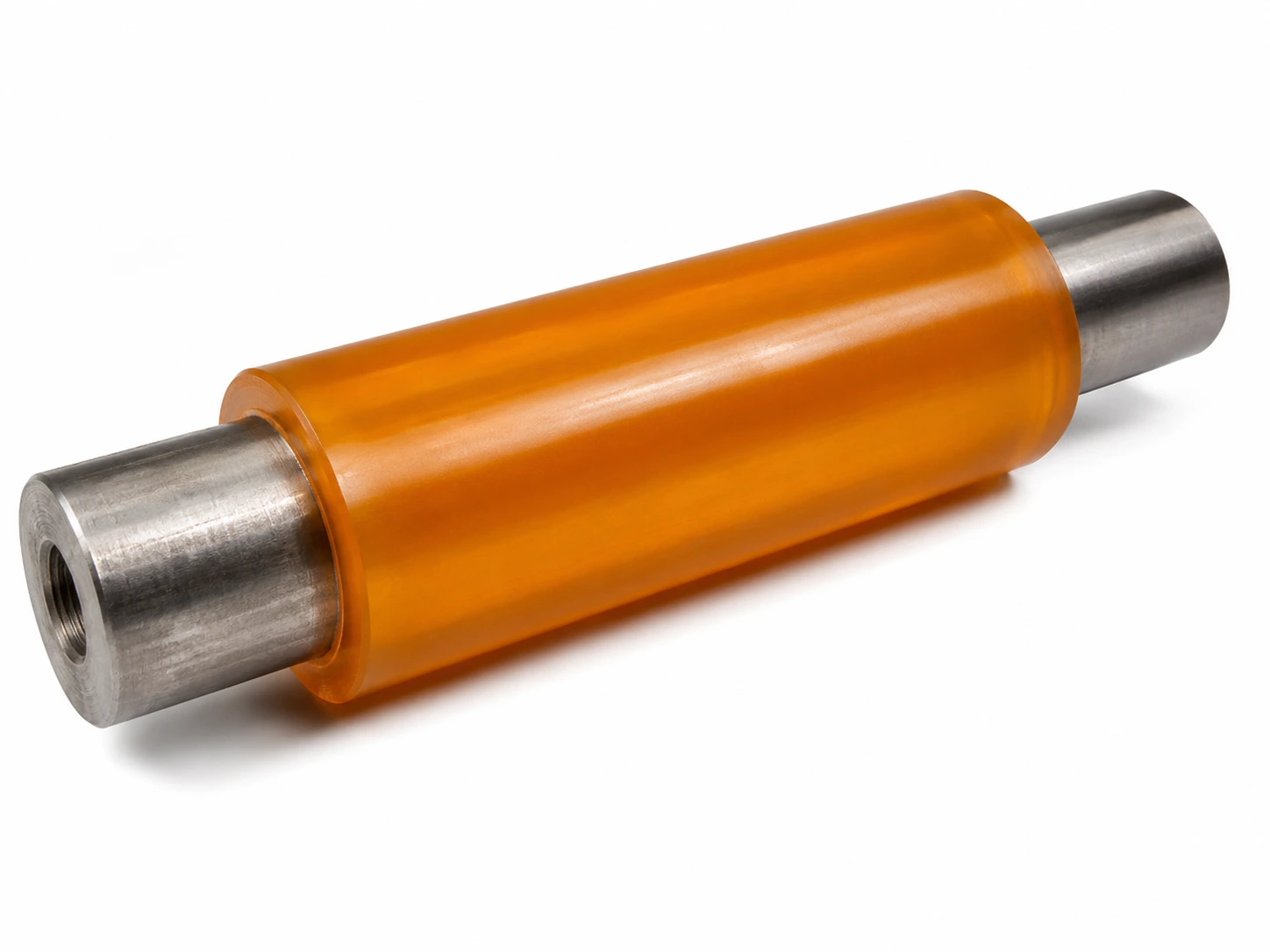
Polyurethane cast onto an insert, a tube or a washer in steel or stainless : a rigid backbone for the mounting, a polyurethane working surface. See overmolding on metal →
Sleeves cast directly onto a steel shaft or tube, with adhesion validated for the metal and the service. A metal + polyurethane combination in a single part, depending on the project.
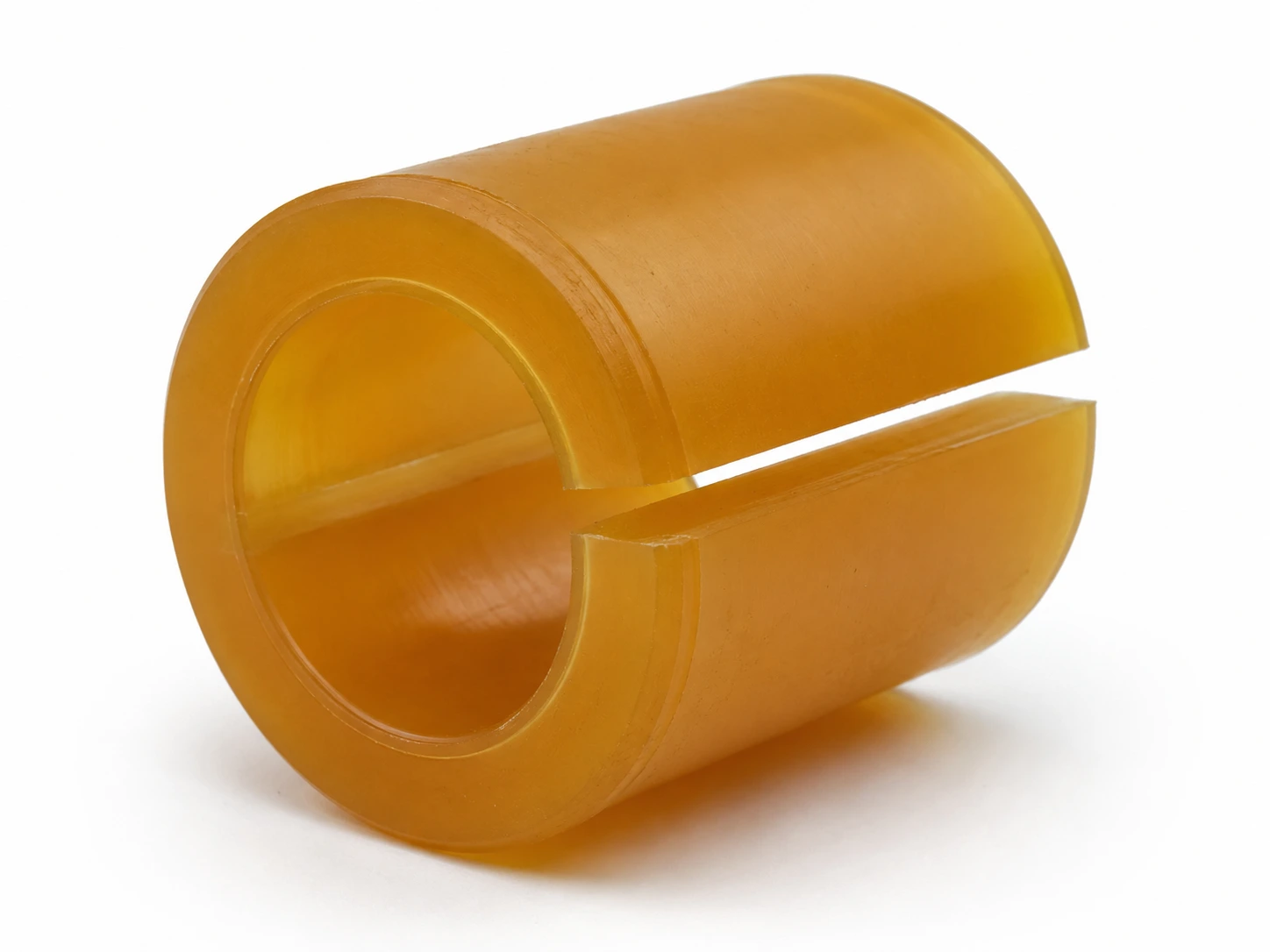
Split bushings or sleeves for installation without disassembly of the shaft, when access is tight. Feasibility and service life to be validated for the application.
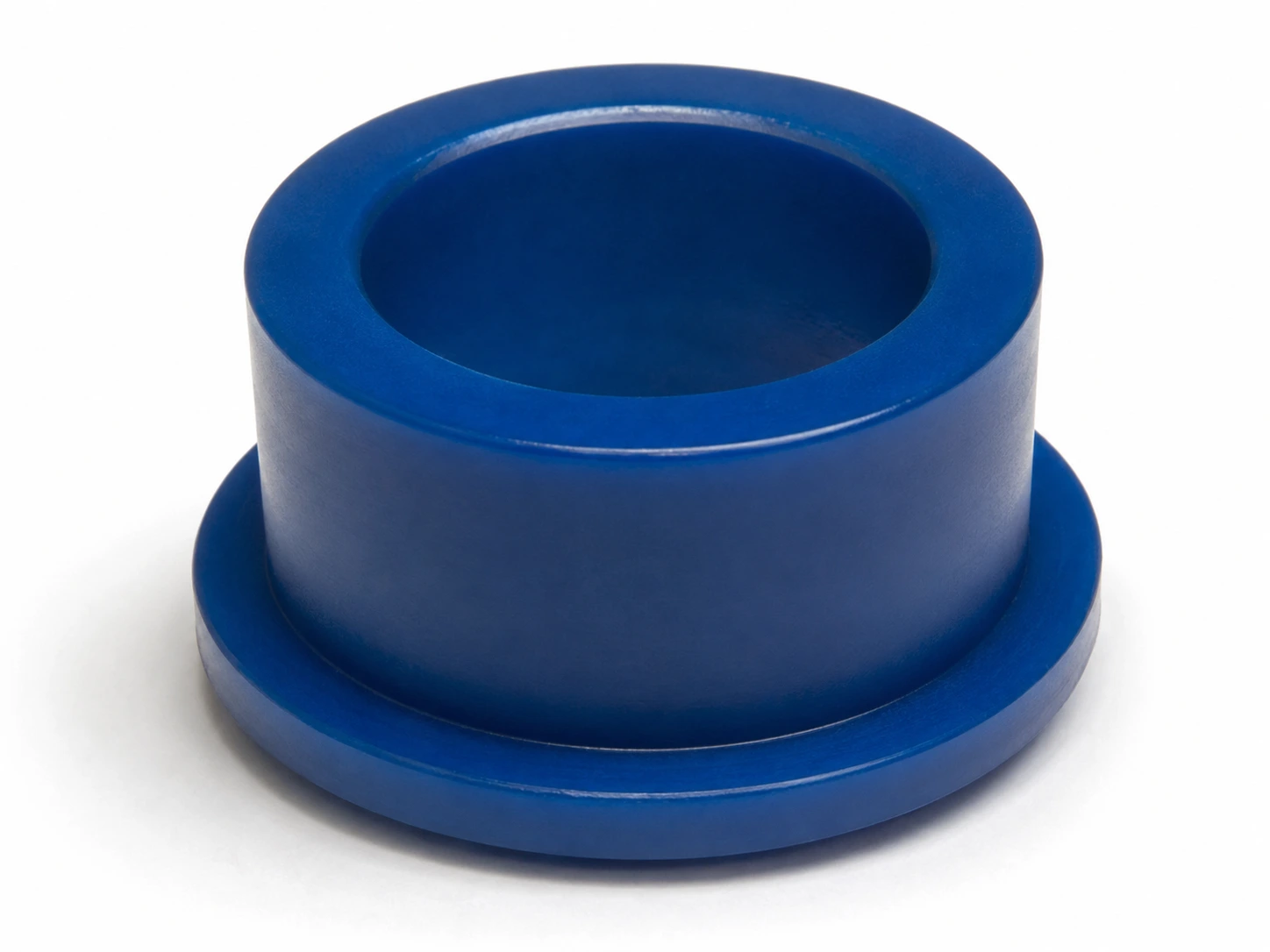
Collar or shoulder bushings (“flanged” type) to carry an axial load on top of the radial one. Profile and dimensions set to suit the mounting.
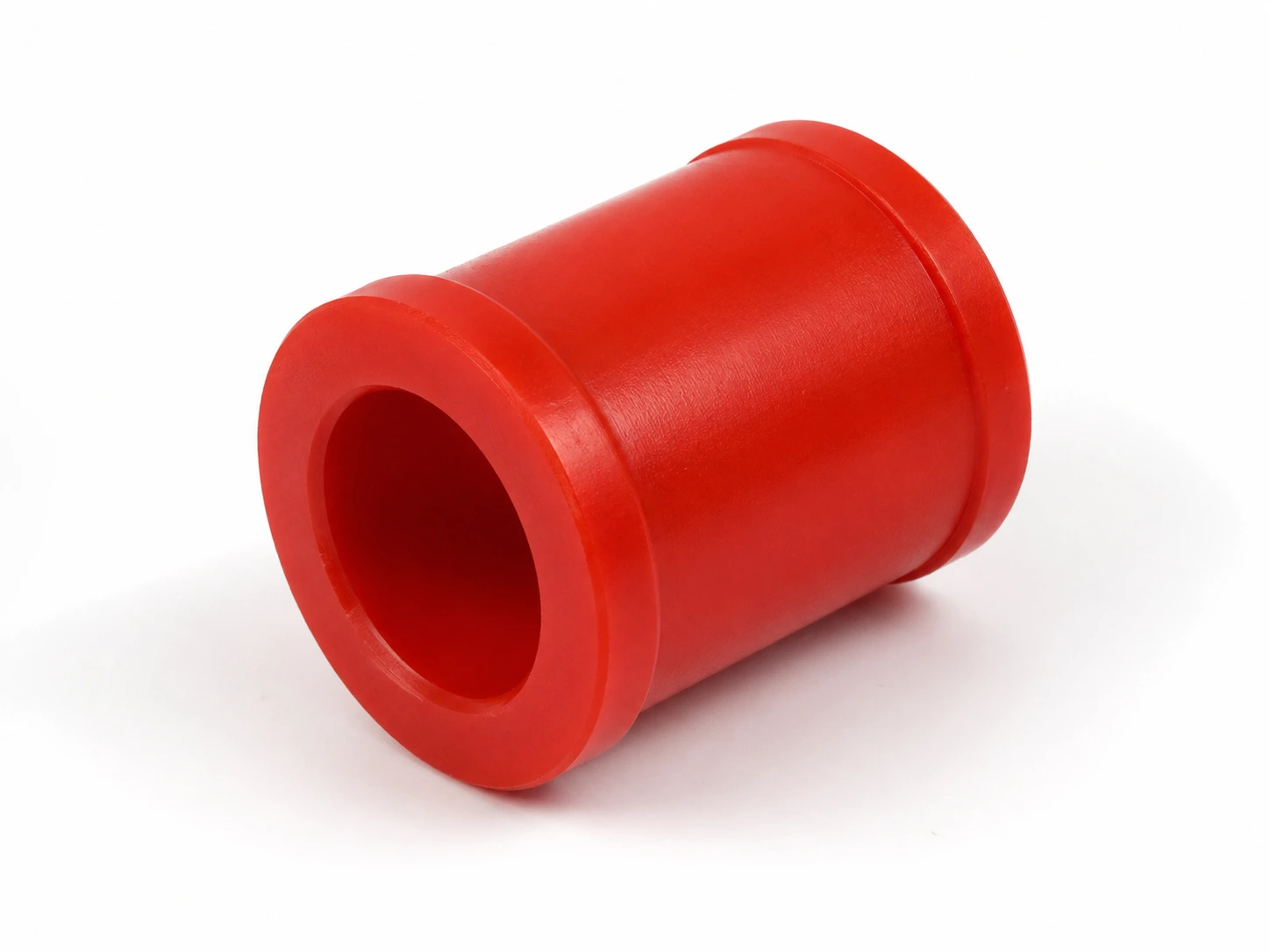
Special shapes, splined, grooved or with multiple shoulders, cast and machined to your drawing, your sample or your requirement — depending on the project.
Have a specific bushing or sleeve in mind, or a sample to copy? Tell us about your part →
There is no universal “best” polyurethane. The right choice is made case by case, depending on the project, from the real service conditions. Here is what we look at with you.
Magnitude and type of load (radial, axial, point load) the part has to carry — a starting point for the hardness and the formulation.
Rotation, sliding, oscillation or a fixed mount: the type of motion steers the formulation and the surface finish.
Relative speed of the surfaces in contact, which drives heat build-up and wear depending on the application.
Load held over time and allowable deformation: to watch in order to avoid compression set, depending on the project.
Service temperature, ambient and local, which can narrow the choice of polyurethane chemistry.
Presence of water, steam or moisture: the chemistry (ester, ether, polycaprolactone) is chosen accordingly.
Contact with oils, greases or solvents — to be validated against the products involved and the contact time.
Repeated or occasional shock: polyurethane can absorb the impact, within a range to be defined for the part.
Frequency and duration of loading (dynamic): useful to anticipate fatigue and heat build-up.
Once the part is cast, it is machined to size in the shop. Depending on the part, we can run the following operations to reach the diameters, the lengths and the finishes you need.
Three application families where cast polyurethane proves itself — and the industries where you find it.
Cam follower and roller bushings, chain guides, pivot bushings: parts that turn millions of cycles in dusty conditions, with no greasing.
See the conveyor industry →Machine joints and pivots, cushioning mounts, cylinder bushings: polyurethane cuts clearance, noise and maintenance on specialized equipment.
See industrial manufacturing →Heavily loaded bushings, shaft protection sleeves and heavy-equipment bearings: where bronze seizes and rubber crushes down.
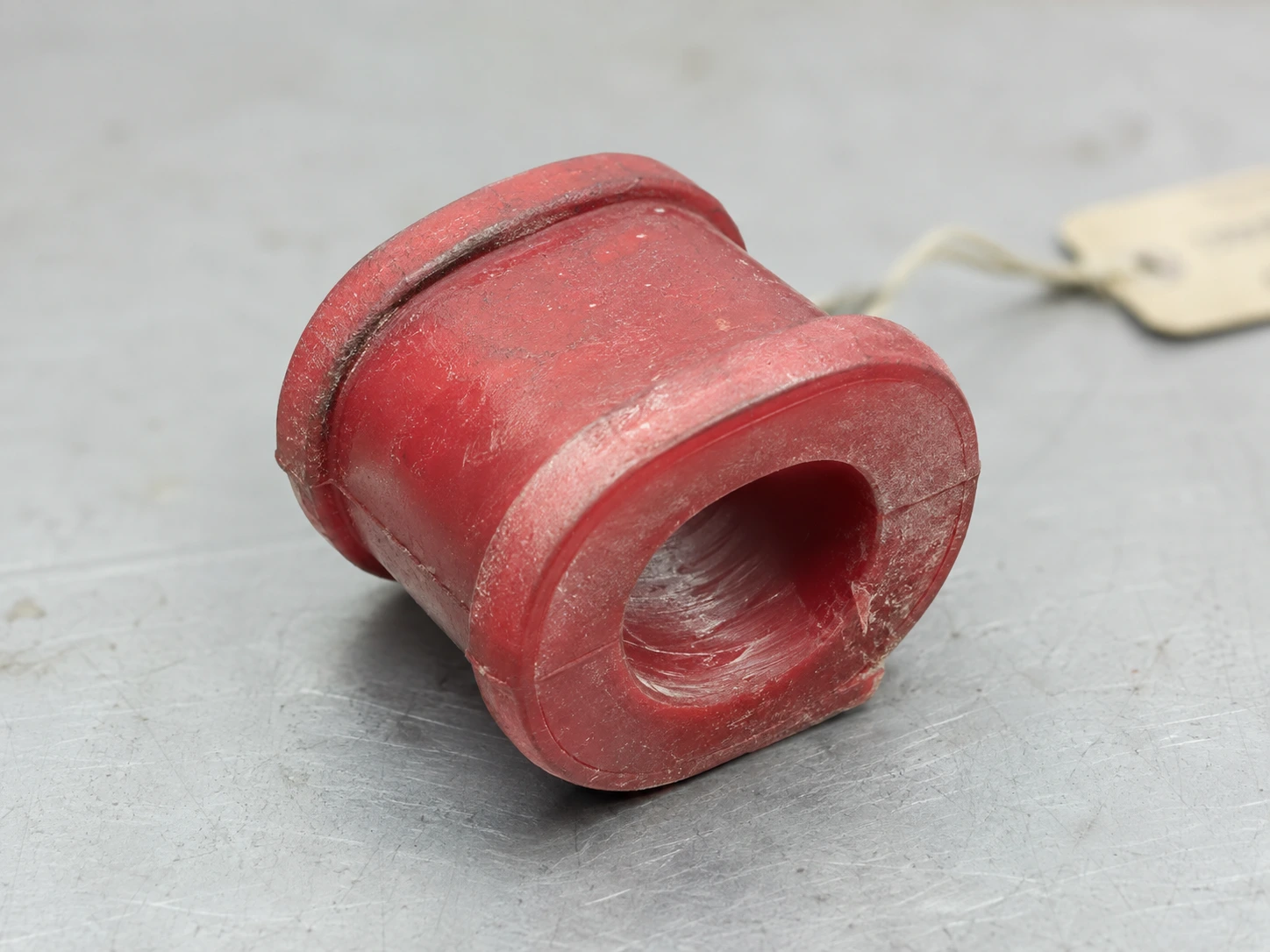
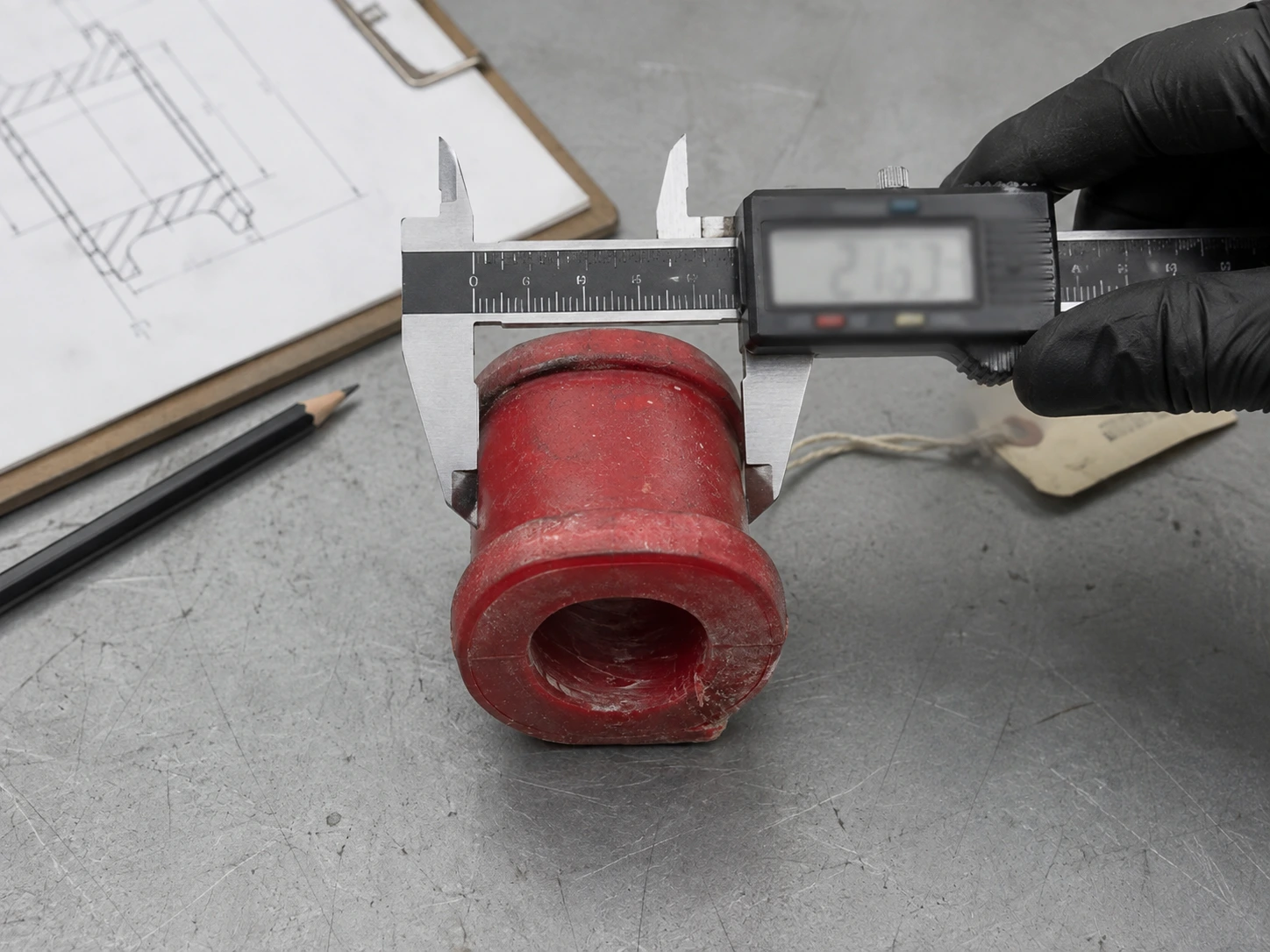
See the steel & metals industry →A worn bushing, with no drawing and no part number? Often we can reproduce it from the sample.
From an existing part, even a worn one, we work to rebuild the original dimensions. Several dimensions can be deduced from
Depending on the condition of the part, some dimensions still have to be validated with you. We confirm the critical dimensions, the hardness and the material together before casting, depending on the project.
Learn more about reverse engineering →Depending on the application, a polyurethane bushing or bearing can cut wear, absorb impact and vibration and limit metal-to-metal contact, while standing up to moisture and corrosion. The real gain depends on the load, the motion and the environment the part works in, and is confirmed by testing or by operating data.
Depending on the project, polyurethane can be cast onto a metal insert or tube, with a surface preparation and a bonding system suited to the metal and the intended service. That gives a bushing or a sleeve that combines a rigid backbone and a polyurethane working surface. See our page on bonding polyurethane to metal.
Often, yes. From a sample, even a worn one, we can rebuild several dimensions using the shaft, the housing, the contact surfaces and the wear marks. Some dimensions still have to be validated with you depending on the condition of the part. Details on our page on reverse engineering.
Send us a drawing, a photo or the worn part, along with what it does, the load and the environment — we will propose the formulation, the hardness and the process to suit, depending on the project, anywhere in Quebec and Canada.
➔ Request a quote