
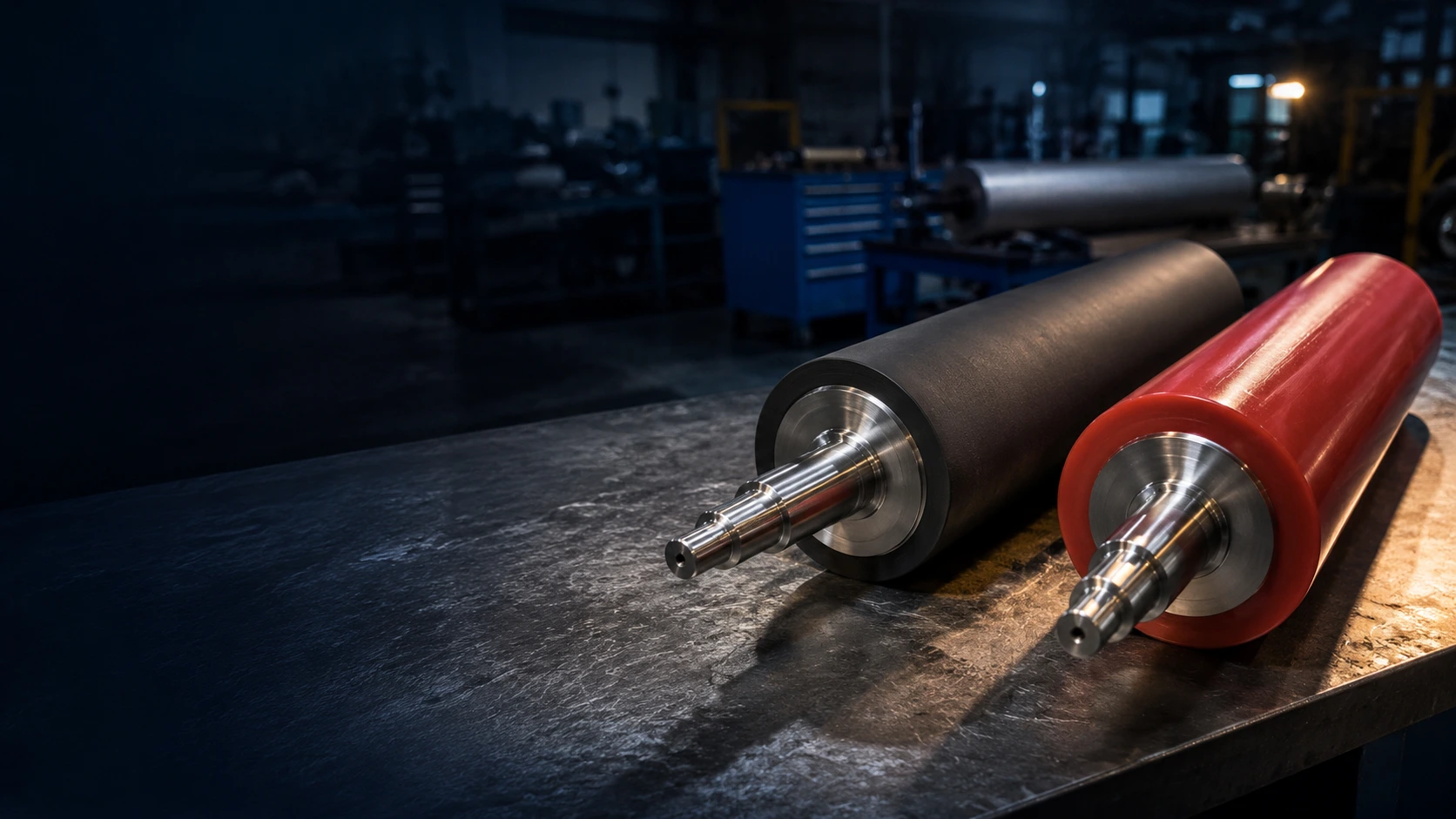
When a roller wears out too fast, marks the product or slips, the first question we get is almost always the same: “Should we be putting polyurethane on instead of rubber?” The real answer fits in one sentence: there is no superior material — there is the one that works best in YOUR conditions. Two rollers that look alike can call for two completely different formulations.
Two families, two logics
Rubber shines when the roller has to “work with the surface”: grip, flexibility, low hardness, vibration damping, or a specific chemical resistance depending on the compound. Polyurethane shines when the roller has to “take the punishment”: abrasion, high loads, cut resistance, mechanical longevity.
Quick comparison table
| Critère | Caoutchouc | Polyuréthane |
|---|---|---|
| Adhérence / traction | Excellent avec les bonnes formulations | Très bon, selon la dureté et le fini |
| Souplesse | Très bon aux basses duretés | Bon, souvent choisi en duretés plus élevées |
| Résistance à l'abrasion | Bonne à excellente selon la formulation | Généralement excellente |
| Résistance aux coupures | Variable selon le composé | Souvent supérieure en conditions sévères |
| Capacité de charge | Bonne selon la formulation | Très élevée dans plusieurs applications |
| Absorption des vibrations | Très bonne | Bonne à très bonne selon la formulation |
| Résistance aux huiles | Très bonne avec nitrile / HNBR | Bonne souvent, à valider |
| Eau / humidité | Très variable selon le caoutchouc | Selon le type (ester vs éther) |
| Température | Très variable selon le composé | Variable, souvent plus limité que certains caoutchoucs spécialisés |
| Coût initial | Souvent compétitif | Souvent plus élevé |
| Coût total à long terme | Excellent si bien choisi | Très avantageux si l'usure est le problème principal |
For the full comparison criterion by criterion and our detailed charts (rubber families and polyurethane systems): Material Selection Guide.
When polyurethane takes the lead
We favor it when enemy number one is mechanical wear: high pressure, friction, cuts, deformation. A good reflex for drive rollers and pressure rollers, polyurethane wheels, film pre-stretch rollers, pull rollers and guide rollers — and any time the original rubber wears out too fast.
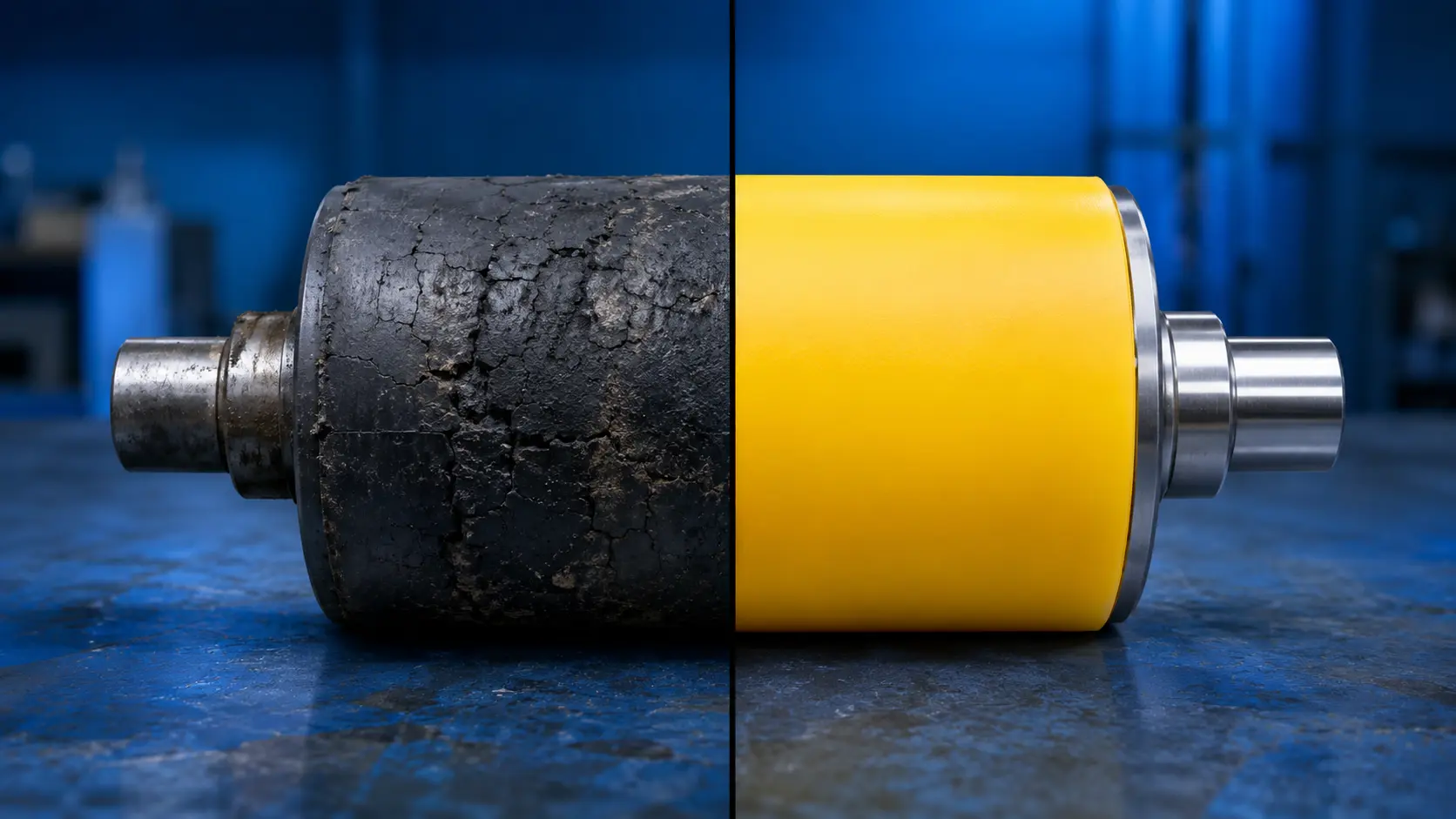
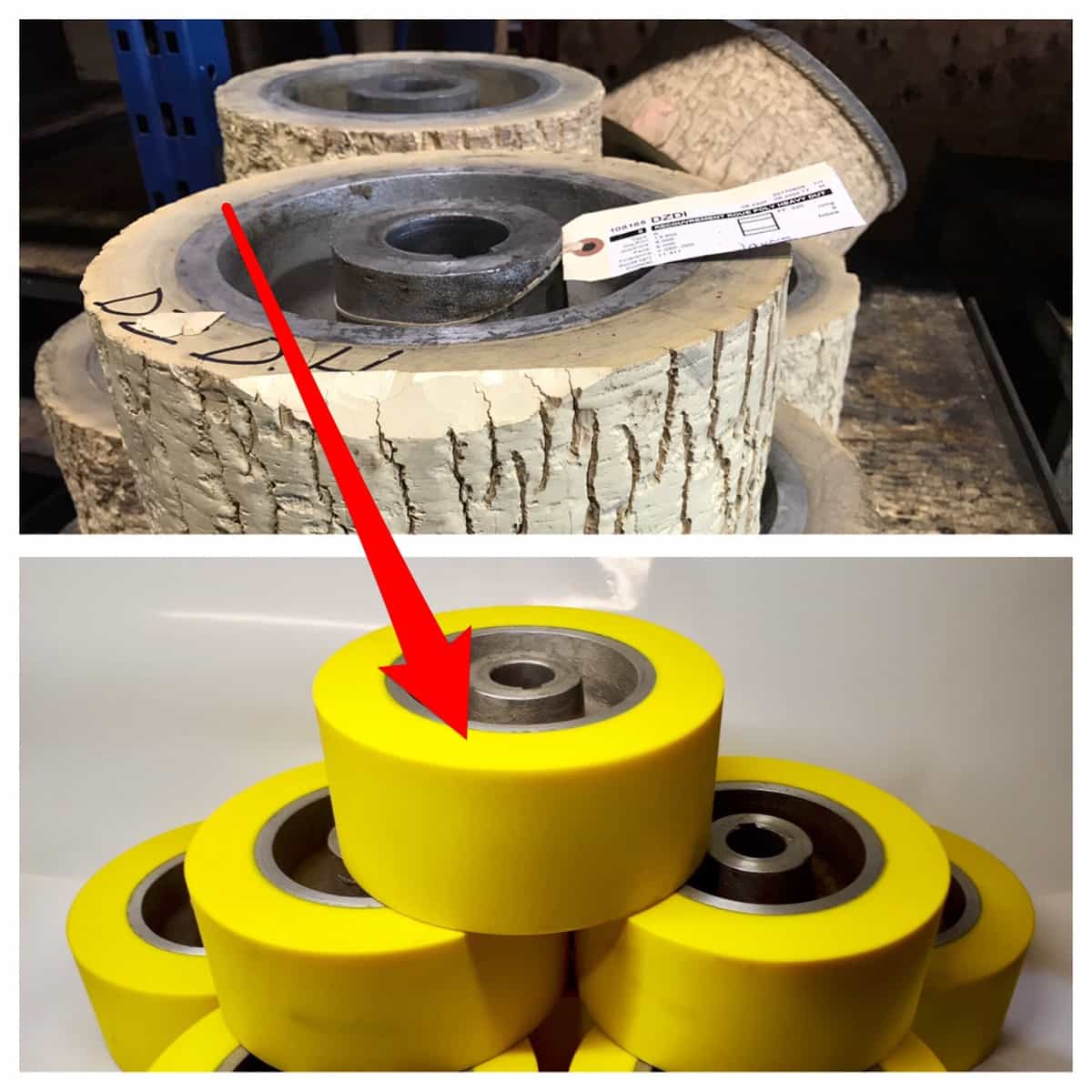
This press wheel came in with its rubber cover glazed, cracked and cut by the friction of the boards. We recovered it with an 80A polyurethane, better suited to the friction and the stresses of wood. Result: a clean surface, better wear resistance and a longer service life. See the full case study
The trap: there is no single polyurethane. Ether-based systems tolerate humidity, water and steam well; several ester-based systems offer excellent mechanical properties but are more sensitive to hydrolysis in a hot, wet environment. Its chemical resistance depends on the product, the concentration, the temperature and the contact time — we validate, we don't assume.
When rubber is still the right choice
Rubber keeps the advantage as soon as you are after grip, flexibility or very low hardness: applicator rollers (glue, ink, coating), pull rollers that conform to an irregular surface, contact with delicate products, or specific chemical environments. And “rubber” means nothing on its own — each family has its own personality:
| Formulation | Forces principales | Applications typiques |
|---|---|---|
| Caoutchouc naturel | Résilience, adhérence, abrasion humide | Traction, contact, amortissement |
| SBR | Bon rapport performance/coût, abrasion standard | Applications générales |
| Nitrile (Buna-N) | Huiles, graisses, hydrocarbures aliphatiques | Rouleaux exposés à l'huile |
| EPDM | Chaleur, ozone, eau, vapeur | Extérieur ou humide |
| Néoprène | Équilibre général, ozone, chaleur | Applications polyvalentes |
| Silicone | Haute température, contact délicat | Applications spécialisées |
| HNBR / XNBR | Huiles, chaleur, abrasion et déchirure améliorées | Applications sévères |
(Details and ranges by formulation: Material Selection Guide.)
What really decides: the application, not the material
The contact — paper, film, wood, metal, belt, fragile part? Driving without slipping does not have the same requirements as carrying a load.
The wear on the old roller — glazed, cut, cracked, swollen, debonded, worn concave, contaminated? The wear tells the real story: that is the point of our Roller and wheel diagnosis.
The hardness — too soft and it heats up and deforms; too hard and it lacks grip and marks the product.
Temperature and chemistry — on their own they can flip the choice.
The surface finish — smooth, textured, grooved, crowned: often it is the finish, not the material, that makes the performance.
Initial cost does not tell the whole story
Polyurethane sometimes costs more up front, but becomes the most economical option when wear is the real problem: less downtime, fewer replacements. Conversely, a well-chosen rubber pays off better when you are after grip, flexibility or chemical compatibility. The right calculation takes into account the real service life, the downtime, the removal and reinstallation and the rejects — not just the price of the covering.
Our approach
At Soremag, the choice does not come out of a data sheet: it comes out of your real application. We analyze the roller, its wear, its environment and your objectives, then we recommend the material + hardness + finish combination that fits best — that is the whole point of our roller covering.
Not sure which material is right for your roller? Talk to our team — we can analyze your part and, if needed, propose a trial.
FAQ
Does polyurethane always last longer than rubber?
No. Often yes in an abrasive or heavily loaded environment, but less suited to chemical, wet or very hot conditions, or where a lot of flexibility is required.
Does rubber give more grip?
Often, especially at low hardness or on an irregular surface. But some polyurethanes give good traction depending on the hardness and the finish.
Can rubber be replaced with polyurethane (or the other way around)?
Yes, both ways. We check grip, hardness, chemistry and temperature.
Which durometer should you choose?
It depends on the job the roller does. Too soft: wear and deformation. Too hard: lack of grip and marking.
Does the surface finish matter as much as the material?
Yes — surface roughness, polishing, crown and grooving all influence traction, liquid drainage and process quality.
Why have a worn roller analyzed?
Because the wear reveals the real cause and often makes it possible to improve the roller instead of just reproducing it.
