
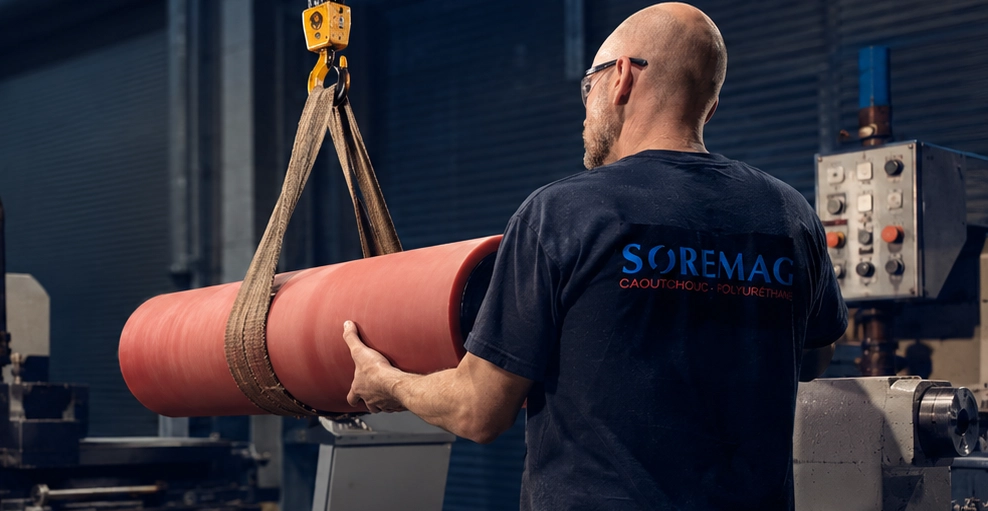
In the wood industry, a wheel whose cover glazes, cracks and cuts does not just wear out: it destabilizes the line. Here is how a change of material — from a rubber to an 80A polyurethane — solved an abrasion and cut problem on a pressure wheel.
The context
A pressure wheel on a wood processing line, in constant contact with boards. In this application, the wheel is not just a wear part: its surface is under constant duty from friction, from the edges and from wood dust, and its condition directly affects the consistency of production.
The problem
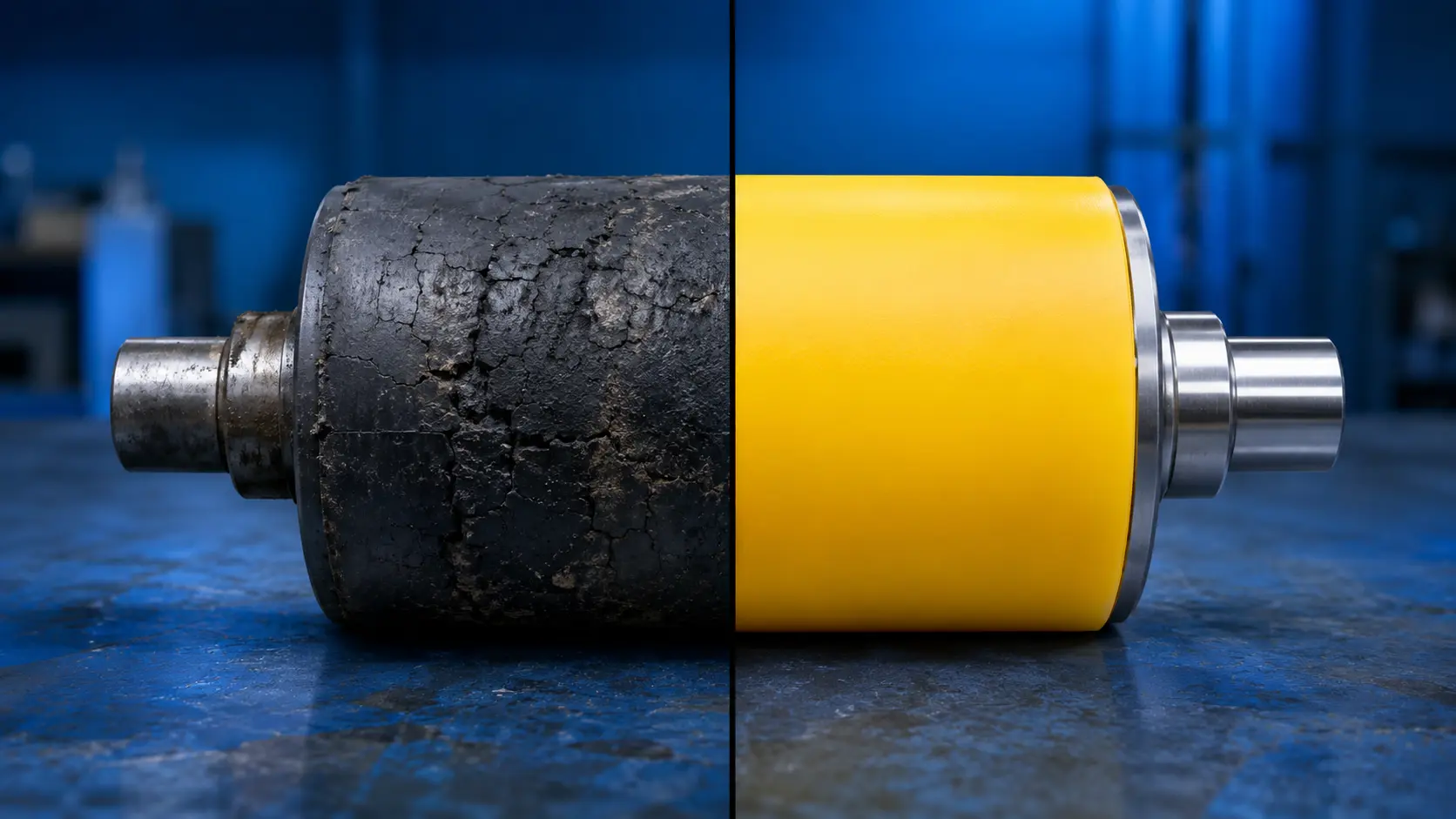
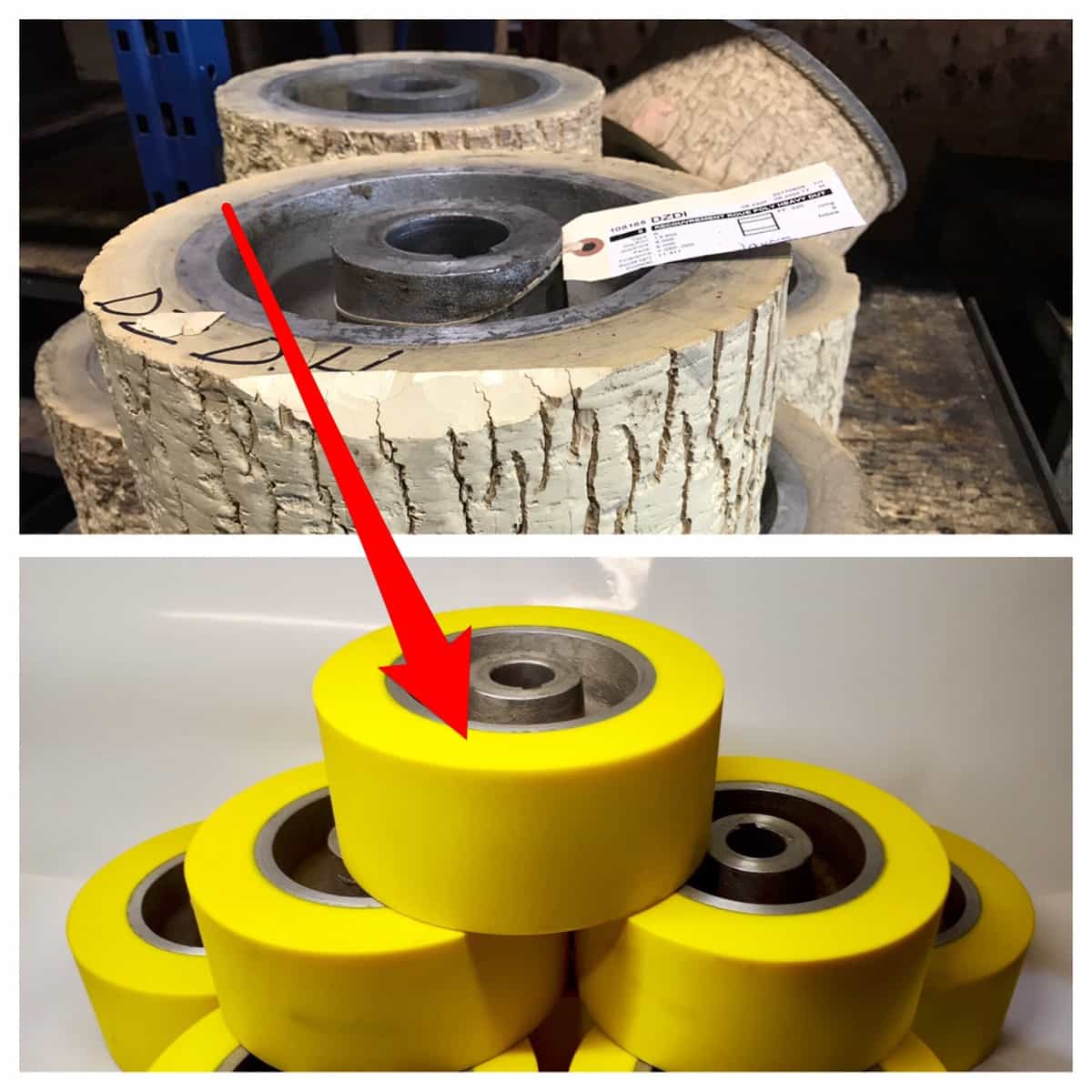
The rubber cover was coming in glazed, cracked and cut by the friction of the boards. Three mechanisms were combining:
- Glazing — under continuous friction and the heat generated at the contact, the rubber surface hardens and becomes smooth, which degrades the way it behaves.
- Cracking — once the surface is hardened and embrittled, micro-cracks appear and then spread.
- Cuts — the edges of the boards nick the cover, and those nicks propagate quickly in a rubber that is sensitive to tearing.
The result: fast wear, frequent replacements and production consistency undermined.
Our analysis
On the floor, the wear told the story. The friction and the edges of the boards went beyond what the original rubber could take: this was not a manufacturing defect in the roller, but a material unsuited to the abrasion and the cuts of this application. A poorly chosen rubber glazes and tears; what was needed was a material with more abrasion resistance, and in which nicks do not propagate. This reading of the wear — working back from the symptom to the cause — is at the heart of our Roller and wheel diagnosis.
At a glance
- Application
- Roue de pression — ligne de transformation du bois, contact constant avec les planches
- Problème
- Revêtement caoutchouc glacé, fissuré et coupé par le frottement; usure rapide
- Solution
- Recouvrement de roue en polyuréthane 80A, résistant à l'abrasion et aux coupures
- Approche
- Remise à neuf du mandrin existant, pas de remplacement complet
The solution
We covered the wheel in an 80A polyurethane. That choice answers the three observed mechanisms directly: polyurethane offers far better abrasion resistance than the original rubber, and its structure resists the propagation of cuts — a nick tends to stay local rather than tear open. The 80 Shore A hardness was chosen to give this resistance to abrasion and to edges while keeping the elasticity needed for contact with the wood; a surface finish suited to contact with the boards completes the cover. The choice of material and durometer is based on our Material Selection Guide.
Why recover rather than buy a new wheel
The core of the wheel was still in good condition: no reason to replace the complete part. Covering the existing core keeps a proven base, cuts lead times and above all makes it possible tomatch the material to the reality of the plant rather than putting back a standard cover identical to the one that had just failed. That is the whole point of wheel covering: we do not just copy the part, we correct what was causing the problem.
The result
A clean, stable surface, far better resistance to wear and cuts, and a longer service life — so fewer replacements and steadier production. The covering made it possible to stabilize the behavior of the wheel and to extend the use of the existing core, while matching the material to the real constraints of the line.
Critical points of a covered wheel
Beyond this particular wheel, several parameters determine how a wheel cover behaves in production:
| Paramètre | Pourquoi c'est important |
|---|---|
| Dureté du recouvrement | Trop dure : risque de marquer ou de manquer de souplesse. Trop molle : usure, glaçage et déformation accélérés. |
| Formulation | Détermine la résistance à l'abrasion, aux coupures et aux contaminants — bien plus que la seule dureté. |
| Fini de surface | Influence le contact avec le bois et le comportement de la roue. |
| Concentricité | Une roue non concentrique crée vibration et pression mal répartie. |
| Adhésion au cœur métallique | Essentielle pour éviter le décollement du recouvrement en service. |
| Compatibilité chimique | Résines, poussières, nettoyants ou humidité peuvent attaquer certaines matières. |
What this case shows
The right material is chosen from the real application, not just from a data sheet. When a rubber wears or cuts too fast under abrasion, polyurethane is often the right instinct — but it is the wear analysis that confirms it. That is exactly the purpose of our roller covering.
A roller or a wheel wearing out too fast?
Talk to our team