

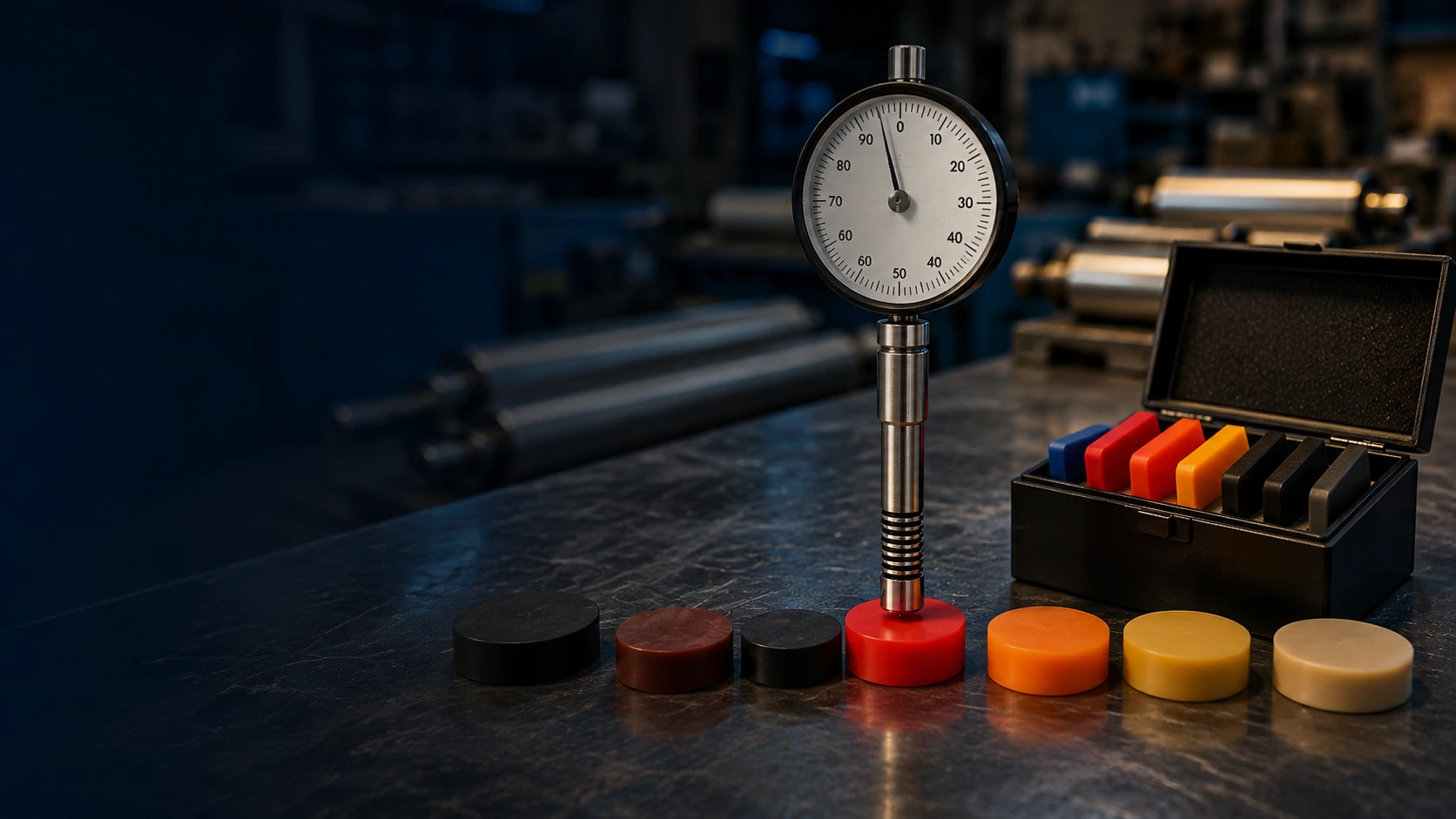
"I want a roller at 60 Shore A." "Is 90 Shore A too hard?" "Recover it at the same hardness as the old one." We hear that every week. Shore hardness is one of the most requested numbers… and one of the most misread. Let's set it straight.
What is it, exactly?
Shore hardness measures one thing only: the material's resistance to the penetration of an indenter under a standardized force, on a scale of 0 to 100. The higher the number, the firmer the material. That's all it is — and it is governed by the ASTM D2240 and ISO 48-4 standards.
For reference: a pencil eraser ≈ 40 Shore A, a tire ≈ 70, a caster wheel ≈ 85-90.
Shore A, Shore D, Shore OO
Shore A — soft to medium-hard: most rubbers and polyurethanes. Shore D — for hard materials, when the A scale "tops out" around 90-95; the two scales overlap at the top of the A range. Covestro illustrates that continuum well: its Vulkollan polyurethane covers roughly 65 Shore A to 60 Shore D depending on the application. The OO and AO scales are used for very soft materials, foams and gels — rare on our rollers.
What it does NOT measure
Here is the trap. Hardness does not measure grip, coefficient of friction, abrasion or cut resistance, resilience, chemical resistance, heat resistance, or true load capacity.
The direct consequence: two materials at the same hardness can behave completely differently. A 70A nitrile, a 70A EPDM and a 70A polyurethane do not react the same way to oils, to water or to wear. Matching the right material to the right hardness is the whole point of our Material Selection Guide.
Why it still matters
Incomplete as it is, hardness weighs heavily on how a roller behaves, especially in the nip (the contact zone). A softer roller conforms to the surface, widens the contact and grips better; a harder roller concentrates the pressure, holds under load and stays precise.
Softer ≠ more grip
Too soft and it flattens, heats up, deforms, marks the product and wears faster. Sometimes a slightly harder roller — with the right finish and the right grooving — grips better than one that is too soft.
Harder ≠ longer lasting
Too hard and it slips, vibrates, marks, concentrates stress and follows irregular surfaces poorly — wear can then get worse.
The hardness of a roller is not the hardness of a test sample
Measuring on a flat slab and measuring on a covered roller are not the same thing. Curvature, cover thickness, the metal core, temperature, grooves and aging all influence the reading. So much so that the standards make the distinction: ISO 48-7 deals specifically with the apparent hardness of roll coverings measured with a Shore durometer.
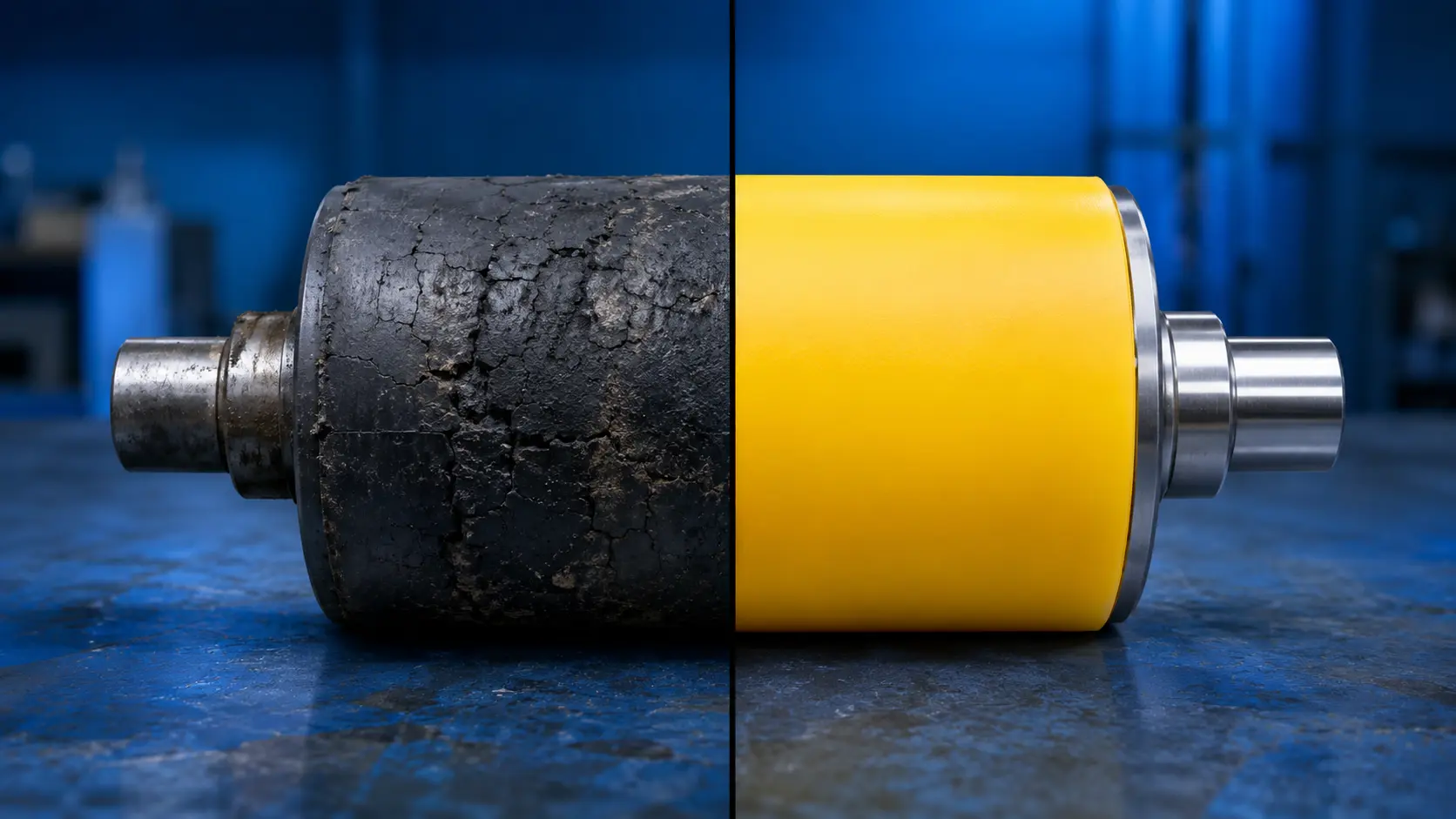
Keep in mind: a quick reading on an old, worn roller is a clue, not the original hardness. A cover ages — it can harden (oxidation, heat, ozone, loss of plasticizers) or soften and swell (oils, solvents, steam, incompatible cleaners). That is why we don't simply copy the hardness of a tired roller: we first look for why it failed — that is the subject of our Roller and wheel diagnosis.
Hardness is not stiffness (modulus)
Another common mix-up: Shore hardness measures a local indentation at the surface; modulus describes resistance to deformation under load. Two materials at the same Shore hardness can have a different modulus. That is why an 80A polyurethane often feels more "load-bearing" than an 80A rubber at the same hardness.
Temperature changes the picture
A roller that is on spec at room temperature can turn too soft, too hard, unstable or brittle in its real environment. Things to account for: process temperature, frictional heat, hot water, steam, ovens, cooling and the temperature of the product in contact. You do not choose a hardness from a bench reading taken at 20 °C alone.
Cover thickness counts too
Two rollers with the same compound and the same Shore hardness can behave differently if one has 1/4 in. of cover and the other 1 in. The thinner the cover, the more the core influences the reading and the behavior (and the harder the roller "feels"); the thicker it is, the more the elastomer can work and deflect under load.
Surface finish: often where the performance comes from
Hardness sets the baseline; the finish often delivers the performance. A roller that is too smooth can slip; too rough, it marks or builds up residue; properly grooved, it evacuates air, water, ink or glue. Depending on the application, we adjust the grinding, the polishing, the surface roughness, the grooving, the profile, the crown and the tolerances.
How we measure at Soremag
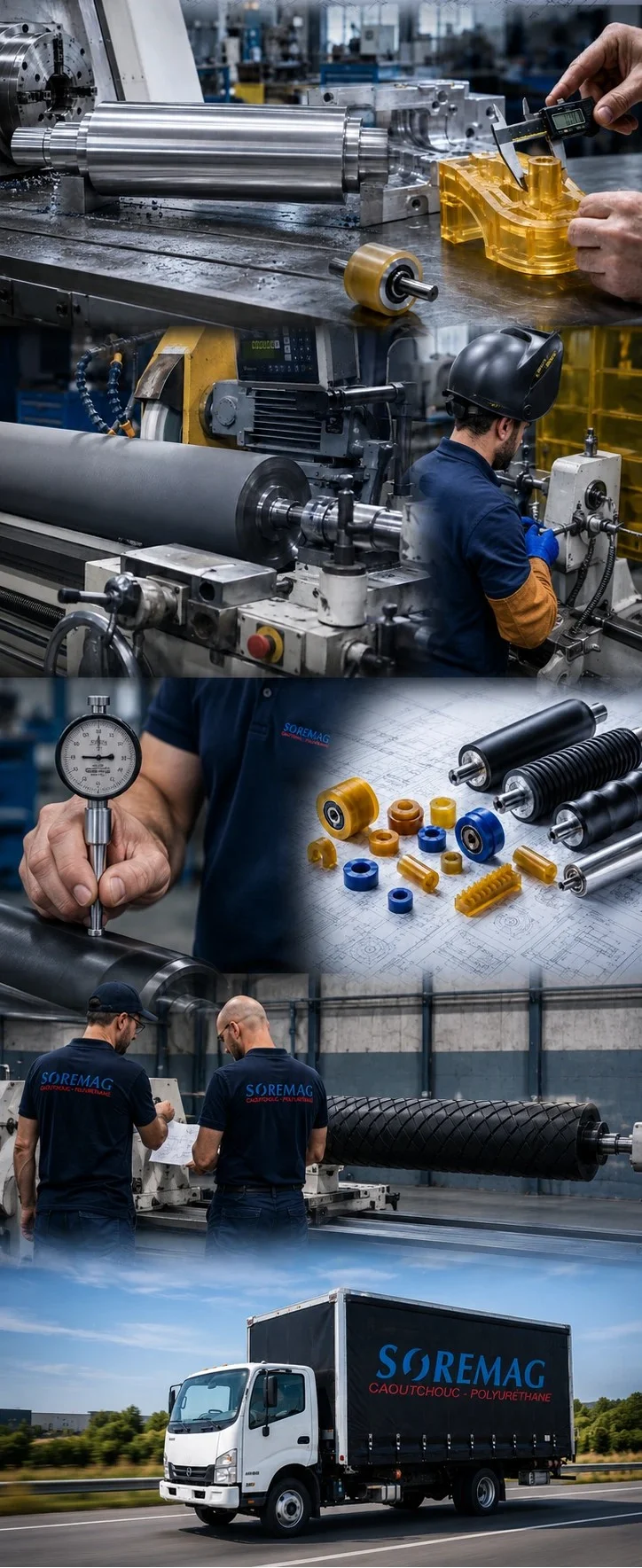
We measure with reference durometers — Soremag is in fact an official distributor of Rex durometers — and we take the hardness at several points (left-center-right) within a tolerance (often on the order of ±5 points), to guarantee a uniform roller. The measuring method and the hardness specifications are detailed in our technical data sheets (Documents).
Need a durometer or advice on measuring? Soremag distributes Rex durometers — email us.
Hardness benchmarks (to cross-reference with the material)
| Plage | Interprétation | Applications possibles |
|---|---|---|
| 10-25 Shore A | Très mou | Contact très délicat, besoin d'épouser fortement une surface |
| 25-40 Shore A | Souple | Rouleaux applicateurs, contact, surfaces irrégulières, grip élevé |
| 40-60 Shore A | Moyen souple | Traction, pression modérée, transfert, polyvalent |
| 60-75 Shore A | Moyen dur | Entraînement, guidage, pression, meilleure stabilité |
| 75-90 Shore A | Dur | Charge, abrasion, traction contrôlée, roues, pré-étirage |
| 90-95 Shore A | Très dur | Applications mécaniques sévères, forte résistance à la déformation |
| Shore D | Très rigide | Polyuréthanes durs, roues techniques, pièces fortement chargées |
Hardness by roller type
Pull rollers
Hardness influences grip, stability and service life. Too hard and it slips; too soft and it wears or deforms. But grip does not come from hardness alone: the right material, the right finish and the right profile count just as much.
Applicator rollers
A lower hardness is often preferred, so the roller conforms to the surface and lays down a liquid, a glue, a dye or an ink evenly. Too soft, on the other hand: uneven application, excess product consumption, deformation, instability at high speed.
Pressure rollers
Hardness determines the nip width and the pressure distribution: softer widens the contact zone, harder concentrates it. In paper, board, film or textiles, you have to balance hardness, load, temperature and chemistry: the right cover depends as much on humidity, temperature, mechanical load and chemical environment as on the hardness itself.
Pre-stretch rollers
They call for a precise balance of pull, stability, wear and surface condition. Too low: deformation or rapid wear. Too high: loss of grip or poorly stretched film.
Heavily loaded wheels and rollers
We often go up in hardness to limit deformation and gain stability; polyurethane excels here, combining hardness, abrasion resistance, tear strength and load capacity. UBE notes that certain TPUs are offered in different hardnesses and chemistries for these demanding applications (durability, abrasion, tear, dynamic properties).
Two materials at the same Shore A ≠ the same performance
Example, all at 70 Shore A:
| Matière | Comportement possible |
|---|---|
| Nitrile (NBR) | Bon choix en présence d'huile ou de graisse |
| EPDM | Mieux adapté à l'eau chaude, la vapeur, l'ozone |
| Caoutchouc naturel | Bonne résilience et bon comportement dynamique |
| Polyuréthane | Très bonne résistance à l'abrasion et aux contraintes |
| Silicone | Utile pour certaines températures ou applications spécialisées |
So hardness is one characteristic among others: formulation, abrasion, resilience, tear, compression set, heat resistance, bond to the core and finish all count just as much. Details: Material Selection Guide.
The mistakes that cost money
- Copying the old roller without analyzing the wear — if it was slipping, cutting or swelling, recovering it at the same hardness reproduces the problem.
- Fixing everything by raising the hardness — often the real culprit is the material, the finish, the pressure or the alignment.
- Going softer for more grip — useful up to a point, but too soft heats up, wears and becomes unstable.
- Comparing two materials on Shore A alone — a 70A polyurethane is not a 70A rubber.
- Forgetting the cleaner — a roller that is compatible with the product it carries can be attacked by the daily detergent.
- Measuring carelessly — a reading taken on a dirty, grooved, curved, aged or hot surface is misleading.
How we decide at Soremag
We do not sell "a Shore number": we recommend a roller that works.
| Information | Pourquoi c'est important |
|---|---|
| Dureté actuelle | Point de départ, pas une vérité absolue |
| Matière actuelle | Deux matières de même dureté réagissent différemment |
| Type de rouleau | Traction, pression, application, guidage, support |
| Produit en contact | Film, bois, papier, métal, courroie, liquide, colle, encre |
| Pression et vitesse | Écrasement, largeur du nip, échauffement |
| Température | Peut changer la dureté effective |
| Produits chimiques | Peuvent gonfler, durcir ou dégrader le revêtement |
| Type d'usure | Indice de la cause réelle |
| Fini et épaisseur | Influencent grip, transfert, mesure et déformation |
| Objectif du client | Plus de grip, moins d'usure, moins d'arrêts, moins de marquage |
From there, we propose the full package: material + hardness + thickness + bonding + finish + grooving + tolerances.
Not sure which hardness is right for your roller? Talk to our team — we recommend it from your actual operating conditions.
Conclusion: a tool, not a complete answer
Shore hardness helps define how a cover behaves, but it must never be used on its own. A roller at 60 Shore A can be perfect in one application and inadequate in another. The real question remains: what does the roller have to do — drive, press, guide, apply, absorb, protect, resist or transfer? That is where the right combination of material + hardness + finish comes from.
FAQ
Which scale applies to rollers?
Shore A for soft to medium-hard covers; Shore D for very hard ones; OO/AO for very soft or cellular materials.
Does a harder roller last longer?
Not always. Harder resists certain deformations, but it can slip, mark or concentrate stress. Service life depends on the material, the application, the finish and the environment.
Does a softer roller always grip better?
Often, but too soft heats up, wears, deforms and becomes unstable.
Can you measure the hardness on an old roller?
Yes, but carefully: age, wear, heat, the core and the thickness all distort the reading.
Why are two materials at the same Shore A not equivalent?
Because hardness measures neither abrasion, nor friction, nor chemical resistance, nor dynamic behavior.
What hardness for a pull roller?
It depends on the product being driven, the pressure, the speed, the finish and the environment — often between 40 and 75 Shore A, but every case has to be analyzed.
What hardness for an applicator roller?
Often lower (sometimes as low as 10-25 Shore A) so the cover conforms to the surface and applies a product evenly; it depends on the liquid, the substrate, the speed and the precision required.
Should you always go back to the original hardness?
If the roller was performing well, it is a good starting point. If it had problems, we analyze the cause before repeating the same hardness.
References
- ASTM D2240
- ISO 48-4
- ISO 48-7
- Covestro (Vulkollan)
- BASF
- UBE
