
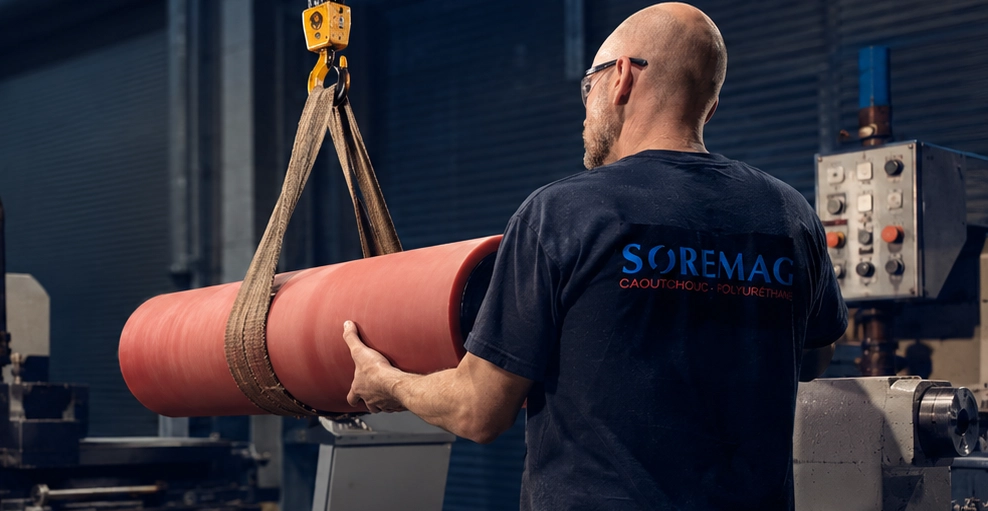
On a plastic film line running 24 hours a day, two rollers that look identical can give very different results. Here is a case where switching from rubber to polyurethane — at equal hardness — solved two production problems at once.
The context
A blown film extrusion line (the “blowing” process, or bubble film) running 24 hours a day, 365 days a year. On this line, nip (pinch rollers) about 10 in. in diameter (≈ 254 mm) and 90 in. wide (≈ 2,286 mm) are in constant contact with the film.
The problem
The rollers were vulcanized with a standard rubber — nitrile or neoprene — calendered into sheets about 2 mm thick and 40 in. wide. In the field, we often see this scenario: when the film breaks and wraps around the roller, the wrap damages the mechanical components of the line and causes downtime. To avoid it, the operators cut the film right on the roller, with a knife (Olfa type).
That is where several problems start. Cuts made in the rubber covering tended to open up, well beyond the width of the blade. And those nicks marked the film — a deal-breaker defect, since most extruded films are printed by the end customer, who cannot use a marked film. The result: costly production rejects. On top of that came fast wear in continuous service, which forced the rollers to be recovered about every 6 months.
Our analysis
Calendered rubber keeps, in a way, the memory of how it was formed: it is made in sheets, so once it is cut, it “tries” to go back to being a sheet — hence cuts that open up. The problem was therefore not how the roller was built, but a material whose behavior did not suit this handling with a knife or the wear rate of the line. This way of working back from the observed wear to the cause is at the heart of our Roller and wheel diagnosis.
The solution
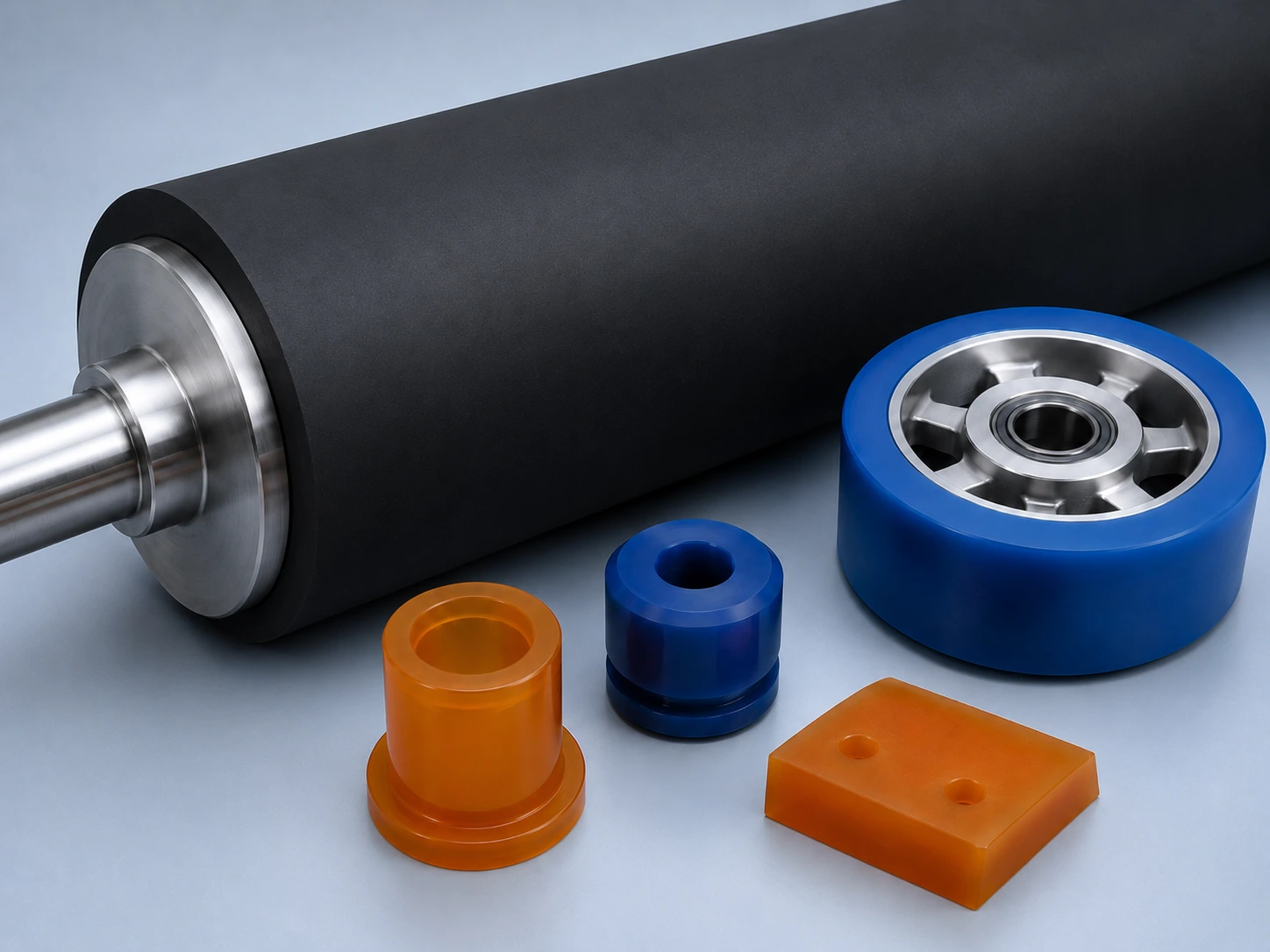
We proposed changing polymer family and covering the roller in polyurethane. Liquid to start with, polyurethane is cast — it is not calendered and therefore has no sheet memory. A cut tends to close back up rather than open up, and the material also offers better wear resistance. More precisely, we did not use a generic polyurethane, but the PolySorNip — a polyurethane recipe developed by Soremag specifically for this type of nip roller: formulated to resist the propagation of the cuts made with a knife while taking the wear of continuous service. The covering was made to the same technical specifications as the original roller, with an identical hardness of 60 Shore A. This material-hardness reasoning is exactly the one behind our Material Selection Guide.
At a glance
- Application
- Rouleau nip — ligne de film plastique soufflé (blowing), service 24/7
- Dimensions
- ≈ 10 po de diamètre (254 mm) × 90 po de large (2 286 mm)
- Avant
- Caoutchouc vulcanisé (nitrile/néoprène) calandré, 60 Shore A
- Après
- Polyuréthane coulé PolySorNip (recette Soremag), 60 Shore A
- Durée de vie
- De ≈ 6 mois à 12–18 mois (selon la formulation)
Putting it to the test
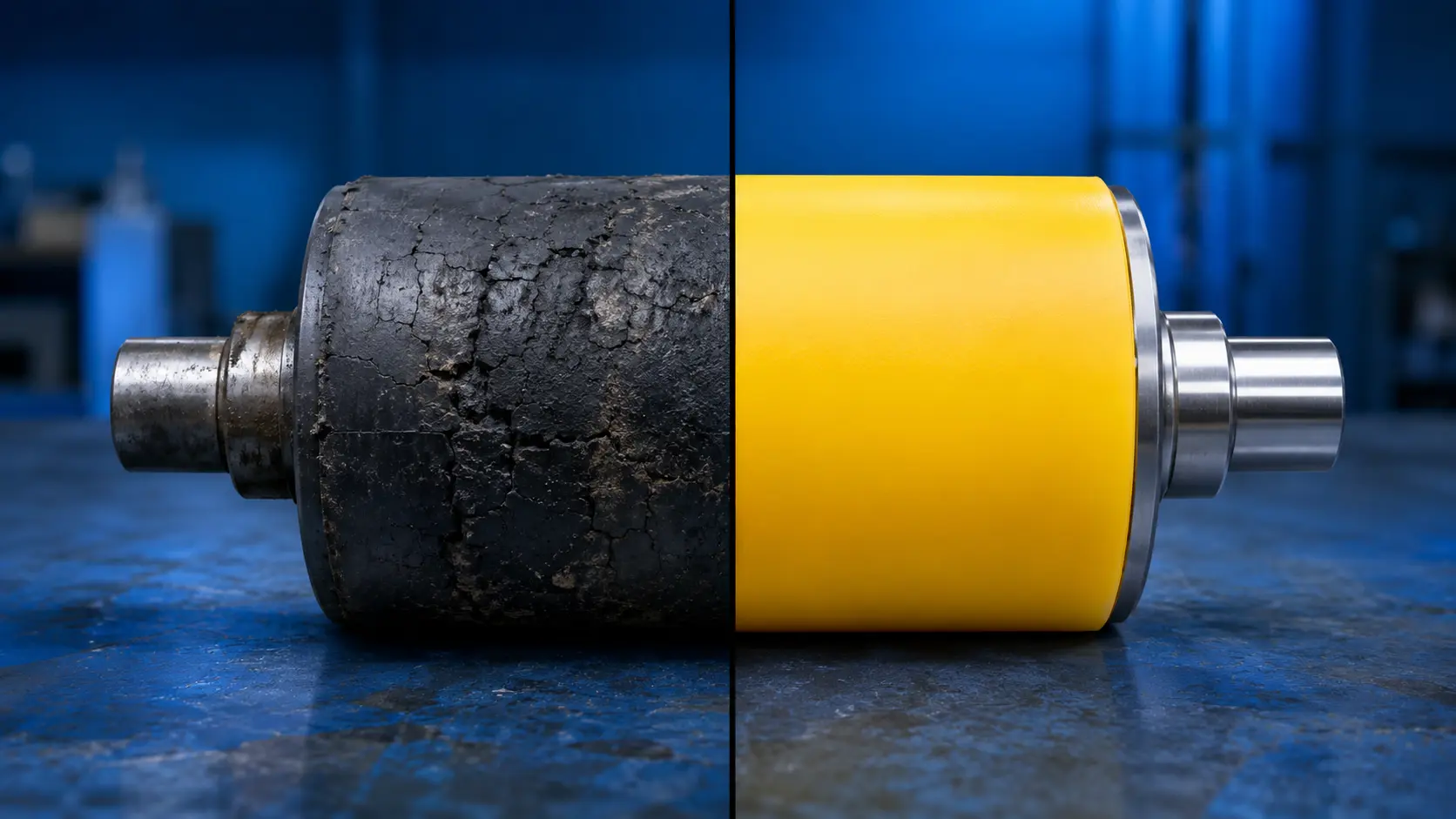
We built a polyurethane roller, put into service with the same specifications as the original vulcanized roller. The results were positive, particularly for the cuts: they no longer pinched the film and no longer left marks, which reduced production rejects. Depending on the chemical formulation developed, the wear resistance extended the service life of the covering by 50 to 100% in some cases — a roller change every 12 to 18 months instead of every 6 months with a nitrile.
The benefits
The drop in cut-related rejects brought the customer significant savings: less rework, and above all less dissatisfaction among their own customers. The longer roller life also spaced out the mechanical interventions, another source of savings.
Demand for this type of covering on this specific kind of roller (nip) has kept growing, and user feedback is unequivocal about the performance obtained — despite a higher cost than a nitrile or neoprene covering.
What this case shows
Even though the two coverings look almost identical, it is the physical properties of the material that determined the quality of the finished product — the film. Yet both coverings had the same hardness (60 Shore A): proof that hardness alone does not tell the whole story. This comes back to a key point in our article on Shore hardness, and to the real difference between material families explained in rubber or polyurethane. That is the whole purpose of our roller covering.
On a more technical note
This phenomenon — a cut that opens up in rubber but closes back up in polyurethane — has a name: notch sensitivity and tear propagation resistance. The difference in behavior between hot cast polyurethane and traditional rubber comes from their molecular microstructure. Here is what happens inside these materials when they are cut.
1. Rubber: the “zipper” effect
Vulcanized rubber is made of long polymer chains linked to each other fairly uniformly (crosslinking). Picture an elastic fishing net under tension:
- Stress concentration: when there is an initiation point (a small cut), the whole applied tensile force concentrates to an extreme degree exactly at the microscopic tip of that cut.
- Propagation: the chemical bonds at the tip give way under the load. As soon as one bond breaks, the force shifts instantly to the next one, which breaks in turn. It is this “zipper” effect that makes rubber tear very easily and very quickly as soon as there is a nick.
2. Polyurethane: microscopic “bumpers”
Hot cast polyurethane has a very different chemical design. It is a block copolymer : at the microscopic level, it is made up of two distinct zones — soft segments (which give it its elasticity) and hard segments (very dense, acting as powerful anchor points, solid islands). This structure prevents tearing in two ways:
- Energy dissipation: when the start of a cut is stretched, the energy does not concentrate at a single point of failure. It is “absorbed” by the soft segments as they stretch, while the crack literally runs into the islands formed by the hard segments.
- Strengthening under stress: under the high tension generated at the tip of the nick, the molecular chains of the polyurethane can align and crystallize locally. The material paradoxically becomes harder and more resistant right where the tear is trying to advance — which stops its propagation cold.
| Caractéristique | Caoutchouc vulcanisé | Polyuréthane coulé à chaud |
|---|---|---|
| Microstructure | Réseau élastique uniforme | Mélange de blocs souples et rigides |
| Sensibilité à l'entaille | Très élevée (déchire facilement) | Très faible (résiste à la propagation) |
| Gestion de la force | La force se concentre sur l'amorce | La force est dissipée dans tout le matériau |
It is this two-phase chemical architecture (soft / hard) that makes hot cast polyurethane a preferred choice for industrial parts exposed to wear or frequent cuts — forklift wheels, scraper blades, crusher liners — because even when damaged, they do not fall apart. It is precisely this mechanism that our PolySorNip recipe exploits: a soft/hard balance tuned for nip rollers cut with a knife in continuous service.
A nip roller that marks your film or wears out too fast?
Talk to our team