
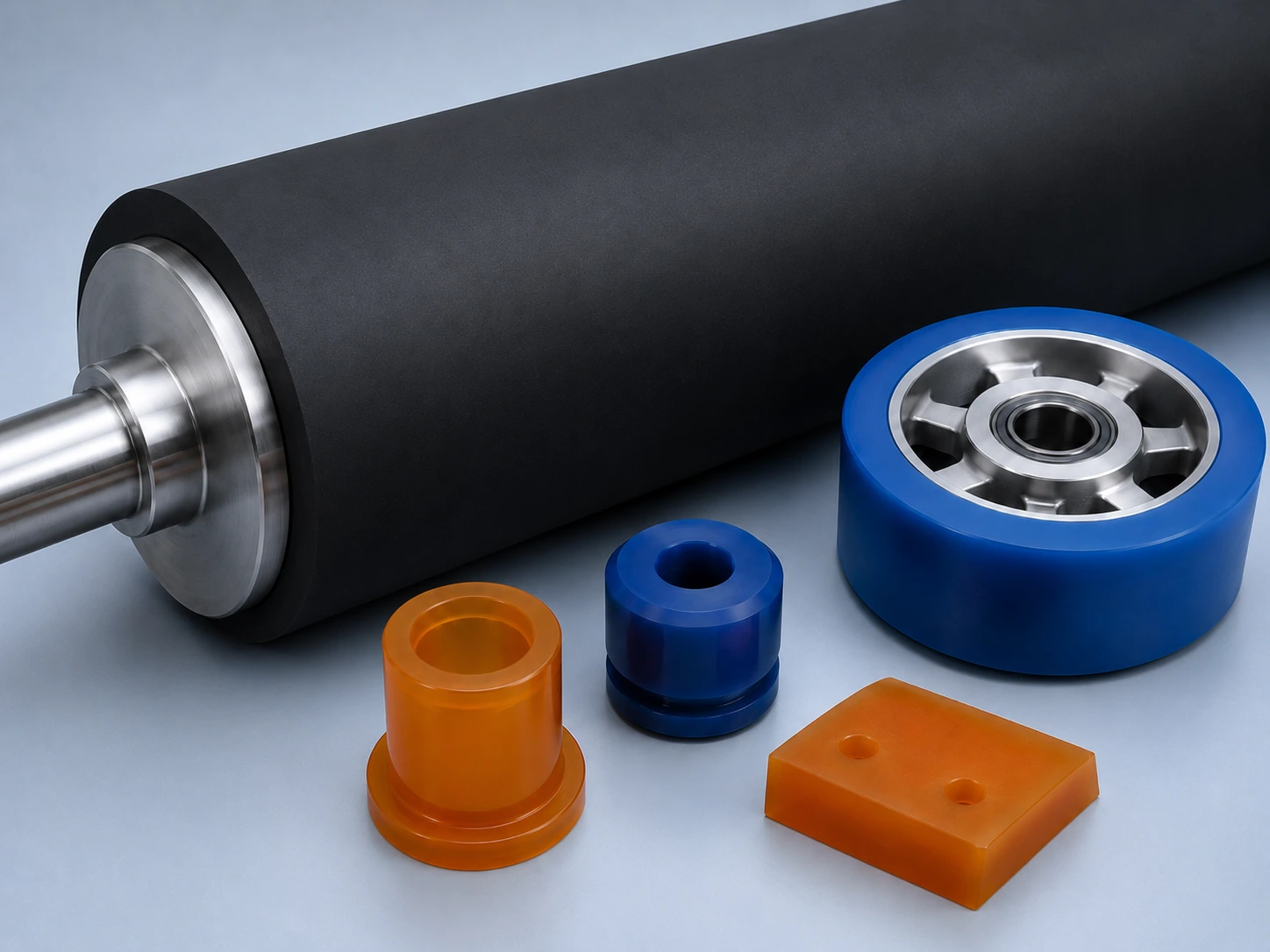
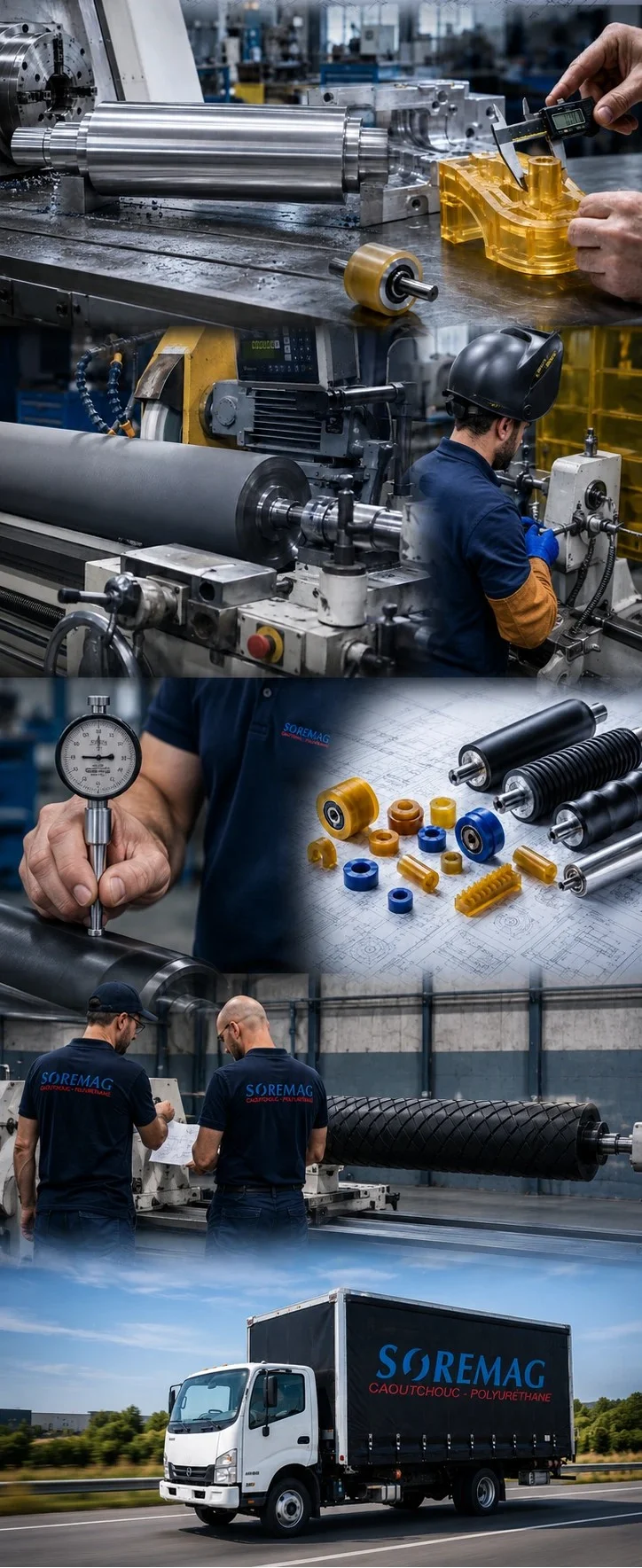
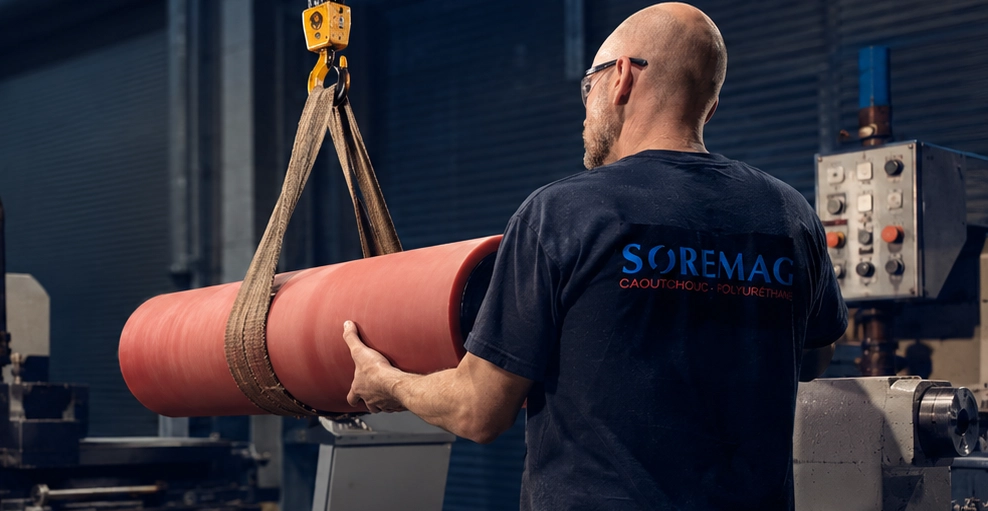
In the roller covering, we talk a lot about material, about hardness, about bonding to the core — and rightly so. But there is one thing that often makes all the difference between a roller that is simply covered and a roller that really performs: precision grinding. In the field, we often see a roller that looks perfect on the bench but that vibrates, slips or marks the product once it is on the machine. Many times the culprit is not the compound — it is the final geometry of the roller.
What is precision grinding?
Once the rubber or the polyurethane is applied, the roller has to be brought back to its final geometry: that is the grinding stage. It is what controls the diameter, the concentricity, the runout, the cylindricity, the crown (when needed), the roughness and the finish, the profile and the depth of the grooves, the uniformity over the whole length, and the repeatability from one roller to the next. A roller can look simple, but once it is running at speed, under pressure and under tension, the smallest geometry defect ends up showing.
The right material does not save a bad finish
A polyurethane with outstanding abrasion resistance performs poorly if it is not round. A rubber that grips well can slip if the surface is too smooth. The roller surface is a critical contact area: it decides traction, pressure, transfer, guiding, stability and, in the end, the quality of your product.
Round, yes — but that is not enough
Many people reduce grinding to roundness. A roller that performs also has to be concentric with its journals, straight over its whole length, at the right diameter, with the right finish, the right crown if one is required and the right grooving. Good to the eye does not mean within tolerance.
The parameters that matter
Diameter
It sets the surface speed, the contact pressure and the relationship with the other rollers. A variation means a speed difference, tension that moves, slip, repeating marks. Diameter is not approximated — it is ground to the actual function of the roller.
Runout
The roller does not turn perfectly round about its axis. At low speed it goes unnoticed; at high speed it vibrates, it pounds, it leaves cyclic marks. That is where a lot of mistakes happen: the machine, the product or the operators get the blame… when the roller simply was not ground precisely enough.
Cylindricity
The same precision over the whole face. A roller that is good at one end but dished or tapered in the middle creates uneven pressure, crooked wear, wrinkles and marks.
Crown
Sometimes a roller must NOT be perfectly straight: we give it a slight crown to compensate for deflection under load or to spread the pressure more evenly. Too little crown corrects nothing, too much creates a problem of its own — so it gets calculated, it does not get improvised.
The surface finish
Two rollers identical in material, hardness and diameter can give opposite results depending on their finish. Smoother: less marking, easier cleaning, uniform transfer. More textured: more grip, less slip. The right finish depends on the job of the roller, not on the eye.
Grooving
Straight, spiral, crosshatched, herringbone… grooves are there to grip, to evacuate air, water or glue, to stabilize the material. A groove that is too deep weakens or marks, one that is too shallow loses its effect quickly: the profile is chosen according to the material in contact and the problem to be solved.
Rubber and polyurethane do not grind the same way — and heat is the enemy
Grinding behavior depends on the hardness, the elasticity, the composition and the heat generated. A soft rubber tends to deform under the load; a polyurethane can heat up. And on an elastomer, heat glazes the surface, creates micro-defects and makes the dimension drift. A roller is not ground the way a steel part is: rubber and polyurethane are living, elastic materials, sensitive to heat. Hence controlled passes, good cooling and a method matched to the compound.
Our equipment (4.0) — but never without the analysis
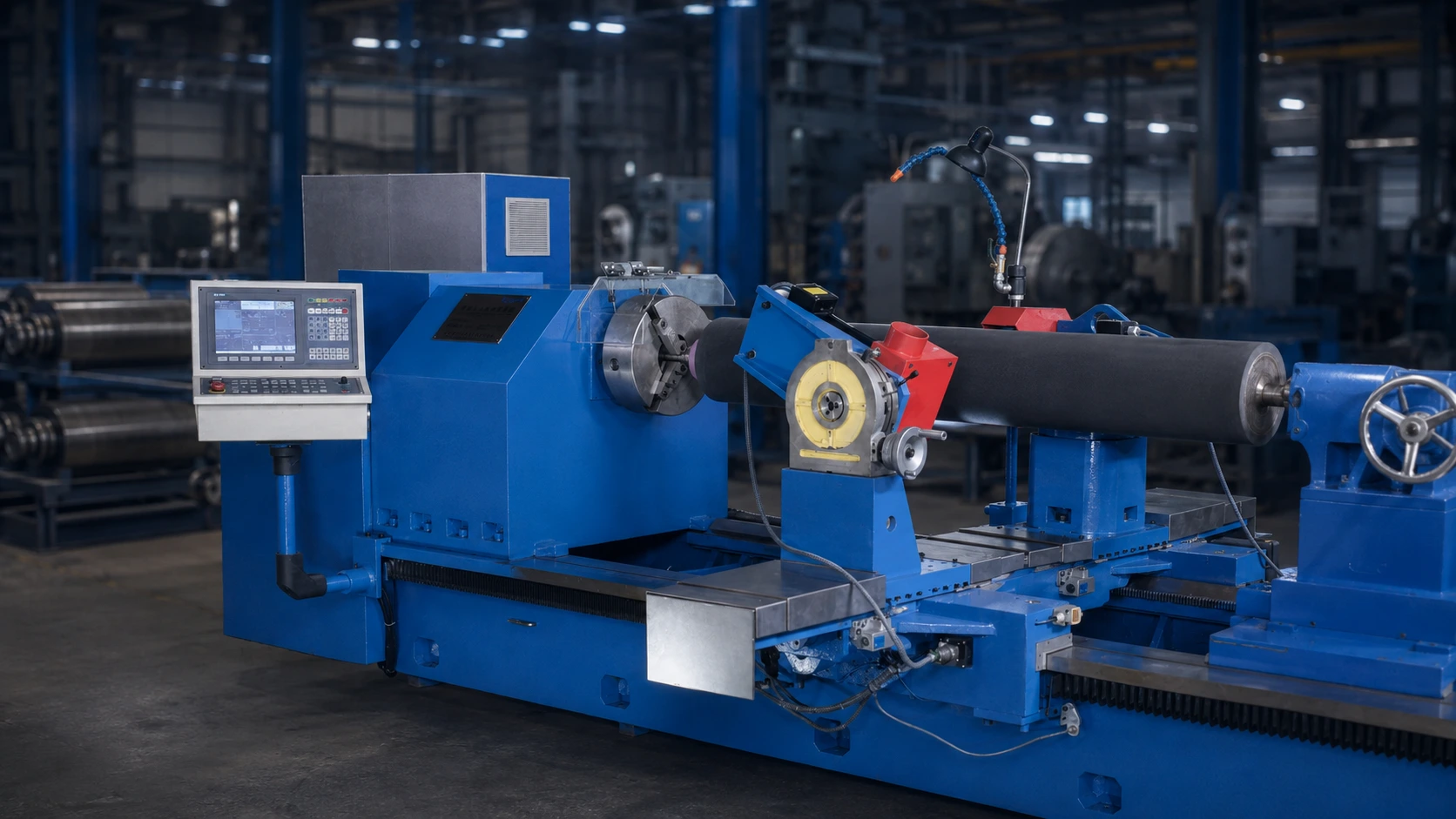
A consistent finish calls for equipment designed for covered rollers: long, heavy, soft at the surface, sometimes grooved or crowned, with tight tolerances. Our finishing equipment is specialized, automated and networked to a server in real time (Industry 4.0) — which gives repeatability and consistent geometric accuracy from one roller to the next, right up to complex profiles. But technology does not replace the analysis: the best result comes from the combination of equipment + shop-floor know-how + understanding of the application.
Why it changes everything in production
A badly ground roller gets paid for on the line: a pull roller that slips, a pressure roller that marks, an applicator that transfers unevenly, a roller that vibrates at high speed, a surface that wears out too fast. And behind that: scrap, downtime, constant adjustments, complaints. A well-ground roller does the opposite: it works evenly, spreads the loads better, limits pressure points and protects the journals and the bearings — so it lasts longer, even with the same compound.
Recovering is the chance to improve
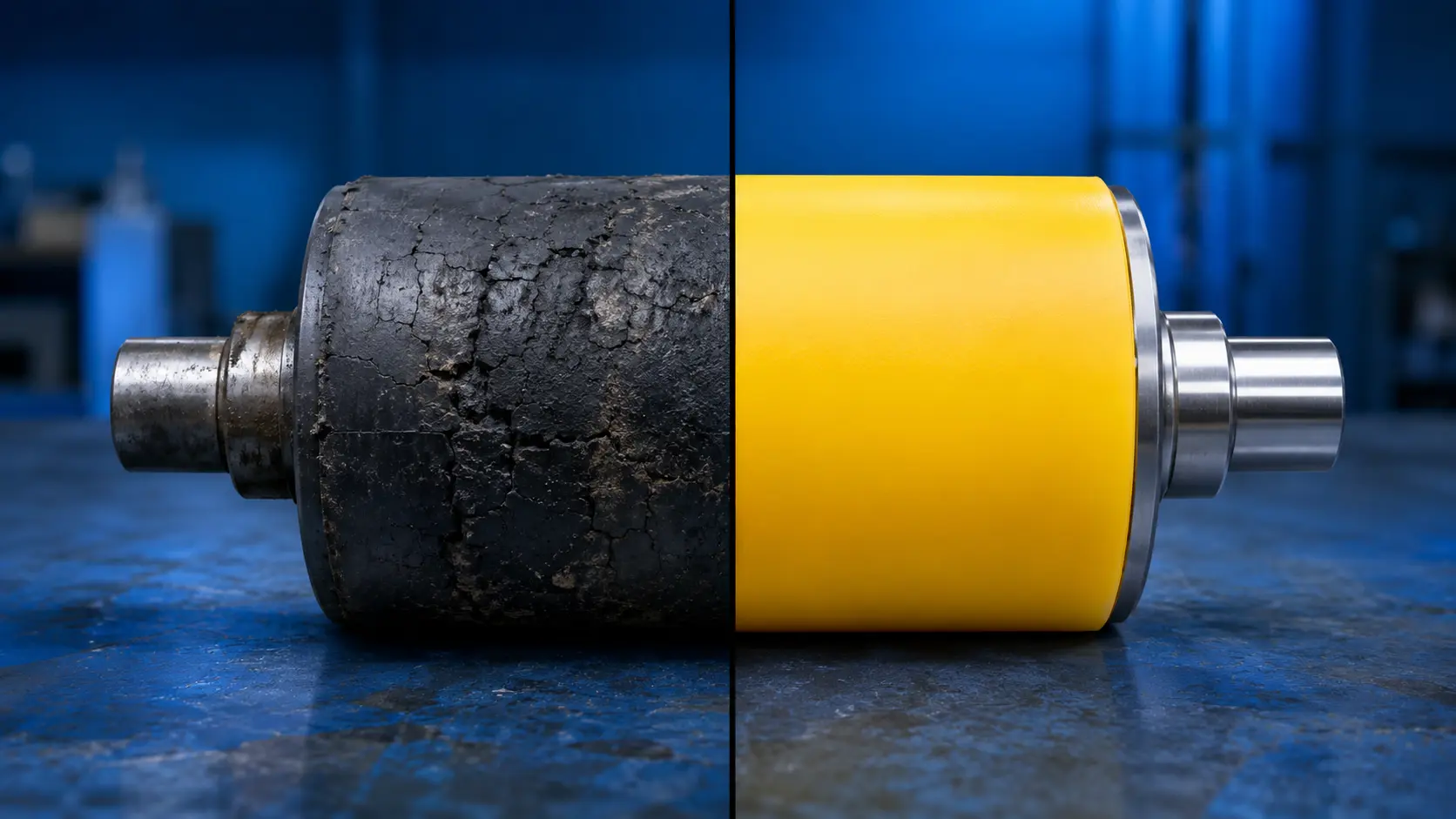
When a roller comes back, the reflex should not be to redo it exactly as it was. This is the right moment to ask: was it slipping? was the surface glazed? were the grooves still working? was it vibrating, marking, wearing out too fast? The cause can often be read in the wear — that is what our Roller and wheel diagnosis is about — and grinding then makes it possible to correct, to optimize and to adapt the roller to the actual application (see also the roller covering).
Regrind or full recover?
A simple regrind can be enough if the cover is still thick enough, well bonded, with no cracks, no swelling and no deep contamination, and if the problem is mainly at the surface. A full recover is called for if the roller is too worn, cracked, debonded or swollen, if the hardness has changed, if the diameter no longer allows another cut, if the material is no longer the right one or if the core has to be repaired. The analysis decides.
What we need from you
To get it right: the type of roller, the application, the material in contact, the speed, the pressure, the temperature, the original and current diameter, the face length, the target hardness, the finish you want, the grooving if there is any, the problems observed, photos, the critical tolerances and your objective (more grip, less marking, longer service life, more stability, less downtime).
A roller to grind or to recover? Talk to our team — we analyze it and finish it to your actual application.
A case from the field: nice roller, but it vibrates
A roller comes back because it vibrates at high speed. To the eye, the cover is still fine: no major crack, surface intact. On inspection, we often find something else — slight runout, uneven wear, a loss of concentricity, a varying diameter or a tired journal. Replacing the material without correcting the geometry fixes nothing. Precision grinding brings the roller back to a stable condition… or confirms that a full recover is needed.
In short: performance is decided in the details
Diameter, roundness, concentricity, runout, cylindricity, crown, finish, grooving: each one influences traction, pressure, stability, service life and quality. A roller that is well covered but badly finished causes problems; a roller that is well ground and well matched improves the line. In production, it is often the details invisible to the eye that make the biggest difference.
Ready to finish your roller with precision? Talk to our team
FAQ
What is precision grinding of a roller?
It is the grinding done after covering, to get the right diameter, the right roundness, the right profile and the right surface finish.
Why grind a roller after covering?
To bring it back to its final dimensions and give it a surface suited to the application.
Does grinding affect grip?
Yes: the surface finish decides grip, slip, transfer and cleaning. Too smooth or too rough, and it performs poorly.
What is the difference between grinding and grooving?
Grinding corrects the surface and the geometry; grooving creates profiles or channels for traction, for evacuation and for the way the roller behaves.
Do all rollers have to be grooved?
No: some have to be smooth, others textured, grooved or crowned, depending on the application.
What is runout?
A variation in rotation relative to the axis: at high speed it causes vibration, noise, marks and premature wear.
What is a crowned roller?
A roller with a slightly crowned profile to compensate for deflection or to spread the pressure more evenly.
Can you simply regrind instead of recovering?
Yes if the cover is still thick, well bonded and sound; otherwise (worn, cracked, swollen, debonded), a full recover is better. The cause is read first in our Roller and wheel diagnosis, and the choice of material in our Material Selection Guide.
