
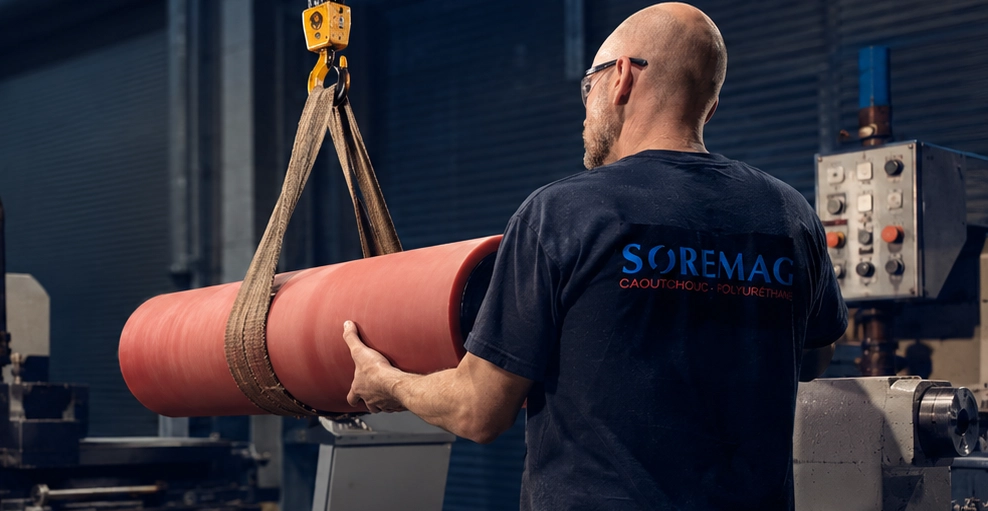
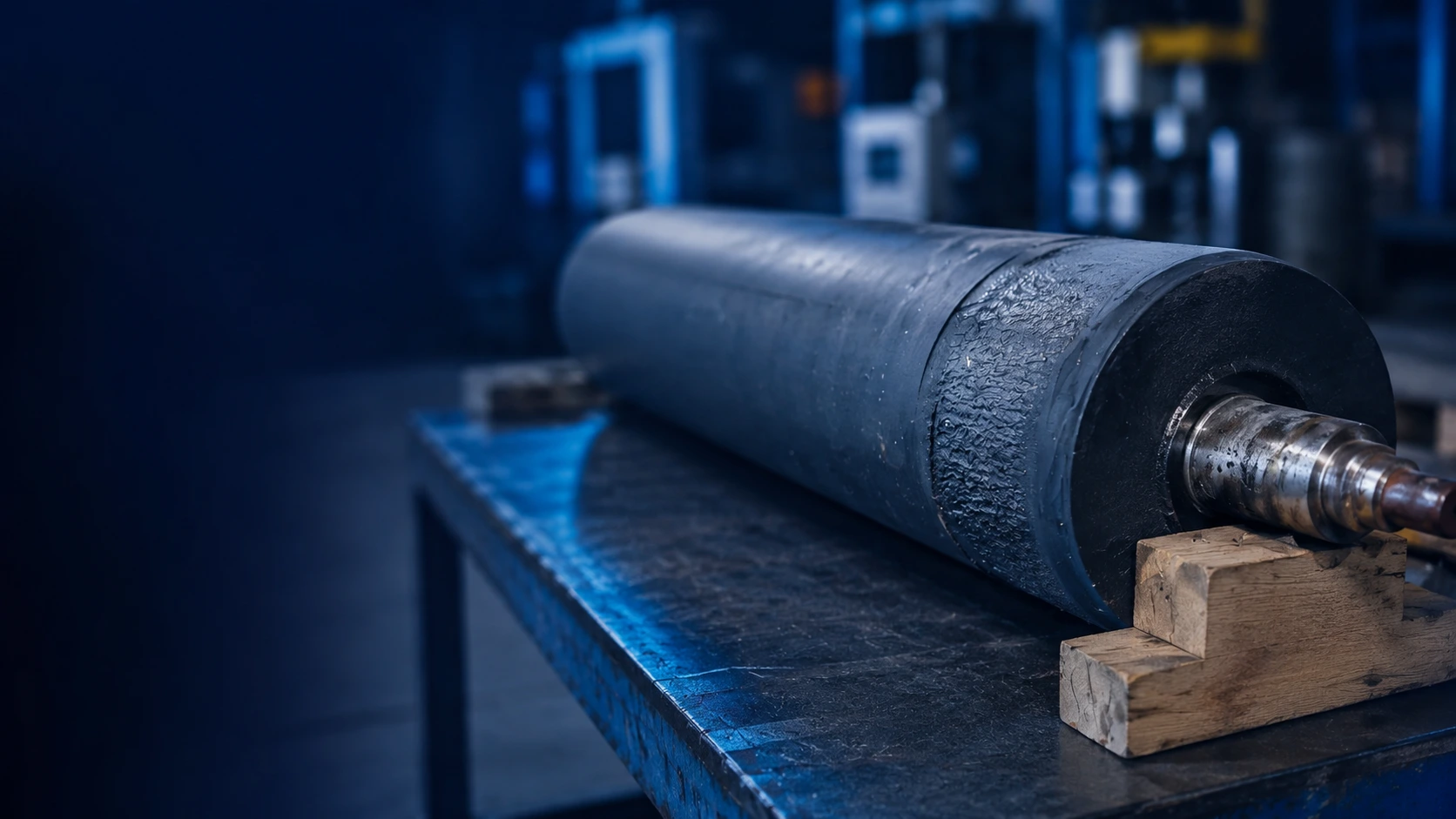
A roller almost never fails all at once. Before it costs you downtime, it talks to you — you just have to listen. Out in the plants, we keep seeing the same story: the surface gets a little more glazed, it slips a touch on startup, a new vibration shows up, an operator says “the machine is harder to set than it used to be.” Taken one at a time, these details look harmless. Put together, they usually mean a cover is nearing the end of its life. A roller can look simple, but what happens in the contact zone is not. The goal here: help you spot these signals early enough to plan the recovering at the right time — during a planned shutdown, not in an emergency.
Why watch for wear instead of waiting for the breakdown
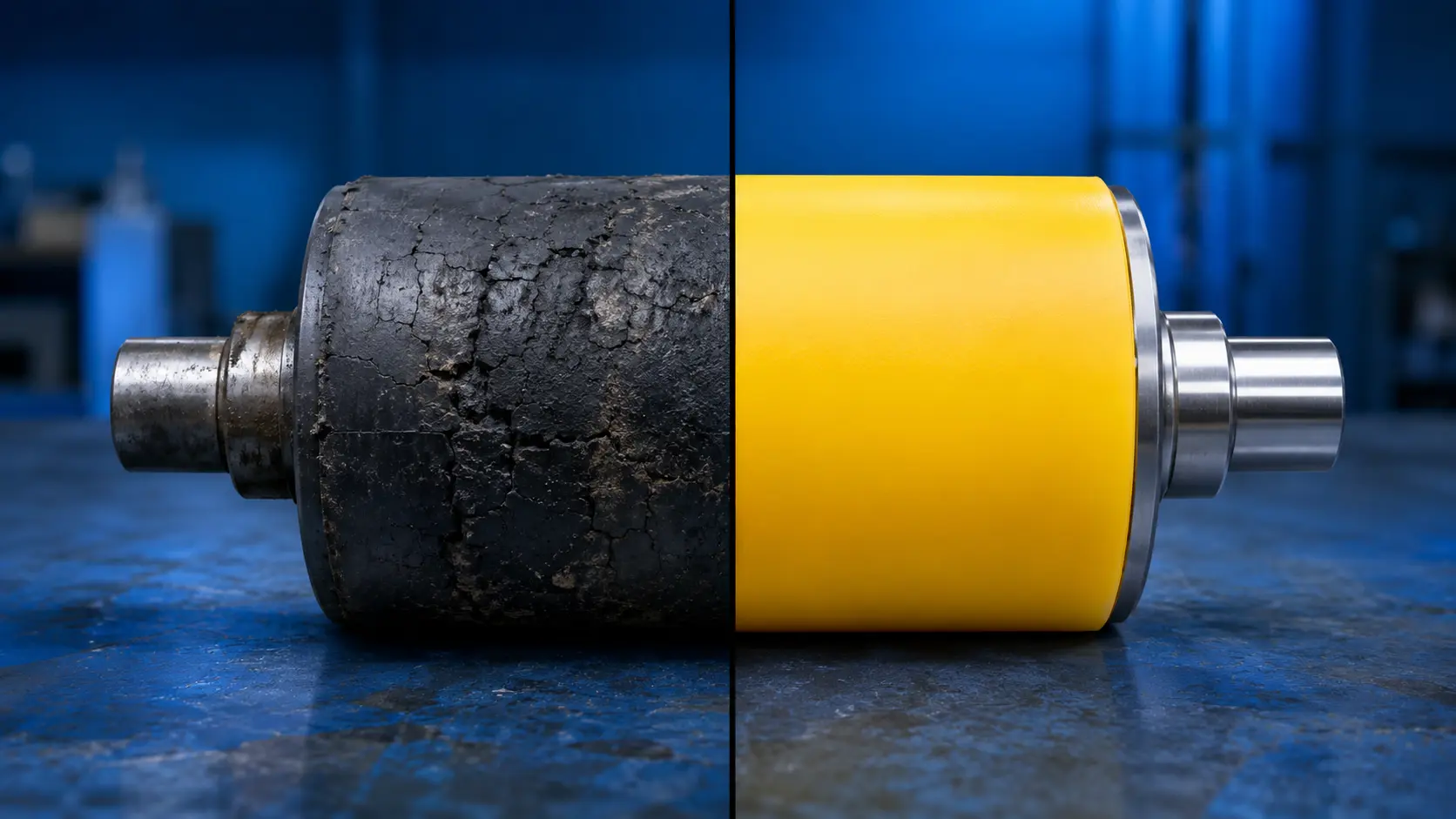
A worn roller is not just a matter of appearance. It loses traction, destabilizes tension, marks the product, generates scrap, runs hot — and, left too long, it ends up damaging its core, its journals, its bearings or the material around it. A roller is a bit like an industrial tire: as long as it turns, everyone assumes it is fine. But glazed, hardened, worn unevenly or contaminated, it no longer gives the same performance, even if it still turns. The golden rule: recover during a planned shutdown, not during one you did not plan.
The signals that do not lie
The surface turns glazed
Often the first sign — and the most misleading. The roller looks clean, almost new… but it has already lost grip. This is where several mistakes happen: people raise the pressure to compensate, and speed up the wear instead of fixing the cause.
It slips
The contact is no longer right. The trap is that you get used to it: a little more pressure, a little less speed, one more cleaning… and the real problem is still there. Slippage is not something to ignore.
The wear is uneven (one side, the center, the edges)
In the field, uneven wear is rarely just the cover: alignment, poorly distributed pressure, crown, journals, deflection. If we recover without understanding why, the new cover will wear exactly the same way.
Cracks appear
A crack is not just a line in the rubber: it is a way in for liquids and contaminants, and it grows under load. When cracks start multiplying, it is time to plan.
Tacky, soft or swollen
Here the roller is reacting to its environment — solvent, oil, cleaner, heat. It is not only losing its surface, it is losing its properties. Rebuilding the same compound without understanding what is attacking it means repeating the problem.
Hardened
The opposite happens too: the roller becomes harder than it was originally and loses its grip and its flexibility. This is often where an operator says “it used to pull better.”
Cuts and chunking
Under pressure and rotation, a small cut does not stay quiet: it opens up and spreads until the cover fails.
The cover is debonding
A blister, a lifted edge, a hollow sound when you tap it: that is a critical signal. At this point the risk is no longer performance, it is breakage. Do not wait.
Vibration or noise
Unbalance, runout, uneven wear… or a tired bearing and journal. Either way, it wears everything else out faster.
The roller marks the product
Once the marks show up, the problem has already reached your production — and therefore your scrap.
The grooves wear out
Rounded over, polished or plugged, they no longer clear the air, the water or the adhesive, and the roller loses its function even if the cover material looks fine.
It runs abnormally hot
The temperature of a roller is not a detail: it is a health indicator. And heat speeds up almost every other form of wear.
For each of these signs, tracing back to the real cause — material, hardness, finish, alignment, pressure, chemistry — is the purpose of our Roller and wheel diagnosis. Our reflex: analyze the worn roller before recommending anything.
Careful: the sign is not always the cause
A roller that wears out is rarely just “bad rubber.” More often, it is the operation that has changed: pressure raised, speed increased, new product, new cleaner, poor alignment. Treat only the symptom and the problem comes back. That is why we do not blindly copy the old roller — we first read what its wear is telling us, and that is exactly the purpose of our Roller and wheel diagnosis.
The right time to recover
Too late is expensive: scrap, unplanned downtime, emergency teardown, damaged core, journals to rebuild. Too early is money left on the table. The right time is in between: as soon as performance drops, but before the core, production or safety are affected. The best strategy fits in one sentence: schedule the roller covering during a planned shutdown.
What your operators say (and what you should listen to)
Operators are often the first to feel a roller changing. These sentences are worth their weight in gold:
- “We have to run more pressure than before.”
- “It slips on startup.”
- “The roller is harder than it used to be.”
- “The surface has turned glossy.”
- “The product always marks in the same spot.”
- “The tension is not stable anymore.”
- “The machine is noisier.”
- “It does not pull like it used to.”
When you hear that, it is time to schedule an inspection — before the downtime.
The sign, what it means, what to do
| Signe observé | Ce que ça peut dire | Quoi faire |
|---|---|---|
| Surface lustrée | Glissement, chaleur, contamination, polissage | Vérifier grip, nettoyage, pression et fini |
| Glissement | Perte d'adhérence, rainures usées, pression insuffisante | Faire analyser dureté, matière, rainurage, alignement (Diagnostic) |
| Usure d'un côté | Alignement, pression inégale, portées, flexion | Vérifier la machine AVANT de recouvrir |
| Craques | Vieillissement, chaleur, ozone, chimie, fatigue | Planifier le recouvrement, valider la formulation |
| Collant / gonflé | Huile, solvant, nettoyant, eau chaude | Identifier le contaminant; ne pas recopier le composé |
| Durci | Chaleur, oxydation, ozone | Mesurer la dureté, revoir les conditions |
| Coupures | Débris, contact mécanique, dureté inadaptée | Vérifier l'environnement et la résistance au déchirement |
| Décollement | Infiltration, corrosion, surcharge | Retirer ou planifier vite selon le risque |
| Vibration | Faux-rond, usure inégale, roulement | Inspecter recouvrement, portées, mécanique |
| Marques produit | Défaut de surface, pression, contamination | Inspecter la surface, valider la finition |
| Rainures usées | Abrasion, nettoyage, accumulation | Refaire le rainurage ou recouvrir selon l'état |
What we look at — and what we need from you
A good inspection is not complicated: above all, it has to be regular. By eye: glazed surface, cracks, cuts, debonding, plugged grooves, wear at the edges. By hand: tacky areas, softer or harder spots, lost grip. Running: slippage, vibration, noise, repeating marks. By measurement: diameter, runout, cover hardness, condition of the journals and the core.
So we can recommend the right solution, the most useful things are: photos (the whole roller + close-ups of the wear), the dimensions, the hardness and the material if you know them, the application, the speed, the pressure, the temperature, the product in contact, the cleaners, the type of wear and your objective (more grip, less wear, less marking, less downtime).
A roller showing signs? Talk to our team — we analyze it and recommend the right solution.
Field example: the roller that slips
A pull roller runs fine for months. Then it slips a little on startup. Someone raises the pressure — it works… for a while. Then the surface glazes, it runs hot, the wear accelerates, the product drifts, the adjustments pile up. Caught in time, we analyze the surface, we measure the hardness, we look at the finish and the grooves, we understand the environment — and we recommend a cover that really fits: sometimes a different hardness, a different finish, new grooving, sometimes a different material (see the Material Selection Guide). That is where field analysis beats the automatic answer. And when the wear is uneven or unexplained, we trace it back to the cause with our Roller and wheel diagnosis.
In short: a worn roller talks
Glazed surface, slippage, uneven wear, cracks, swelling, hardening, cuts, vibration, marking, worn grooves: each of these signs is telling you something. Read properly, a worn roller becomes the starting point for a roller that performs better and lasts longer — not just a copy of the old one.
Ready to make your roller talk? Talk to our team
FAQ
What are the first signs of wear?
Often a glazed surface, a loss of traction, slight slippage, residue buildup, uneven wear or a variation in product quality.
Can a roller be worn out even if it looks fine?
Yes. It can have lost its grip, its original hardness, its surface roughness or its roundness while still looking clean.
Why is my roller turning shiny?
Slippage, heat, friction, polishing by the material, improper cleaning or contamination — often at the cost of grip.
Why is it cracking?
Aging, heat, ozone, chemicals, fatigue or a poorly matched hardness.
Why is it swelling?
A chemical incompatibility (oil, solvent, cleaner, process fluid). The substance has to be identified before choosing the new cover.
Should you always go back to the same cover?
No. If the roller was performing well, it is a good starting point; if it was wearing fast, slipping, marking or swelling, we analyze the cause first with our Roller and wheel diagnosis.
When should a recovering be scheduled?
As soon as performance drops, but before the core, production or safety are affected — ideally during a planned shutdown.
