
A drainage chute on a bridge spends its life under rain, sun, de-icing salt and standing water. The real question is not “does it work on day one?”, but “will it still hold up in ten years?”. Here is the data that answers that — on the material behind the SoreDrain PU 80/90.
The context
A SoreDrain PU 80/90 is a hot cast polyurethane developed by Soremag for outdoor cast parts in road infrastructure: bridge drainage chutes, exposed catch basins and collectors. In these applications, the part has to take continuous UV, humidity, standing water, freeze-thaw cycles and road contaminants — salt, oil, gasoline — without cracking, breaking down or hydrolyzing.
The challenge
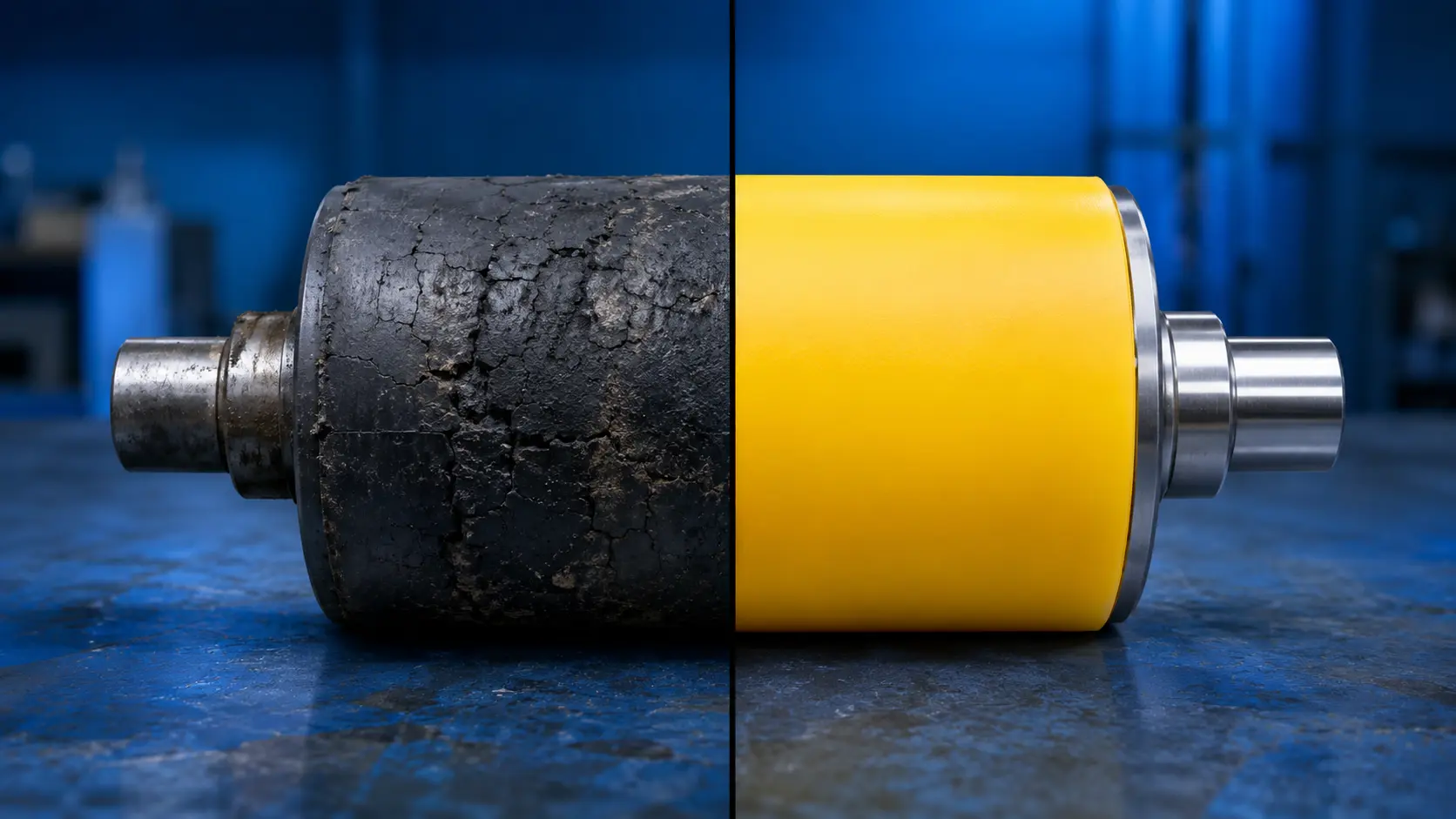
Plenty of materials look right on installation day. The problem shows up later: the wrong elastomer crazes in the sun, softens or swells in water, gets colonized by mold, or crumbles under hydrolysis. On a drainage part that is hard to reach, every replacement is expensive. So the material had to be chosen on its long-term durability, not only on its initial properties — the very logic behind our Material Selection Guide.
The SoreDrain PU 80/90 at a glance
- Type
- Polyuréthane moulé à chaud
- Dureté
- 80 – 90 Shore A (ajustable selon le projet)
- Traction
- 34 – 38 MPa (≈ 4 930 – 5 510 psi)
- Allongement
- 430 – 490 %
- Déchirement (Die C)
- 92 – 105 kN/m (≈ 525 – 600 lbf/po)
- Température de fragilité
- < -63 °C (< -81 °F)
- Conçu pour
- UV, humidité, eau stagnante, sel, huile, essence
- Applications
- Goulottes sur ponts, puisards et collecteurs exposés, pièces moulées d'extérieur
Data sheet — SoreDrain PU 80/90
A special product, outside our materials guide. See the full data sheet: mechanical properties, processing and typical applications.
The evidence — 10 years of aging in a tropical climate
To validate the outdoor performance of this polyurethane, samples were exposed for ten years in a particularly severe tropical environment, under several simultaneous exposure regimes: humid forest with no direct sun (“jungle”), continuous full sun, under an open shelter, immersion in sea water and burial in the soil.
| Propriété | À l'origine | Jungle | Plein soleil* | Sous abri | Eau de mer | Enfoui |
|---|---|---|---|---|---|---|
| Dureté (Shore A) | 91 | 81 | 82 | 88 | 80 | 89 |
| Module 100 % (psi) | 1100 | 1040 | 720 | 990 | 1040 | 990 |
| Module 300 % (psi) | 1650 | 1600 | — | 1500 | 1500 | 1530 |
| Traction (psi) | 5400 | 3600 | 855 | 3330 | 4100 | 4000 |
| Allongement (%) | 510 | 510 | 140 | 570 | 580 | 540 |
The reading is clear: under shelter, in sea water and buried, the material keeps most of its properties after ten years. The only marked drop concerns the clear, unpigmented sample left in continuous full sun — behavior that is expected for a transparent polyurethane.
Adding a pigment (such as carbon black) or a UV absorber brings property retention back to a nearly complete level, even in full sun, over the same period. That is precisely why SoreDrain intended for direct exposure is formulated with this protection.
Two observations reinforce the picture. After prolonged immersion in sea water, the samples were heavily encrusted with marine organisms, but once cleaned, no pitting, cracking or sign of attack was visible and the properties stayed excellent. In the soil, the test ground was crawling with termites that “tasted” other elastomers — but not this one. The mold seen in the humid forest affects appearance more than anything, not the mechanical properties.
The evidence — 20 years of immersion in water
Outdoor durability is not enough if the material hydrolyzes on prolonged contact with water. So this polyurethane was also tracked over twenty years of continuous immersion at room temperature.
| Propriété | À l'origine | Après 20 ans |
|---|---|---|
| Dureté (Shore A) | 90 | 89 |
| Module 100 % (psi) | 1000 | 1100 |
| Module 300 % (psi) | 1700 | 2350 |
| Traction (psi) | 3925 | 3400 |
| Allongement (%) | 480 | 460 |
| Déchirement (lbf/po) | 97 | 130 |
| Prise de masse | — | ≈ +1,3 % |
After two decades in water, hardness, tensile strength and elongation are essentially maintained, tear strength stays high, and weight gain levels off at around 1%. In other words: exceptional hydrolytic stability, exactly what a drainage part calls for.
What this case shows
For an outdoor cast part, the right choice is not decided by the day-one data sheet, but by long-term performance: UV, water, salt, micro-organisms and hydrolysis. SoreDrain PU 80/90 was selected because this family of hot cast polyurethane has shown, over spans measured in decades, that it stays stable where other materials give way. That logic — choosing the material on how it is actually used — is what guides our roller coverings as well as our cast polyurethane parts.
An outdoor part exposed to UV, water or salt?
Talk to our team