
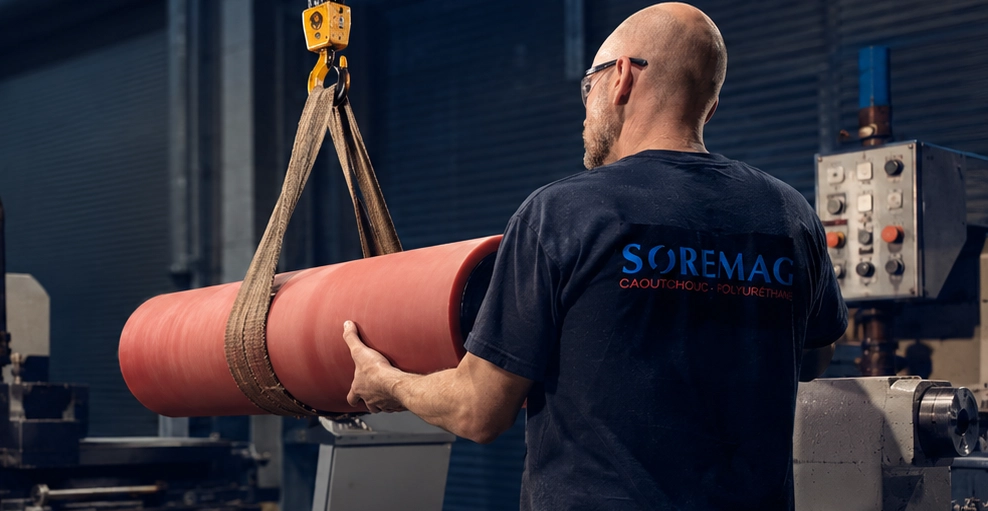
A roller can look simple: a metal cylinder with a layer of elastomer over it. But that layer of rubber is the heir to a long history — the story of a latex tapped from a tree, unusable for a long time, that became the reigning material of industry. Here is how we got there, and why rubber is still at the heart of roll covering today.
In the beginning: latex from the rubber tree
Natural rubber is not a laboratory invention: it is a product of nature. It comes from latex, a milky sap harvested mainly from the Hevea, a tree native to South America. The word “caoutchouc” itself is said to come from an Indigenous Amazonian language and evokes “the tree that weeps” — a fine image for the drop-by-drop harvesting of latex.
Long before the industrial era, peoples of Central and South America were already using this material to make balls, to waterproof fabrics and to form containers. But once it was brought back to Europe, raw rubber hit a wall: it was unstable.
The big problem: a material that melts and cracks
Untreated natural rubber has a disqualifying flaw for industrial use: it softens and turns sticky in heat, then hardens and cracks in cold. The first rubber boots and waterproof clothing turned into a disaster depending on the season. To become a real working material, rubber had to be stabilized.
Vulcanization: two men, one revolution (1839-1844)
The solution arrives around 1839. In the United States, Charles Goodyear, after years of trials and hardship, discovers — somewhat by accident, dropping a mix of rubber and sulfur onto a hot stove — that heating rubber with sulfur yields a stable, elastic and durable material. He obtains his American patent in 1844.
On the other side of the Atlantic, the Briton Thomas Hancock — already a pioneer of the rubber industry with his “masticator” patented in 1837 — analyzes samples from Goodyear's process, deduces the role of sulfur, and files his own patent in the United Kingdom on November 21, 1843, a few weeks before Goodyear. It was in fact a friend of Hancock, William Brockedon, who named the process vulcanization, after Vulcan, the Roman god of fire.
It hardly matters who was “first”: together, this work turned an unstable curiosity into an industrial cornerstone. Without vulcanization, no tires, no seals… and no covered rollers.
The era of synthetic rubbers
In the 20th century, chemistry takes over from nature. To break free of natural rubber shortages — particularly during the wars — and to obtain targeted properties, the industry develops synthetic rubbers :
- Neoprene (polychloroprene), developed at DuPont around 1930 and sold commercially shortly after — valued for its resistance to weather, oils and aging.
- Nitrile (Buna-N / NBR), developed in Germany around 1931 and produced on a larger scale from 1935 — the benchmark for resisting oils and hydrocarbons.
- SBR (Buna-S, styrene-butadiene), also born in the early 1930s — a versatile, low-cost rubber.
For roll covering, this variety changes everything: we no longer just “put rubber on it,” we choose the right compound based on the application — resistance to oils, to heat, to abrasion, food-grade requirements, and so on.
Why cover a roller with rubber?
On a production line, a bare metal roller is rarely ideal: it marks, it slips, it absorbs nothing. A layer of vulcanized rubber fixes all of that: it gives grip, cushions the pressure, protects the product and can be chosen across a wide range of hardnesses. In practice, the rubber is calendered into sheets, built onto the roller, then vulcanized — often in an autoclave — to cure and bond to the core. Then come the machining and the surface finishing.
That know-how is at the heart of our roller covering, and the full steps are described in our article on the roll covering process.
Rubber at Soremag today
Nearly two centuries after Goodyear and Hancock, rubber remains irreplaceable in many applications. At Soremag, we work with the whole family — nitrile, neoprene, SBR, natural rubber and special compounds — to cover rollers and wheels at the right hardness and the right finish. The right compound is always chosen from the real application: that is the point of our Material Selection Guide.
A roller or a wheel to cover in rubber?
Talk to our team