
Rubber has close to two centuries of history behind it; polyurethane is the younger one — born in 1937. Yet in a few decades this material, liquid to start with, became essential for wear parts, wheels and rollers. Here is its history, and why the way it is made changes everything.
1937: an entirely new chemistry
Polyurethane was born in 1937 in the laboratories of the German chemist Otto Bayer and his team. The idea: react diisocyanates with compounds rich in active hydrogen (the polyols) through what is called a “polyaddition” reaction, which forms the polymer without releasing by-products. At the start, the goal was to compete with the star synthetic fiber of the day, nylon.
It was quickly discovered that this chemistry is unusually versatile: depending on the ingredients and the proportions, you get flexible or rigid materials, foams, fibers, adhesives or elastomers.
From foams to the postwar years
Polyurethane first made its name with its foams: the flexible foams appeared in 1952, rigid foams in the early 1960s. This is the postwar boom: insulation, upholstery, mattresses… PU enters everyday life. But another branch was developing alongside it, quieter and crucial for industry: the cast polyurethane elastomers, that is, solid, tough parts obtained by pouring the material into a mold.
Why polyurethane is so different
The big difference from rubber comes down to the way it is formed. Rubber is worked in sheets and then vulcanized; polyurethane, for its part, starts out liquid and is cast into a mold, where it hardens. That one difference opens the door to molding complex shapes.
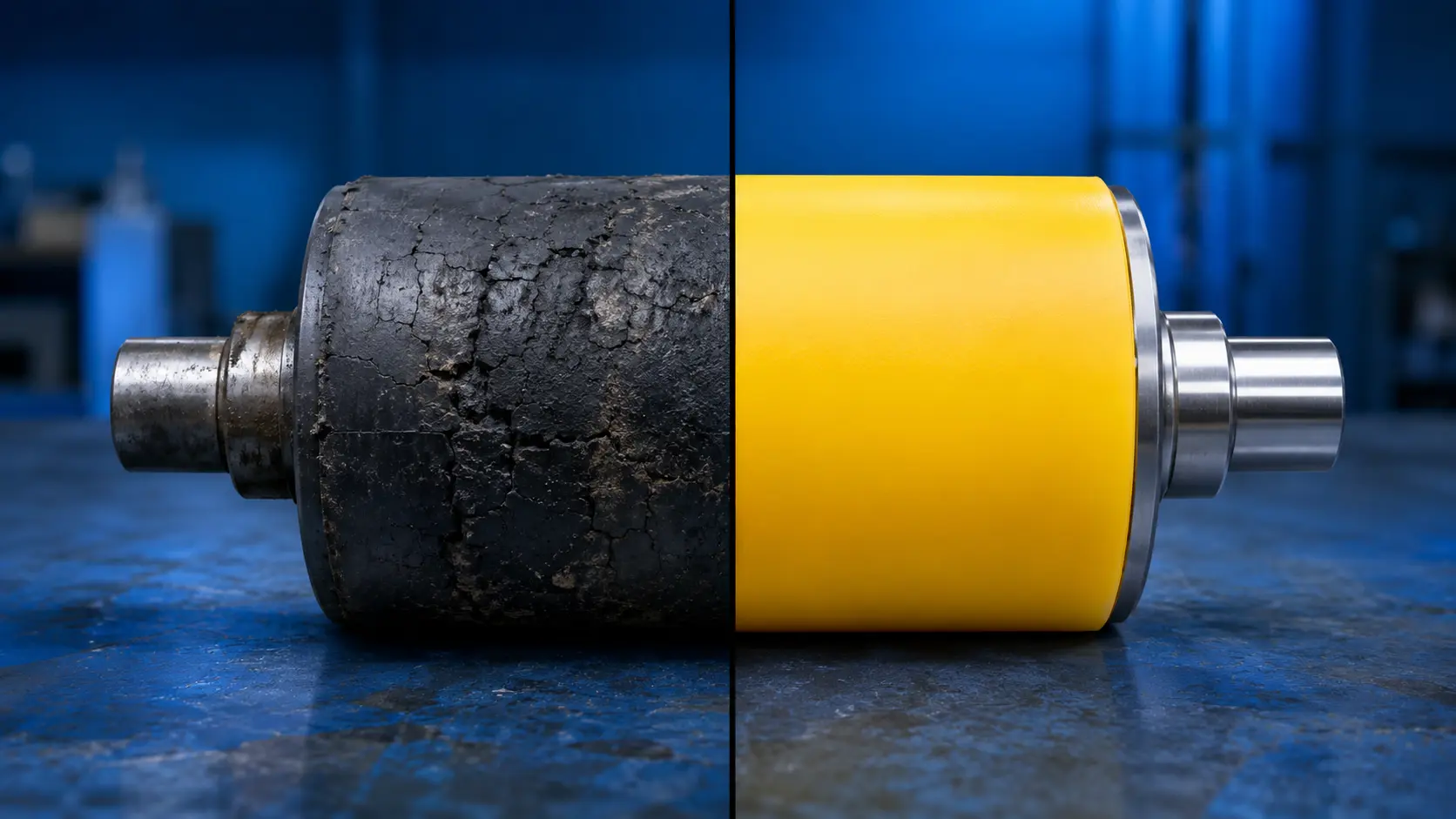
On the microscopic scale, cast polyurethane is a block copolymer : it combines soft segments (which give the elasticity) and hard segments (which act as anchor points). The result: excellent resistance to abrasion, to cuts and to loads, over a very wide range of hardnesses — from very soft (Shore A) to nearly rigid (Shore D). That is why a cut spreads far less in it than in a rubber, a point we go into in our case study on a plastic film roller.
Cast polyurethane parts
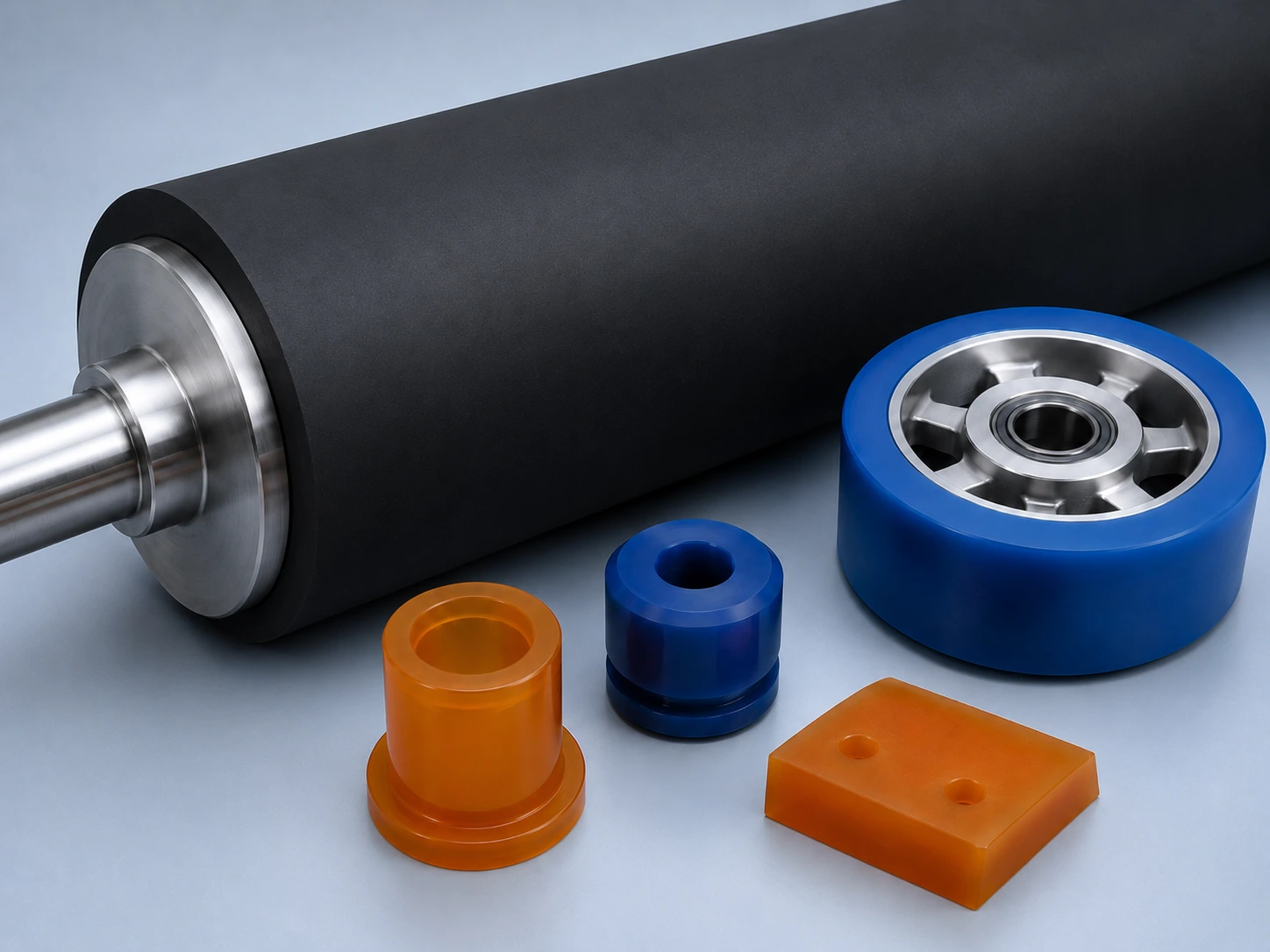
Because it starts out liquid, polyurethane is the ideal material for cast parts. We design a mold, pour the material in, it hardens, and we get a part in the exact shape we wanted: guide rollers, pads, bumpers, wear parts. It is often the best answer when a part wears out too fast or when you need a precise geometry in a tough material.
Polyurethane wheels and rollers
On a wheel or a roller, polyurethane brings valuable advantages: resistance to abrasion and cuts, good load-bearing capacity, and a wide latitude of hardnesses and formulations. For outdoor applications and prolonged contact with water, some formulations show remarkable durability — as shown by our SoreDrain case study.
Polyurethane at Soremag today
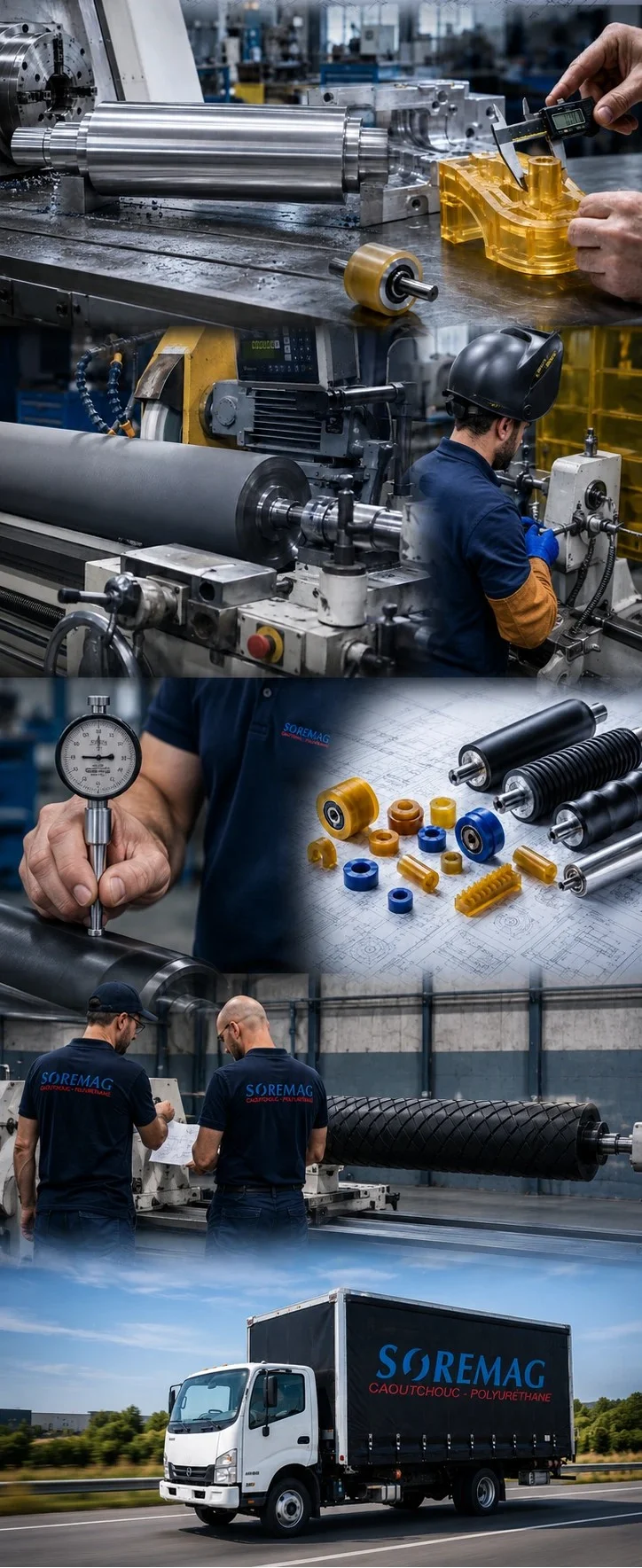
Eighty years after Otto Bayer, polyurethane is everywhere in our shops. At Soremag, we cast thousands of different polyurethane (and foam) formulations, from molds designed in-house, for custom molded parts, wheels and rollers . The right hardness/formulation trade-off is always chosen according to the actual application: see our Material Selection Guide.
So, rubber or polyurethane?
The two materials do not replace each other: they complement each other. Rather than settling it here, we wrote an article devoted to the question: rubber or polyurethane, which one to choose?
A polyurethane molded part, wheel or roller?
Talk to our team